
Andere Kunden interessierten sich auch für
 Liberty and the News14,99 €
 Government/Press Connection22,99 €
 Slanted15,99 €
 Messing with the Enemy17,99 €
 The Rape of the Mind: The Psychology of Thought Control, Menticide, and Brainwashing15,99 €
 The Think Tank Racket20,99 €
 Delusion and Mass Delusion10,99 €



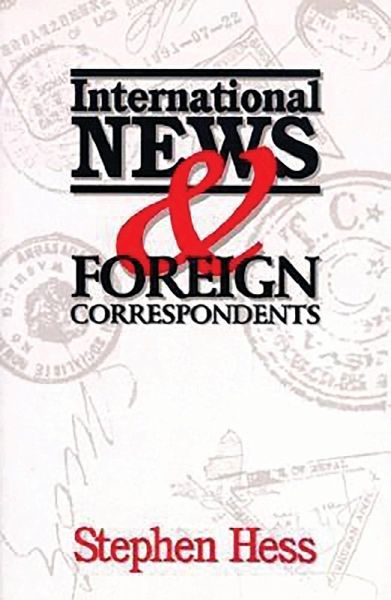
Today, American public opinion is having more influence than ever on how U.S. leaders respond to international crises and formulate foreign policy. Yet at the same time, there is evidence that Americans are increasingly ill-informed of international affairs. This paradox raises many serious questions: What information about the world are we given by the mainstream media? How much? How good? By whom? Through what means? And how much foreign news is really enough? In this fifth volume of his highly acclaimed Newswork series, Stephen Hess addresses these questions and offers a revealing look at how the print and broadcast media cover international affairs and how foreign correspondents do their work. Hess contends that the United States is a nation of two media societies. One is awash in specialized information, available to those who have the time, interest, money, and education to take advantage of it. The other encompasses the vast majority of Americans, who rely on the top stories of TV networks' evening news programs and their community's daily newspaper. For them, Hess says, the current diet of international news offered is not adequate considering its potential importance to their lives. When the world imposes itself on the U.S. media, it does so in a big way?the Gulf War, the coup in Moscow, the fall of the Berlin Wall. But there are remarkable peaks and valleys in international news coverage. According to Hess, TV in particular shrinks the globe geographically?with Asia underrepresented and the Middle East overrepresented, for example. And much of TV's focus on international violence is gratuitous, telling us where and how, but very rarely why. Hess concludes with suggestions for improving international coverage.