
T. V. Paul / A. Hall (eds.)
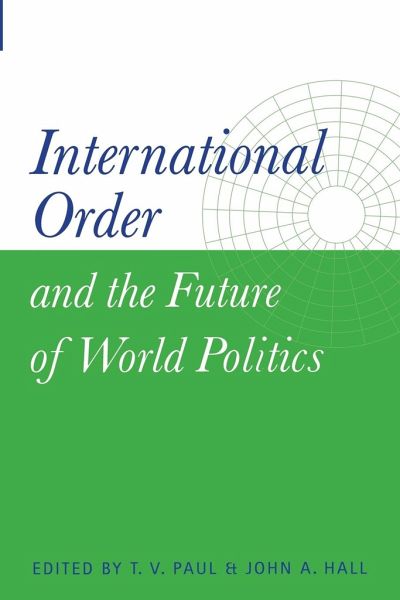
International Order and the Future of World Politics
Herausgeber: Paul, Thazha Varkey; Hall, John A.
T. V. Paul / A. Hall (eds.)
International Order and the Future of World Politics
Herausgeber: Paul, Thazha Varkey; Hall, John A.
- Broschiertes Buch
- Merkliste
- Auf die Merkliste
- Bewerten Bewerten
- Teilen
- Produkt teilen
- Produkterinnerung
- Produkterinnerung
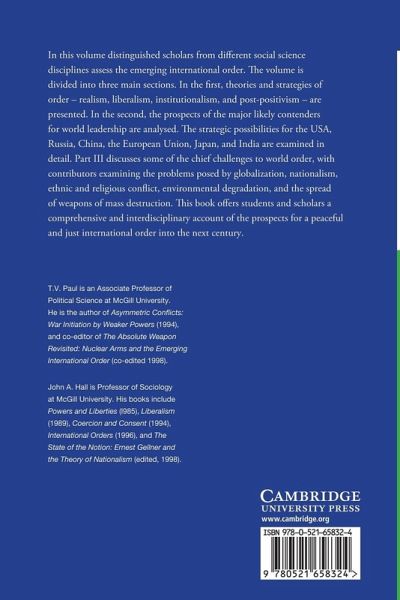
Distinguished scholars assess the emerging international order, examining leading theories, the major powers, and potential problems.
Distinguished scholars assess the emerging international order, examining leading theories, the major powers, and potential problems.
Produktdetails
- Produktdetails
- Verlag: Cambridge University Press
- Seitenzahl: 434
- Erscheinungstermin: 19. Februar 2014
- Englisch
- Abmessung: 229mm x 152mm x 23mm
- Gewicht: 625g
- ISBN-13: 9780521658324
- ISBN-10: 0521658322
- Artikelnr.: 21892565
- Herstellerkennzeichnung
- Libri GmbH
- Europaallee 1
- 36244 Bad Hersfeld
- gpsr@libri.de
- Verlag: Cambridge University Press
- Seitenzahl: 434
- Erscheinungstermin: 19. Februar 2014
- Englisch
- Abmessung: 229mm x 152mm x 23mm
- Gewicht: 625g
- ISBN-13: 9780521658324
- ISBN-10: 0521658322
- Artikelnr.: 21892565
- Herstellerkennzeichnung
- Libri GmbH
- Europaallee 1
- 36244 Bad Hersfeld
- gpsr@libri.de
Introduction John A. Hall and T. V. Paul; Part I. Theories and Strategies:
1. A realist view: three images of the coming international order Michael
Mastanduno; 2. A liberal view: preserving and expanding the liberal pacific
union Michael Doyle; 3. Preconditions for prudence: a sociological
synthesis of realism and liberalism John A. Hall and T. V. Paul; 4. An
institutionalist view: international institutions and state strategies Lisa
Martin; 5. Is the truth out there? Eight questions about international
order Steve Smith; Part II. Contenders: Major Powers and International
Order: 6. Liberal hegemony and the future of American postwar order G. John
Ikenberry; 7. Russia: responses to relative decline Jack Snyder; 8. The
European Union: economic giant, political dwarf Juan Diez Medrano; 9.
Unsteady anticipation: reflections on the future of Japan's changing
political economy T. J. Pempel; 10. Chinese perspectives on world order
Steve Chan; 11. India as a limited challenger Baldev Raj Nayar; Part III.
Challenges: 12. Has globalization ended the rise and rise of the
nation-state Michael Mann; 13. Stateless nations and the emerging
international order Hudson Meadwell; 14. The coming chaos? Armed conflict
at the world's periphery K. J. Holsti; 15. Political religion in the
twenty-first century Peter van der Veer; 16. Environmental security in the
coming century Karen T. Litfin; 17. Demography, domestic conflict, and the
international order Jack A. Goldstone; 18. Great equalizers of agents of
chaos? Weapons of mass destruction and the emerging world order T. V. Paul;
Part IV. Conclusions: 19. The state and the future of world politics John
A. Hall and T. V. Paul.
1. A realist view: three images of the coming international order Michael
Mastanduno; 2. A liberal view: preserving and expanding the liberal pacific
union Michael Doyle; 3. Preconditions for prudence: a sociological
synthesis of realism and liberalism John A. Hall and T. V. Paul; 4. An
institutionalist view: international institutions and state strategies Lisa
Martin; 5. Is the truth out there? Eight questions about international
order Steve Smith; Part II. Contenders: Major Powers and International
Order: 6. Liberal hegemony and the future of American postwar order G. John
Ikenberry; 7. Russia: responses to relative decline Jack Snyder; 8. The
European Union: economic giant, political dwarf Juan Diez Medrano; 9.
Unsteady anticipation: reflections on the future of Japan's changing
political economy T. J. Pempel; 10. Chinese perspectives on world order
Steve Chan; 11. India as a limited challenger Baldev Raj Nayar; Part III.
Challenges: 12. Has globalization ended the rise and rise of the
nation-state Michael Mann; 13. Stateless nations and the emerging
international order Hudson Meadwell; 14. The coming chaos? Armed conflict
at the world's periphery K. J. Holsti; 15. Political religion in the
twenty-first century Peter van der Veer; 16. Environmental security in the
coming century Karen T. Litfin; 17. Demography, domestic conflict, and the
international order Jack A. Goldstone; 18. Great equalizers of agents of
chaos? Weapons of mass destruction and the emerging world order T. V. Paul;
Part IV. Conclusions: 19. The state and the future of world politics John
A. Hall and T. V. Paul.
Introduction John A. Hall and T. V. Paul; Part I. Theories and Strategies:
1. A realist view: three images of the coming international order Michael
Mastanduno; 2. A liberal view: preserving and expanding the liberal pacific
union Michael Doyle; 3. Preconditions for prudence: a sociological
synthesis of realism and liberalism John A. Hall and T. V. Paul; 4. An
institutionalist view: international institutions and state strategies Lisa
Martin; 5. Is the truth out there? Eight questions about international
order Steve Smith; Part II. Contenders: Major Powers and International
Order: 6. Liberal hegemony and the future of American postwar order G. John
Ikenberry; 7. Russia: responses to relative decline Jack Snyder; 8. The
European Union: economic giant, political dwarf Juan Diez Medrano; 9.
Unsteady anticipation: reflections on the future of Japan's changing
political economy T. J. Pempel; 10. Chinese perspectives on world order
Steve Chan; 11. India as a limited challenger Baldev Raj Nayar; Part III.
Challenges: 12. Has globalization ended the rise and rise of the
nation-state Michael Mann; 13. Stateless nations and the emerging
international order Hudson Meadwell; 14. The coming chaos? Armed conflict
at the world's periphery K. J. Holsti; 15. Political religion in the
twenty-first century Peter van der Veer; 16. Environmental security in the
coming century Karen T. Litfin; 17. Demography, domestic conflict, and the
international order Jack A. Goldstone; 18. Great equalizers of agents of
chaos? Weapons of mass destruction and the emerging world order T. V. Paul;
Part IV. Conclusions: 19. The state and the future of world politics John
A. Hall and T. V. Paul.
1. A realist view: three images of the coming international order Michael
Mastanduno; 2. A liberal view: preserving and expanding the liberal pacific
union Michael Doyle; 3. Preconditions for prudence: a sociological
synthesis of realism and liberalism John A. Hall and T. V. Paul; 4. An
institutionalist view: international institutions and state strategies Lisa
Martin; 5. Is the truth out there? Eight questions about international
order Steve Smith; Part II. Contenders: Major Powers and International
Order: 6. Liberal hegemony and the future of American postwar order G. John
Ikenberry; 7. Russia: responses to relative decline Jack Snyder; 8. The
European Union: economic giant, political dwarf Juan Diez Medrano; 9.
Unsteady anticipation: reflections on the future of Japan's changing
political economy T. J. Pempel; 10. Chinese perspectives on world order
Steve Chan; 11. India as a limited challenger Baldev Raj Nayar; Part III.
Challenges: 12. Has globalization ended the rise and rise of the
nation-state Michael Mann; 13. Stateless nations and the emerging
international order Hudson Meadwell; 14. The coming chaos? Armed conflict
at the world's periphery K. J. Holsti; 15. Political religion in the
twenty-first century Peter van der Veer; 16. Environmental security in the
coming century Karen T. Litfin; 17. Demography, domestic conflict, and the
international order Jack A. Goldstone; 18. Great equalizers of agents of
chaos? Weapons of mass destruction and the emerging world order T. V. Paul;
Part IV. Conclusions: 19. The state and the future of world politics John
A. Hall and T. V. Paul.