Nowadays, peacekeepers are increasingly engaged in internal rather than international conflicts and perform a multitude of tasks. Among others, they act as civilian administrators, oversee elections and monitor human rights. These changes have raised new legal problems. Which human rights obligations exist for peacekeepers? Do peacekeepers have to intervene if they witness war crimes and acts of genocide? How are they protected under international law? What is the legal framework of UN administrations like in Kosovo and East Timor? In order to enhance a better understanding of these legal…mehr
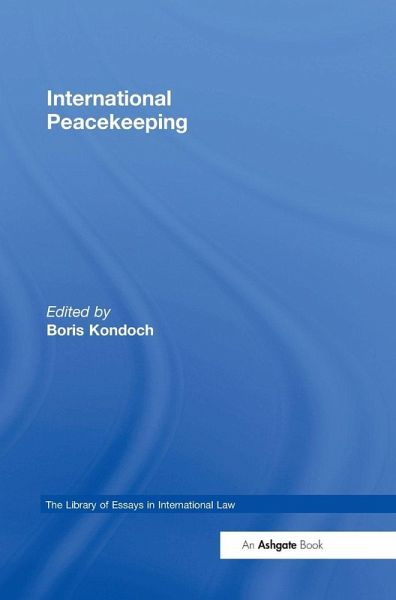
Nowadays, peacekeepers are increasingly engaged in internal rather than international conflicts and perform a multitude of tasks. Among others, they act as civilian administrators, oversee elections and monitor human rights. These changes have raised new legal problems. Which human rights obligations exist for peacekeepers? Do peacekeepers have to intervene if they witness war crimes and acts of genocide? How are they protected under international law? What is the legal framework of UN administrations like in Kosovo and East Timor? In order to enhance a better understanding of these legal issues arising from peacekeeping operations, a collection of articles written by the leading experts in the field have been compiled in the volume, International Peacekeeping.
Boris Kondoch is a Professor at University of Peace, South Korea.
Inhaltsangabe
Contents: Series preface; Introduction; Part I The Role and the Rule of Law in International Peacekeeping: The uses of law in international peace-keeping, Oscar Schachter; Rule of law strategies for peace operations, Nina Lahoud. Part II The Constitutional Basis of Peacekeeping: The legal basis of United Nations peace-keeping operations, Alexander Orakhelashvili; The UN Charter and peacekeeping forces: constitutional issues, Nigel D. White. Part III Principles of International Peacekeeping: The Consent of the Parties: Military intervention, regional organizations and host-state consent, David Wippmann; Host-state consent and United Nations peacekeeping in Yugoslavia, Christine Gray. Peacekeeping and the Use of Force: Beyond self-defense: United Nations peacekeeping operations and the use of force, Katherine E. Cox. The Legal Principles of Peacekeeping and the Brahimi Report: Changing 'peacekeeping' in the new millennium? - the recommendations of the panel on United Nations peace operations of August 2000, Heike Spieker . Part IV Law Applicable to Peacekeeping Operations: International Humanitarian Law: United Nations military operations and international humanitarian law: what rules apply to peacekeepers?, Ray Murphy; The Secretary-General's bulletin on observance by United Nations forces of international humanitarian law: some preliminary observations, Marten Zwanenberg; Maintaining discipline in United Nations peace support operations: the legal quagmire for military contingents, Peter Rowe; The fall of Srebrenica and the attitude of Dutchbat from an international legal perspective, Robert C.R. Siekmann. Human Rights: The creation and control of places of protection during United Nations peace operations, Bruce M. Oswald. International Criminal Law: Responsibilities of states participating in multilateral operations with respect to persons indicted for war crimes, Diane F. Orentlicher; The ambiguities of Security Council resolution 1422, (2002), Carsten Stahn.
Contents: Series preface; Introduction; Part I The Role and the Rule of Law in International Peacekeeping: The uses of law in international peace-keeping, Oscar Schachter; Rule of law strategies for peace operations, Nina Lahoud. Part II The Constitutional Basis of Peacekeeping: The legal basis of United Nations peace-keeping operations, Alexander Orakhelashvili; The UN Charter and peacekeeping forces: constitutional issues, Nigel D. White. Part III Principles of International Peacekeeping: The Consent of the Parties: Military intervention, regional organizations and host-state consent, David Wippmann; Host-state consent and United Nations peacekeeping in Yugoslavia, Christine Gray. Peacekeeping and the Use of Force: Beyond self-defense: United Nations peacekeeping operations and the use of force, Katherine E. Cox. The Legal Principles of Peacekeeping and the Brahimi Report: Changing 'peacekeeping' in the new millennium? - the recommendations of the panel on United Nations peace operations of August 2000, Heike Spieker . Part IV Law Applicable to Peacekeeping Operations: International Humanitarian Law: United Nations military operations and international humanitarian law: what rules apply to peacekeepers?, Ray Murphy; The Secretary-General's bulletin on observance by United Nations forces of international humanitarian law: some preliminary observations, Marten Zwanenberg; Maintaining discipline in United Nations peace support operations: the legal quagmire for military contingents, Peter Rowe; The fall of Srebrenica and the attitude of Dutchbat from an international legal perspective, Robert C.R. Siekmann. Human Rights: The creation and control of places of protection during United Nations peace operations, Bruce M. Oswald. International Criminal Law: Responsibilities of states participating in multilateral operations with respect to persons indicted for war crimes, Diane F. Orentlicher; The ambiguities of Security Council resolution 1422, (2002), Carsten Stahn.
Es gelten unsere Allgemeinen Geschäftsbedingungen: www.buecher.de/agb
Impressum
www.buecher.de ist ein Internetauftritt der buecher.de internetstores GmbH
Geschäftsführung: Monica Sawhney | Roland Kölbl | Günter Hilger
Sitz der Gesellschaft: Batheyer Straße 115 - 117, 58099 Hagen
Postanschrift: Bürgermeister-Wegele-Str. 12, 86167 Augsburg
Amtsgericht Hagen HRB 13257
Steuernummer: 321/5800/1497
USt-IdNr: DE450055826