This volume explores the impact of international service learning programs on members of host communities (local residents, business owners and hosting families) who are increasingly influenced by the presence of international students in their lives. Drawing upon post-colonial, feminist and other critical theories, it examines the complicated power relations between North American students and their host communities in South Africa and Central America. It stresses the importance of developing relations between North American students, faculty and individuals in the host communities to create a mutually engaging learning experience.…mehr
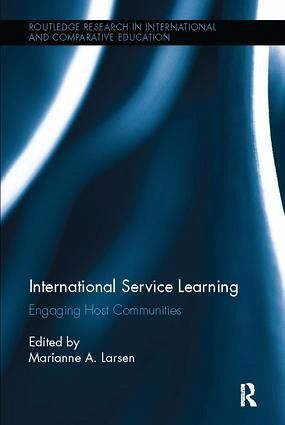
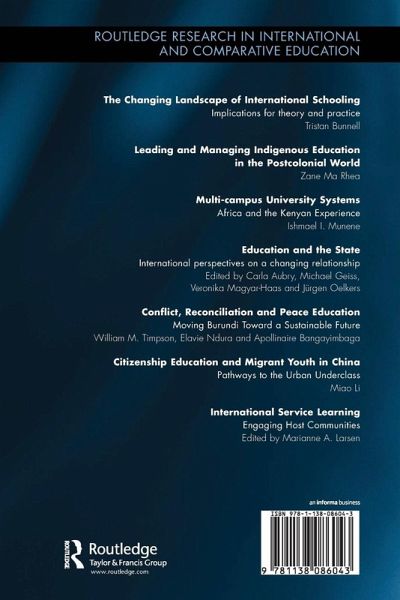
This volume explores the impact of international service learning programs on members of host communities (local residents, business owners and hosting families) who are increasingly influenced by the presence of international students in their lives. Drawing upon post-colonial, feminist and other critical theories, it examines the complicated power relations between North American students and their host communities in South Africa and Central America. It stresses the importance of developing relations between North American students, faculty and individuals in the host communities to create a mutually engaging learning experience.
Marianne A. Larsen is Professor of Comparative and International Education at The University of Western Ontario, CA.
Inhaltsangabe
Part I. Overview 1. International Service Learning: Engaging Host Communities: Introduction Marianne A. Larsen 2. Epistemological, Methodological and Theoretical Challenges of Carrying Out ISL Research Involving Host Communities: A Conversation Allyson Larkin, Marianne Larsen, Katie MacDonald and Harry Smaller Part II. Case Studies: Impact of ISL on Host Communities 3. Saying It Doesn't Make It So: Do We Listen and Act When the Host Community Tells Us What They Want? Nora Pillard Reynolds and Junior Cezar Gasparini 4. Solidarity or Neocolonialism? The Challenges of Understanding the Impact of ISL on Nicaraguan Host Communities Michael O'Sullivan and Harry Smaller 5. The Economic Circle: Impacts of Volunteerism and Service Learning on Three Rural Communities in Costa Rica Cynthia Toms Smedley 6. Southern Perspectives on ISL Volunteers: Reframing the Neocolonial Barbara Heron 7. International Service Learning in a Tanzanian Host Community: Post-Colonial Insights Marianne Larsen 8. In Right Relationship: A Case Study of International Service Learning in Eastern Africa Jessica Arends 9. Orient(aliz)ation: A case study of North American Exchange Programs at the University of Ghana Shelane Jorgenson 10. Struggles for Mutuality: Conceptualizing Hosts as Participants in International Service Learning in Ghana Katie Macdonald and Jessica Vorstermans Part III. Rethinking and Re-imagining ISL and Host Community Relations 11. Reflections from a Nicaraguan Career ISL Program Coordinator: Challenges and Guidelines for Moving Forward Joselin Hernández 12. Many Meanings: Moving Reciprocity Towards Interdependence Samantha Dear and Ryan Howard 13. Resipwosite as Guiding Framework for Rethinking Mutual Exchange in Global Service Learning Partnerships: Findings from a Case Study of the Haiti Compact Jessica Murphy 14. A Cross-Cultural Conversation about International Service Learning in Ghana Godwin Agudey and Hannah Deloughery 15. The Potential of ISL: Re-examining Ethical engagement Amongst ISL Partners Tamara Baldwin, Salim Mohamed and Juliet Tembe 16. Fair Trade Learning: A Framework for Ethical Global Partnerships Eric Hartman 17. Mi Casa es Tu Casa: A Framework for Reciprocal Public Benefit Gonzalo Duarte 18. I Am Because We Are: Rethinking Service Learning and the Possibility of Learning from Ubuntu Allyson Larkin 19. Conclusion: ISL and Host Communities: Relationships and Responsibility Jennifer Kozak and Marianne Larsen
Part I. Overview 1. International Service Learning: Engaging Host Communities: Introduction Marianne A. Larsen 2. Epistemological, Methodological and Theoretical Challenges of Carrying Out ISL Research Involving Host Communities: A Conversation Allyson Larkin, Marianne Larsen, Katie MacDonald and Harry Smaller Part II. Case Studies: Impact of ISL on Host Communities 3. Saying It Doesn't Make It So: Do We Listen and Act When the Host Community Tells Us What They Want? Nora Pillard Reynolds and Junior Cezar Gasparini 4. Solidarity or Neocolonialism? The Challenges of Understanding the Impact of ISL on Nicaraguan Host Communities Michael O'Sullivan and Harry Smaller 5. The Economic Circle: Impacts of Volunteerism and Service Learning on Three Rural Communities in Costa Rica Cynthia Toms Smedley 6. Southern Perspectives on ISL Volunteers: Reframing the Neocolonial Barbara Heron 7. International Service Learning in a Tanzanian Host Community: Post-Colonial Insights Marianne Larsen 8. In Right Relationship: A Case Study of International Service Learning in Eastern Africa Jessica Arends 9. Orient(aliz)ation: A case study of North American Exchange Programs at the University of Ghana Shelane Jorgenson 10. Struggles for Mutuality: Conceptualizing Hosts as Participants in International Service Learning in Ghana Katie Macdonald and Jessica Vorstermans Part III. Rethinking and Re-imagining ISL and Host Community Relations 11. Reflections from a Nicaraguan Career ISL Program Coordinator: Challenges and Guidelines for Moving Forward Joselin Hernández 12. Many Meanings: Moving Reciprocity Towards Interdependence Samantha Dear and Ryan Howard 13. Resipwosite as Guiding Framework for Rethinking Mutual Exchange in Global Service Learning Partnerships: Findings from a Case Study of the Haiti Compact Jessica Murphy 14. A Cross-Cultural Conversation about International Service Learning in Ghana Godwin Agudey and Hannah Deloughery 15. The Potential of ISL: Re-examining Ethical engagement Amongst ISL Partners Tamara Baldwin, Salim Mohamed and Juliet Tembe 16. Fair Trade Learning: A Framework for Ethical Global Partnerships Eric Hartman 17. Mi Casa es Tu Casa: A Framework for Reciprocal Public Benefit Gonzalo Duarte 18. I Am Because We Are: Rethinking Service Learning and the Possibility of Learning from Ubuntu Allyson Larkin 19. Conclusion: ISL and Host Communities: Relationships and Responsibility Jennifer Kozak and Marianne Larsen
Es gelten unsere Allgemeinen Geschäftsbedingungen: www.buecher.de/agb
Impressum
www.buecher.de ist ein Internetauftritt der buecher.de internetstores GmbH
Geschäftsführung: Monica Sawhney | Roland Kölbl | Günter Hilger
Sitz der Gesellschaft: Batheyer Straße 115 - 117, 58099 Hagen
Postanschrift: Bürgermeister-Wegele-Str. 12, 86167 Augsburg
Amtsgericht Hagen HRB 13257
Steuernummer: 321/5800/1497
USt-IdNr: DE450055826