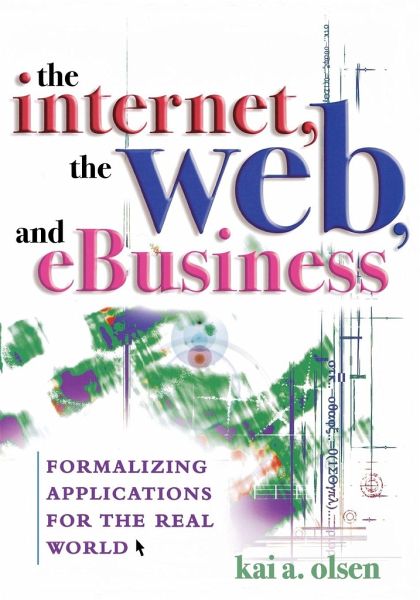
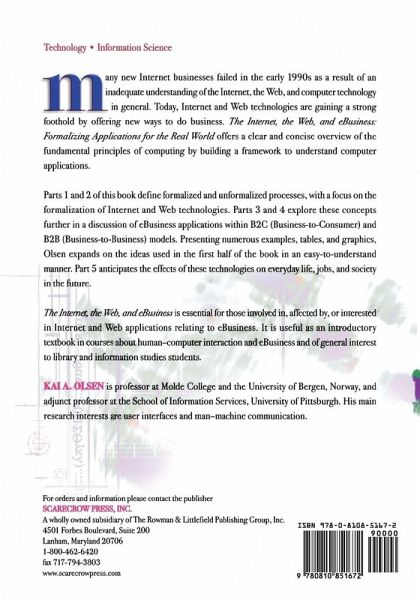
In this clear overview of the fundamental principles of Internet computing, author Kai Olsen defines formalized and unformalized processes, with a focus on the formalization of Internet and Web technologies; discusses eBusiness applications within Business-to-Consumer and Business-to-Business models; presents numerous examples, tables, and graphics to illustrate ideas in an easy-to-understand manner; and prophesizes about the effects that these technologies will have on everyday life, jobs, and society in the future.
In this clear overview of the fundamental principles of Internet computing, author Kai Olsen defines formalized and unformalized processes, with a focus on the formalization of Internet and Web technologies; discusses eBusiness applications within Business-to-Consumer and Business-to-Business models; presents numerous examples, tables, and graphics to illustrate ideas in an easy-to-understand manner; and prophesizes about the effects that these technologies will have on everyday life, jobs, and society in the future.
Kai A. Olsen-- Professor, Molde University College (Associate professor from 1982, full professor from 1993); adjunct professor at Department of Informatics, University of Bergen (1993 - ), adjunct professor University of Pittsburgh (1995 - ). Professor Olsen is widely published in the journal literature particularly dealing with a range of issues in eBusiness. He has been interested, and written about, the cashless society for many years and has had many articles published in the press and has been interviewed often on the subject. A book on this topic by someone with the professional respectability of Olsen promises to be reviewed broadly and have relatively high sales.
Inhaltsangabe
Part 1 Preface Part 2 Ways to Use This Book for Teaching Part 3 Acknowledgments Part 4 Trademark Notice Part 5 Introduction Part 6 Part 1 Fundamentals Chapter 7 1 Formalization Chapter 8 2 Symbolic Data Chapter 9 3 Constraints on Technology Chapter 10 4 Cultural Constraints Part 11 Part 2 Internet and WWW Chapter 12 5 Internet Protocols Chapter 13 6 Development of Web Protocols Chapter 14 7 Email Chapter 15 8 Browsers Chapter 16 9 World Wide Web Chapter 17 10 Searching the Web Chapter 18 11 Organizing the Web - Portals Chapter 19 12 Web Presence Chapter 20 13 Mobile Computing Chapter 21 14 Automated Web (Push Technology) Chapter 22 15 Dynamic Web Pages Chapter 23 16 Embedded Scripts Chapter 24 17 Peer-to-Peer Computing Part 25 Part 3 Formalizing Business-to-Consumer Applications for the Web Chapter 26 18 Symbolic Services - Information-providers Chapter 27 19 Online Symbolic Services - Case Studies Chapter 28 20 Online Retail Shopping, Physical Items Chapter 29 21 Technical Constraints - Case Studies Chapter 30 22 Cultural Constraints - Case Studies Chapter 31 23 A Better Model? Part 32 Part 4 Formalizing Business-to-Business Applications Chapter 33 24 Data Exchange Chapter 34 25 Formalized Data Exchange Chapter 35 26 Electronic Data Interchange (EDI) Chapter 36 27 XML Chapter 37 28 Web Services Chapter 38 29 Automated Value Chain Chapter 39 30 Electronic Marketplaces Chapter 40 31 Outsourcing Part 41 Part 5 Interfacing with the Web of the Future Chapter 42 32 A Disruptive Technology? Chapter 43 33 Virtual Businesses Chapter 44 34 Semantic Web Part 45 Part 6 Summary Chapter 46 35 Lessons Learned Chapter 47 36 Advances in Technology Part 48 Index Part 49 About the Author
Part 1 Preface Part 2 Ways to Use This Book for Teaching Part 3 Acknowledgments Part 4 Trademark Notice Part 5 Introduction Part 6 Part 1 Fundamentals Chapter 7 1 Formalization Chapter 8 2 Symbolic Data Chapter 9 3 Constraints on Technology Chapter 10 4 Cultural Constraints Part 11 Part 2 Internet and WWW Chapter 12 5 Internet Protocols Chapter 13 6 Development of Web Protocols Chapter 14 7 Email Chapter 15 8 Browsers Chapter 16 9 World Wide Web Chapter 17 10 Searching the Web Chapter 18 11 Organizing the Web - Portals Chapter 19 12 Web Presence Chapter 20 13 Mobile Computing Chapter 21 14 Automated Web (Push Technology) Chapter 22 15 Dynamic Web Pages Chapter 23 16 Embedded Scripts Chapter 24 17 Peer-to-Peer Computing Part 25 Part 3 Formalizing Business-to-Consumer Applications for the Web Chapter 26 18 Symbolic Services - Information-providers Chapter 27 19 Online Symbolic Services - Case Studies Chapter 28 20 Online Retail Shopping, Physical Items Chapter 29 21 Technical Constraints - Case Studies Chapter 30 22 Cultural Constraints - Case Studies Chapter 31 23 A Better Model? Part 32 Part 4 Formalizing Business-to-Business Applications Chapter 33 24 Data Exchange Chapter 34 25 Formalized Data Exchange Chapter 35 26 Electronic Data Interchange (EDI) Chapter 36 27 XML Chapter 37 28 Web Services Chapter 38 29 Automated Value Chain Chapter 39 30 Electronic Marketplaces Chapter 40 31 Outsourcing Part 41 Part 5 Interfacing with the Web of the Future Chapter 42 32 A Disruptive Technology? Chapter 43 33 Virtual Businesses Chapter 44 34 Semantic Web Part 45 Part 6 Summary Chapter 46 35 Lessons Learned Chapter 47 36 Advances in Technology Part 48 Index Part 49 About the Author
Rezensionen
...presents a clear overview of the fundamental principles of Internet computing by building a framework to understand these real-world applications. Olsen is a well-known and respected expert in user interfaces and human-machine communication. The book consists of six parts. Parts 1 and 2 focus on developing formalization of Internet and Web technologies. Parts 3 and 4 further explore the concepts and discuss both B2C (Business-to-Consumer) and B2B (Business-to-Business) e-business applications. Part 5 offers a glimpse of the future, discussing primarily the semantic Web that will be possible once Web data has been formalized to a higher degree, and presenting scenarios of possible semantic-Web high-level automated services. Finally, Part 6 summarizes the main ideas covered in the book. The section at the end of each chapter provides ideas for exercises and discussion topics. The book can serve as a course resource for undergraduates and for general readers who want to learn more about this field. Highly recommended. All levels. CHOICE I highly recommend this book... JASIST (Journal of the American Society for Information Science & Technology) Olsen (informatics, U. of Bergen, Norway; adjunct, U. of Pittsburgh) presents an introduction to the human-computer interface and how it affects Internet applications such as eBusiness. He explains the distinction between formalized and unformalized processes; their enabling and limiting relationship to virtual environments; and the impact of these technologies on the workplace and society. Chapters include case studies and exercises but surprisingly few references. Suitable for introductory computer and business courses and anyone interested in the online world. Scitech Book News…mehr
Es gelten unsere Allgemeinen Geschäftsbedingungen: www.buecher.de/agb
Impressum
www.buecher.de ist ein Internetauftritt der buecher.de internetstores GmbH
Geschäftsführung: Monica Sawhney | Roland Kölbl | Günter Hilger
Sitz der Gesellschaft: Batheyer Straße 115 - 117, 58099 Hagen
Postanschrift: Bürgermeister-Wegele-Str. 12, 86167 Augsburg
Amtsgericht Hagen HRB 13257
Steuernummer: 321/5800/1497
USt-IdNr: DE450055826