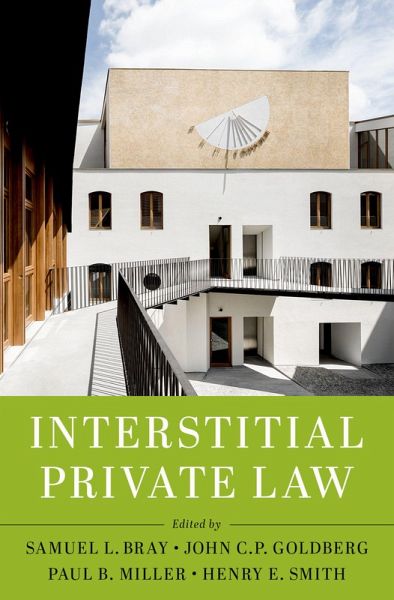
The essays collected in Interstitial Private Law encourage the next generation of private law theorists to engage with the 'connective tissue' of private law. Internationally prominent scholars introduce and analyse these crucially important interstitial aspects, including legal personhood, agency and other attribution rules, consent, estoppel, equity, remedies, and restitution.
The essays collected in Interstitial Private Law encourage the next generation of private law theorists to engage with the 'connective tissue' of private law. Internationally prominent scholars introduce and analyse these crucially important interstitial aspects, including legal personhood, agency and other attribution rules, consent, estoppel, equity, remedies, and restitution.
Samuel L. Bray is the John N. Matthews Professor of Law at Notre Dame Law School. His primary areas of expertise are remedies, equity, and constitutional law. He was previously a faculty member at UCLA School of Law, as well as a Harrington Faculty Fellow at the University of Texas. He is a McDonald Senior Distinguished Fellow at the Center for the Study of Law and Religion at Emory University, and he serves as an advisor to the Restatement (Third) of Torts: Remedies. John C.P. Goldberg, the Carter Professor of General Jurisprudence at Harvard Law School, is an expert in tort law, tort theory, and political philosophy. He joined the Law School faculty in 2008 and served as a Deputy Dean from 2017 to 2022. Previously, he was a faculty member of Vanderbilt Law School, where he was Associate Dean for Research (2006-08). An Associate Reporter for the American Law Institute's Fourth Restatement of Property, he also serves as an advisor to the Third Restatement of Torts. In addition, he is a member of the editorial boards of the Journal of Tort Law and Legal Theory, and in 2009 was Chair of the Torts and Compensation Systems Section of the Association of American Law Schools. Paul B. Miller is the Robert and Marion Short Professor of Law and Associate Dean for International and Graduate Programs at Notre Dame Law School, where he also serves as Director of the Notre Dame Program on Private Law. Miller taught previously at McGill University in Montréal and has held visiting appointments at Bucerius Law School, the University of Melbourne, Université Paris-Panthéon-Assas, and Tel Aviv University. He has been a member of the Global Faculty of Peking University Law School since 2018. Henry E. Smith is the Fessenden Professor of Law at Harvard Law School, where he directs the Project on the Foundations of Private Law. Previously, Smith taught at the Northwestern University School of Law and was the Fred A. Johnston Professor of Property and Environmental Law at Yale Law School. He has served as the President of the Society for Institutional and Organizational Economics and is the Reporter for the American Law Institute's Fourth Restatement of Property.
Inhaltsangabe
* Introduction * Henry E. Smith * 1. Equity Will Not. . . * Samuel L. Bray * 2. Duties Owed to the Public * Nicolas Cornell * 3. This Is a Chapter About Deception * Courtney M. Cox * 4. On the Form and Justification of Some Private Law Rights, Liberties, and Powers * Christopher Essert * 5. Consent Across Private Law * Mark P. Gergen * 6. Private Law's Choice of Private Law * Andrew S. Gold * 7. Recklessness in Tort: Interstitial Law as Doctrinal Fine-Tuning * John C.P. Goldberg and Benjamin C. Zipursky * 8. Equitable Estoppel and Restitution as Interstitial Causes of Action * Ben McFarlane * 9. The Concept of Personality in Private Law * Paul B. Miller * 10. Understanding the Rules of Attribution in Private Law * James Penner * 11. General Customs and Legal Institutions: The Short, Sad Example of Racially Restrictive Covenants in the United States * Carol M. Rose * 12. The Threat and Promise of Collateral Benefits for Private Law's Coherence * Zoë Sinel
* Introduction * Henry E. Smith * 1. Equity Will Not. . . * Samuel L. Bray * 2. Duties Owed to the Public * Nicolas Cornell * 3. This Is a Chapter About Deception * Courtney M. Cox * 4. On the Form and Justification of Some Private Law Rights, Liberties, and Powers * Christopher Essert * 5. Consent Across Private Law * Mark P. Gergen * 6. Private Law's Choice of Private Law * Andrew S. Gold * 7. Recklessness in Tort: Interstitial Law as Doctrinal Fine-Tuning * John C.P. Goldberg and Benjamin C. Zipursky * 8. Equitable Estoppel and Restitution as Interstitial Causes of Action * Ben McFarlane * 9. The Concept of Personality in Private Law * Paul B. Miller * 10. Understanding the Rules of Attribution in Private Law * James Penner * 11. General Customs and Legal Institutions: The Short, Sad Example of Racially Restrictive Covenants in the United States * Carol M. Rose * 12. The Threat and Promise of Collateral Benefits for Private Law's Coherence * Zoë Sinel
Es gelten unsere Allgemeinen Geschäftsbedingungen: www.buecher.de/agb
Impressum
www.buecher.de ist ein Internetauftritt der buecher.de internetstores GmbH
Geschäftsführung: Monica Sawhney | Roland Kölbl | Günter Hilger
Sitz der Gesellschaft: Batheyer Straße 115 - 117, 58099 Hagen
Postanschrift: Bürgermeister-Wegele-Str. 12, 86167 Augsburg
Amtsgericht Hagen HRB 13257
Steuernummer: 321/5800/1497
USt-IdNr: DE450055826