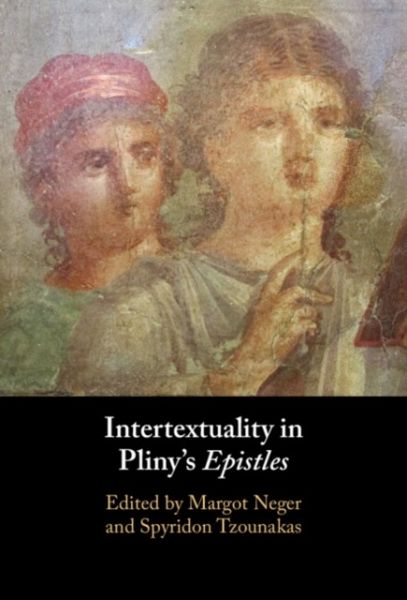
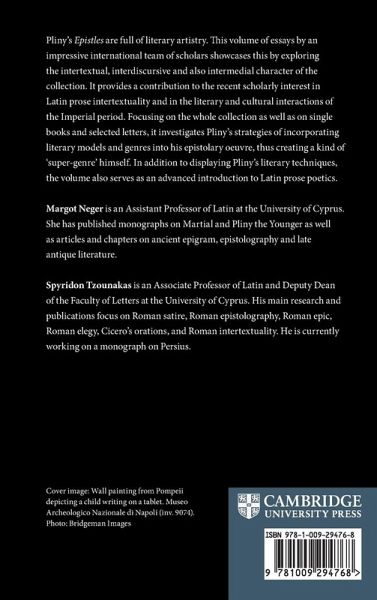
Essential reading for anyone interested in the artistry of Pliny's Epistles and, more broadly, in Latin prose intertextuality, in the generic enrichment of Latin epistolography and in the literary and cultural interactions of the Imperial period. The book also serves as an advanced introduction to Latin prose poetics.
Essential reading for anyone interested in the artistry of Pliny's Epistles and, more broadly, in Latin prose intertextuality, in the generic enrichment of Latin epistolography and in the literary and cultural interactions of the Imperial period. The book also serves as an advanced introduction to Latin prose poetics.
Introduction Margot Neger and Spyridon Tzounakas; Part I. Intertextuality and Interdiscursivity in Pliny's Letters: 1. Pliny, Man of Many Parts (Lucretius, Cicero, Valerius Maximus, Tacitus) Christopher Whitton; 2. Intertextuality in Pliny Epistles 6 Roy Gibson; 3. Discourses of Authority in Pliny, Epistles 10 Alice König; Part II. Models and Anti-Models: Pliny's Interaction with Oratory and Natural History; 4. Oratorical Speeches and the Political Elite in the Regulus Cycle Matthew Mordue; 5. Again on Corinthian Bronzes and Vases and on the Use of Cicero's Verrine Orations in Pliny's Works Stefano Rocchi; 6. The Elder Pliny as source of inspiration: Pliny the Younger's reception of the Naturalis Historia and his uncle's writing by the light of a lamp (lucubratio) Judith Hindermann; Part III. Pliny and Seneca: Discourses of Grief and Posthumous Reputation; 7. Pliny's Seneca and the Intertextuality of Grief Michael Hanaghan; 8. Intertextuality and Posthumous Reputation in Pliny's Letter on the Death of Silius Italicus (Plin. Ep. 3.7) Spyridon Tzounakas; Part IV. Pliny's Villas and their Poetic Models: 9. The Villa and the Monument: Horace in Plin. Ep. 1.3 Alberto Canobbio; 10. The Villas of Pliny and Statius Christopher Chinn; Part V. Pliny Turns Nasty: Satire and the Scoptic Tradition; 11. A Busy Day in Rome: Pliny Ep. 1.9 Satirized by Horace Sat. 1.9 Ábel Tamás; 12. Putting Pallas out of Context: Pliny on the Roman Senate voting Honours to a Freedman (Ep. 7.29 and 8.6) Jakub Pigö; 13. Risus et indignatio: Scoptic Elements in Pliny's Letters Margot Neger; Part VI. Final Thoughts: Discourses of Representation and Reproduction; 14. Pliny's Calpurnia: Filiation, Imitation, Allusion Ilaria Marchesi.
Introduction Margot Neger and Spyridon Tzounakas; Part I. Intertextuality and Interdiscursivity in Pliny's Letters: 1. Pliny, Man of Many Parts (Lucretius, Cicero, Valerius Maximus, Tacitus) Christopher Whitton; 2. Intertextuality in Pliny Epistles 6 Roy Gibson; 3. Discourses of Authority in Pliny, Epistles 10 Alice König; Part II. Models and Anti-Models: Pliny's Interaction with Oratory and Natural History; 4. Oratorical Speeches and the Political Elite in the Regulus Cycle Matthew Mordue; 5. Again on Corinthian Bronzes and Vases and on the Use of Cicero's Verrine Orations in Pliny's Works Stefano Rocchi; 6. The Elder Pliny as source of inspiration: Pliny the Younger's reception of the Naturalis Historia and his uncle's writing by the light of a lamp (lucubratio) Judith Hindermann; Part III. Pliny and Seneca: Discourses of Grief and Posthumous Reputation; 7. Pliny's Seneca and the Intertextuality of Grief Michael Hanaghan; 8. Intertextuality and Posthumous Reputation in Pliny's Letter on the Death of Silius Italicus (Plin. Ep. 3.7) Spyridon Tzounakas; Part IV. Pliny's Villas and their Poetic Models: 9. The Villa and the Monument: Horace in Plin. Ep. 1.3 Alberto Canobbio; 10. The Villas of Pliny and Statius Christopher Chinn; Part V. Pliny Turns Nasty: Satire and the Scoptic Tradition; 11. A Busy Day in Rome: Pliny Ep. 1.9 Satirized by Horace Sat. 1.9 Ábel Tamás; 12. Putting Pallas out of Context: Pliny on the Roman Senate voting Honours to a Freedman (Ep. 7.29 and 8.6) Jakub Pigö; 13. Risus et indignatio: Scoptic Elements in Pliny's Letters Margot Neger; Part VI. Final Thoughts: Discourses of Representation and Reproduction; 14. Pliny's Calpurnia: Filiation, Imitation, Allusion Ilaria Marchesi.
Es gelten unsere Allgemeinen Geschäftsbedingungen: www.buecher.de/agb
Impressum
www.buecher.de ist ein Internetauftritt der buecher.de internetstores GmbH
Geschäftsführung: Monica Sawhney | Roland Kölbl | Günter Hilger
Sitz der Gesellschaft: Batheyer Straße 115 - 117, 58099 Hagen
Postanschrift: Bürgermeister-Wegele-Str. 12, 86167 Augsburg
Amtsgericht Hagen HRB 13257
Steuernummer: 321/5800/1497
USt-IdNr: DE450055826