
Andere Kunden interessierten sich auch für
 Viatge Al Purgatori De Sant Patrici28,99 €
 An Etymological Dictionary of the Romance Languages: Chiefly From the German of Friedrich Diez37,99 €
 Llegendes de l'altra vida: Viatges del Cavaller Owein y de Ramón de Perellós al purgatori de Sant Patrici; Visions de Tundal y de Trictelm; Apari34,99 €
 Grammaire, Dialogues & Vocabulaire De La Langue Rommane Des Sigans Pour Faire Suite a L'histoire Vraie Des Vrais Bohémiens23,99 €
 Recueillis Et Traduits Par V. Alexandri Avec Une Introduction Par. A. Ubicin") Ballades Et Chants Populaires De La Roumanie: (principautés Danubiennes.) Recueillis Et Traduits Par V. Alexandri Avec Une Introduction Par. A. Ubicin31,99 €
Ballades Et Chants Populaires De La Roumanie: (principautés Danubiennes.) Recueillis Et Traduits Par V. Alexandri Avec Une Introduction Par. A. Ubicin31,99 € Glossariu Care Coprinde Vorbele D'in Limb'a Romana Straine Prin Originea Sau Form'a Loru30,99 €
 An Essay on The Origin and Formation of the Romance Languages32,99 €



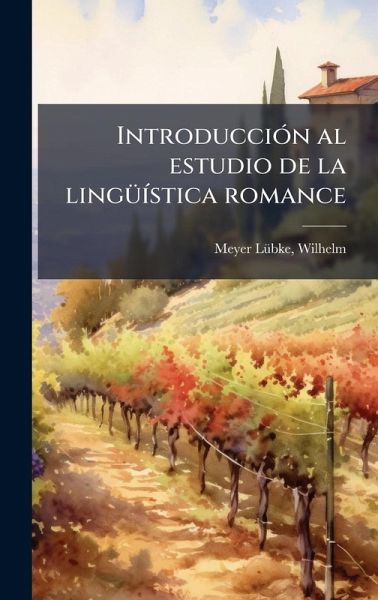
IntroducciÃ3n al estudio de la lingÃ1/4Ã-stica romance, by Wilhelm Meyer-LÃ1/4bke, offers a detailed exploration into the study of Romance languages. This foundational work, originally published in 1914, provides invaluable insights into the evolution and characteristics of languages such as Spanish, French, Italian, Portuguese, and Romanian. Meyer-LÃ1/4bke's comprehensive approach makes this book an essential resource for students and scholars of linguistics and Romance philology. Delve into the historical development and structural nuances that define these vibrant and influential languages. A timeless classic for anyone passionate about understanding the roots and complexities of Romance linguistics. This work has been selected by scholars as being culturally important, and is part of the knowledge base of civilization as we know it. This work was reproduced from the original artifact, and remains as true to the original work as possible. Therefore, you will see the original copyright references, library stamps (as most of these works have been housed in our most important libraries around the world), and other notations in the work. This work is in the public domain in the United States of America, and possibly other nations. Within the United States, you may freely copy and distribute this work, as no entity (individual or corporate) has a copyright on the body of the work. As a reproduction of a historical artifact, this work may contain missing or blurred pages, poor pictures, errant marks, etc. Scholars believe, and we concur, that this work is important enough to be preserved, reproduced, and made generally available to the public. We appreciate your support of the preservation process, and thank you for being an important part of keeping this knowledge alive and relevant.