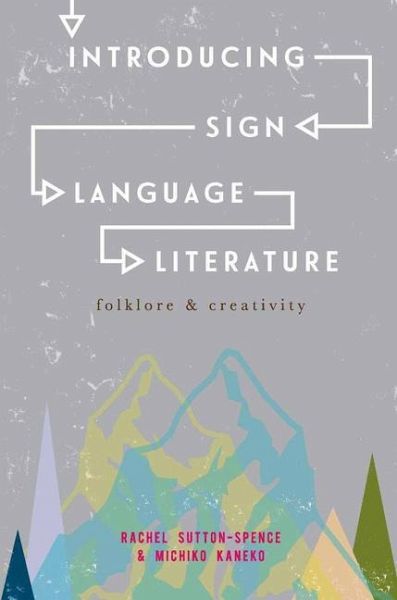
Introducing Sign Language Literature: Folklore and Creativity is the first textbook dedicated to analyzing and appreciating sign language storytelling, poetry and humour. The authors assume no prior knowledge of sign language or literary studies, introducing readers to a world of visual language creativity in deaf communities. Introducing Sign Language Literature: Folklore and Creativity - Explains in straightforward terms the unique features of this embodied language art form - Draws on an online anthology of over 150 sign language stories, poems and jokes - Suggests ways of analysing and…mehr
Introducing Sign Language Literature: Folklore and Creativity is the first textbook dedicated to analyzing and appreciating sign language storytelling, poetry and humour. The authors assume no prior knowledge of sign language or literary studies, introducing readers to a world of visual language creativity in deaf communities. Introducing Sign Language Literature: Folklore and Creativity - Explains in straightforward terms the unique features of this embodied language art form - Draws on an online anthology of over 150 sign language stories, poems and jokes - Suggests ways of analysing and appreciating the rich artistic heritage of deaf communities Watch a short video about the book.
Rachel Sutton-Spence is a lecturer in Sign Language Studies at the Federal University of Santa Catarina in Brazil. She has long been fascinated by sign language poetry and folklore, and has published extensively on linguistic and educational aspects of sign language creativity, humour and metaphor. She is co-author, with Bencie Woll, of The Linguistics of British Sign Language: An Introduction (1999). She taught sign language linguistics and literature at the University of Bristol and to professionals working with sign language within the British Deaf community for many years. Michiko Kaneko is a Lecturer and Head of the Department of South African Sign Language in the University of the Witwatersrand, Johannesburg. She obtained her PhD in Deaf Studies in the University of Bristol, where she also completed a three-year postdoctoral project titled "Metaphor in Creative Sign Language". Her research interests include sign language linguistics, sign language literature (poetry and stories expressed visually, spatially and manually) and metaphor studies.
Inhaltsangabe
1. What is Sign Language Literature? 2. Sign Language Literature in Context 3. Oral Literature and Performance 4. Folklore and Deaflore 5. Story Types 6. Storytelling Techniques 7. Anthropomorphism 8. Beginnings and Endings 9. Plots, Protagonists, Subjects and Themes 10. Metaphor 11. Prose and Poetry 12. Neologism and Ambiguity 13. Repetition 14. Handshape 15. Use of Signing Space 16. Symmetry and Balance 17. Nonmanual Features 18. Deaf Humour and Sign Language Humour 19. Style in Signed Art Forms 20. Conclusion.
Es gelten unsere Allgemeinen Geschäftsbedingungen: www.buecher.de/agb
Impressum
www.buecher.de ist ein Internetauftritt der buecher.de internetstores GmbH
Geschäftsführung: Monica Sawhney | Roland Kölbl | Günter Hilger
Sitz der Gesellschaft: Batheyer Straße 115 - 117, 58099 Hagen
Postanschrift: Bürgermeister-Wegele-Str. 12, 86167 Augsburg
Amtsgericht Hagen HRB 13257
Steuernummer: 321/5800/1497
USt-IdNr: DE450055826