
- Broschiertes Buch
- Merkliste
- Auf die Merkliste
- Bewerten Bewerten
- Teilen
- Produkt teilen
- Produkterinnerung
- Produkterinnerung
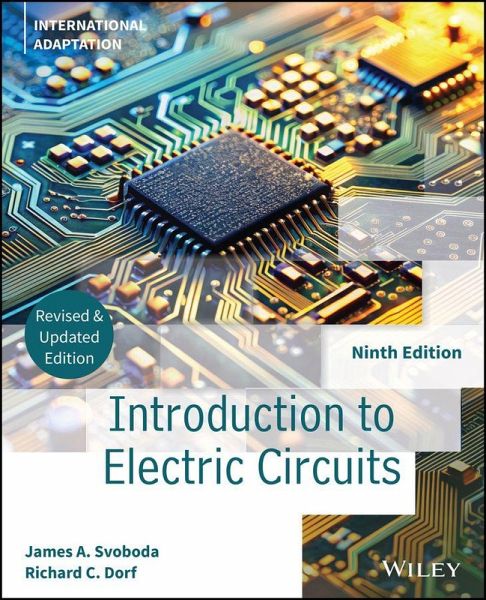
Introduction to Electric Circuits, 9th edition, International Adaptation is revised and updated for a one- to -three term course in electric circuits or linear circuit analysis. The book endeavors to support students encountering electric circuits for the first time and equips them to solve realistic problems involving these circuits. It features numerous design examples, challenging design problems, and the "How Can We Check" feature to emphasize its practical approach to design. This International Adaptation features revised design examples and problem sets, making them even more effective,…mehr
Andere Kunden interessierten sich auch für
 Basak CanLink Adaptation for Relay-Based Cellular Networks116,99 €
 Mathias WilhelmsMultiscale Modeling of Cardiac Electrophysiology: Adaptation to Atrial and Ventricular Rhythm Disorders and Pharmacological Treatment42,00 €
 Raja Kumar R.Classification, Estimation and Adaptation of Error Control Coding43,99 €
 Timothy A. BigelowElectric Circuits, Systems, and Motors90,94 €
 Shujun LiFlexible Adaptation in Cognitive Radios76,99 €
 Karim AbbasHandbook of Digital CMOS Technology, Circuits, and Systems213,99 €
 Electronic Circuits, Systems and Applications148,99 €
-
-
-





Introduction to Electric Circuits, 9th edition, International Adaptation is revised and updated for a one- to -three term course in electric circuits or linear circuit analysis. The book endeavors to support students encountering electric circuits for the first time and equips them to solve realistic problems involving these circuits. It features numerous design examples, challenging design problems, and the "How Can We Check" feature to emphasize its practical approach to design. This International Adaptation features revised design examples and problem sets, making them even more effective, useful, and up-to-date. This edition continues the expanded use of problem-solving software such as PSpice and MATLAB.
Produktdetails
- Produktdetails
- Verlag: John Wiley & Sons Inc
- 9th Edition, Revised and Updated
- Seitenzahl: 912
- Erscheinungstermin: 16. Dezember 2025
- Englisch
- ISBN-13: 9781394394319
- ISBN-10: 1394394314
- Artikelnr.: 75619347
- Herstellerkennzeichnung
- Libri GmbH
- Europaallee 1
- 36244 Bad Hersfeld
- gpsr@libri.de
- Verlag: John Wiley & Sons Inc
- 9th Edition, Revised and Updated
- Seitenzahl: 912
- Erscheinungstermin: 16. Dezember 2025
- Englisch
- ISBN-13: 9781394394319
- ISBN-10: 1394394314
- Artikelnr.: 75619347
- Herstellerkennzeichnung
- Libri GmbH
- Europaallee 1
- 36244 Bad Hersfeld
- gpsr@libri.de
James A. Svoboda is an associate professor of electrical and computer engineering at Clarkson University, where he teaches courses on topics such as circuits, electronics, and computer programming. He earned a PhD in electrical engineering from the University of Wisconsin at Madison, an MS from the University of Colorado, and a BS from General Motors Institute. Sophomore Circuits is one of Professor Svoboda's favorite courses. He has taught this course to 6,500 undergraduates at Clarkson University over the past 35 years. In 1986, he received Clarkson University's Distinguished Teaching Award. Professor Svoboda has written several research papers describing the advantages of using nullors to model electric circuits for computer analysis. He is interested in the way technology affects engineering education and has developed several software packages for use in Sophomore Circuits. Richard C. Dorf, professor of electrical and computer engineering at the University of California, Davis, teaches graduate and undergraduate courses in electrical engineering in the fields of circuits and control systems. He earned a PhD in electrical engineering from the U.S. Naval Postgraduate School, an MS from the University of Colorado, and a BS from Clarkson University. Highly concerned with the discipline of electrical engineering and its wide value to social and economic needs, he has written and lectured internationally on the contributions and advances in electrical engineering. Professor Dorf has extensive experience with education and industry and is professionally active in the fields of robotics, automation, electric circuits, and communications. He has served as a visiting professor at the University of Edinburgh, Scotland, the Massachusetts Institute of Technology, Stanford University, and the University of California at Berkeley. A Fellow of the Institute of Electrical and Electronic Engineers and the American Society for Engineering Education, Dr. Dorf is widely known to the profession for his Modern Control Systems, twelfth edition (Pearson, 2011) and The International Encyclopedia of Robotics (Wiley, 1988). Dr. Dorf is also the coauthor of Circuits, Devices and Systems (with Ralph Smith), fifth edition (Wiley, 1992). Dr. Dorf edited the widely used Electrical Engineering Handbook, third edition (CRC Press and IEEE press), published in 2011. He has also worked for Technology Ventures, fourth edition, (McGraw-Hill), published in 2013.
Chapter 1 Electric Circuit Variables 1 1.1 Introduction 1 1.2 Electric Circuits and Current 1 1.3 Systems of Units 5 1.4 Voltage 7 1.5 Power and Energy 7 1.6 Circuit Analysis and Design 11 1.7 How Can We Check ? 13 1.8 Design Example-Jet Valve Controller 14 1.9 Summary 15 Problems 15 Design Problems 19 Chapter 2 Circuit Elements 20 2.1 Introduction 20 2.2 Engineering and Linear Models 20 2.3 Active and Passive Circuit Elements 23 2.4 Resistors 25 2.5 Independent Sources 28 2.6 Voltmeters and Ammeters. 30 2.7 Dependent Sources 33 2.8 Resistive Transducers 37 2.9 Switches 41 2.10 How Can We Check ? 43 2.11 Design Example-Temperature Sensor 44 2.12 Summary 46 Problems 47 Design Problems 55 Chapter 3 Resistive Circuits 56 3.1 Introduction 56 3.2 Kirchhoff's Laws 57 3.3 Series Resistors and Voltage Division 66 3.4 Parallel Resistors and Current Division 71 3.5 Series Voltage Sources and Parallel Current Sources 77 3.6 Circuit Analysis 81 3.7 Analyzing Resistive Circuits Using MATLAB 86 3.8 How Can We Check ?. 89 3.9 Design Example-Adjustable Voltage Source 91 3.10 Summary 94 Problems 95 Design Problems 112 Chapter 4 Methods of Analysis of Resistive Circuits 116 4.1 Introduction 116 4.2 Node Voltage Analysis of Circuits with Current Sources 117 4.3 Node Voltage Analysis of Circuits with Current and Voltage Sources 123 4.4 Node Voltage Analysis with Dependent Sources 128 4.5 Mesh Current Analysis with Independent Voltage Sources 130 4.6 Mesh Current Analysis with Current and Voltage Sources 135 4.7 Mesh Current Analysis with Dependent Sources 139 4.8 The Node Voltage Method and Mesh Current Method Compared 141 4.9 Circuit Analysis Using MATLAB 144 4.10 Using PSpice to Determine Node Voltages and Mesh Currents 146 4.11 How Can We Check ?. 148 4.12 Design Example-Potentiometer Angle Display 151 4.13 Summary 154 Problems 155 PSpice Problems 167 Design Problems 167 Chapter 5 Circuit Theorems 169 5.1 Introduction 169 5.2 Source Transformations 169 5.3 Superposition 176 5.4 Thévenin's Theorem 180 5.5 Norton's Equivalent Circuit 187 5.6 Maximum Power Transfer 191 5.7 Using MATLAB to Determine the Thévenin Equivalent Circuit 194 5.8 Using PSpice to Determine the Thévenin Equivalent Circuit 197 5.9 How Can We Check ? 200 5.10 Design Example-Strain Gauge Bridge 201 5.11 Summary 203 Problems 204 PSpice Problems 214 Design Problems 215 Chapter 6 The Operational Amplifier 219 6.1 Introduction 219 6.2 The Operational Amplifier 219 6.3 The Ideal Operational Amplifier 221 6.4 Nodal Analysis of Circuits Containing Ideal Operational Amplifiers 223 6.5 Design Using Operational Amplifiers 228 6.6 Operational Amplifier Circuits and Linear Algebraic Equations 233 6.7 Characteristics of Practical Operational Amplifiers 238 6.8 Analysis of Op Amp Circuits Using MATLAB 245 6.9 Using PSpice to Analyze Op Amp Circuits 247 6.10 How Can We Check ?. 248 6.11 Design Example-Transducer Interface Circuit 250 6.12 Summary 252 Problems 252 PSpice Problems 263 Design Problems 264 Chapter 7 Energy Storage Elements 265 7.1 Introduction 265 7.2 Capacitors 266 7.3 Energy Storage in a Capacitor 273 7.4 Series and Parallel Capacitors 276 7.5 Inductors 278 7.6 Energy Storage in an Inductor 283 7.7 Series and Parallel Inductors. 285 7.8 Initial Conditions of Switched Circuits 286 7.9 Operational Amplifier Circuits and Linear Differential Equations 290 7.10 Using MATLAB to Plot Capacitor or Inductor Voltage and Current 296 7.11 How Can We Check ?. 298 7.12 Design Example-Integrator for Battery Charge Estimation 299 7.13 Summary 302 Problems 303 Design Problems 315 Chapter 8 The Complete Response of RL and RC Circuits 317 8.1 Introduction 317 8.2 First-Order Circuits 317 8.3 The Response of a First-Order Circuit to a Constant Input 320 8.4 Sequential Switching 333 8.5 Stability of First-Order Circuits 335 8.6 The Unit Step Source 337 8.7 The Response of a First-Order Circuit to a Nonconstant Source 341 8.8 Differential Operators 346 8.9 Using PSpice to Analyze First-Order Circuits 347 8.10 How Can We Check ?. 350 8.11 Design Example-A Computer and Printer 354 8.12 Summary 356 Problems 358 PSpice Problems 368 Design Problems 369 Chapter 9 The Complete Response of Circuits with Two Energy Storage Elements 370 9.1 Introduction 370 9.2 Differential Equation for Circuits with Two Energy Storage Elements 371 9.3 Solution of the Second-Order Differential Equation-The Natural Response 375 9.4 Natural Response of the Unforced Parallel RLC Circuit 377 9.5 Natural Response of the Critically Damped Unforced Parallel RLC Circuit 380 9.6 Natural Response of an Underdamped Unforced Parallel RLC Circuit 381 9.7 Forced Response of an RLC Circuit 384 9.8 Complete Response of an RLC Circuit 387 9.9 State Variable Approach to Circuit Analysis 390 9.10 Roots in the Complex Plane 395 9.11 How Can We Check ?. 396 9.12 Design Example-Auto Airbag Igniter 398 9.13 Summary 400 Problems 402 PSpice Problems 411 Design Problems 412 Chapter 10 Sinusoidal Steady-State Analysis 414 10.1 Introduction 414 10.2 Sinusoidal Sources 415 10.3 Phasors and Sinusoids 419 10.4 Impedances 424 10.5 Series and Parallel Impedances 430 10.6 Mesh and Node Equations 436 10.7 Thévenin and Norton Equivalent Circuits 444 10.8 Superposition 448 10.9 Phasor Diagrams 451 10.10 Op Amps in AC Circuits 452 10.11 The Complete Response 454 10.12 Using MATLAB to Analyze AC Circuits 461 10.13 Using PSpice to Analyze AC Circuits 463 10.14 How Can We Check ? 465 10.15 Design Example-An Op Amp Circuit 468 10.16 Summary 470 Problems 471 PSpice Problems 486 Design Problems 488 Chapter 11 AC Steady-State Power 489 11.1 Introduction 489 11.2 Electric Power 489 11.3 Instantaneous Power and Average Power 490 11.4 Effective Value of a Periodic Waveform 494 11.5 Complex Power 497 11.6 Power Factor 504 11.7 The Power Superposition Principle 512 11.8 The Maximum Power Transfer Theorem 515 11.9 Coupled Inductors 516 11.10 The Ideal Transformer 524 11.11 How Can We Check ? 531 11.12 Design Example-Maximum Power Transfer 532 11.13 Summary 534 Problems 536 PSpice Problems 549 Design Problems 550 Chapter 12 Three-Phase Circuits 551 12.1 Introduction 551 12.2 Three-Phase Voltages 552 12.3 The Y-to-Y Circuit 555 12.4 The
-Connected Source and Load 564 12.5 The Y-to-
Circuit 566 12.6 Balanced Three-Phase Circuits 568 12.7 Instantaneous and Average Power in a Balanced Three-Phase Load 571 12.8 Two-Wattmeter Power Measurement 574 12.9 How Can We Check ? 577 12.10 Design Example-Power Factor Correction 580 12.11 Summary 582 Problems 582 PSpice Problems 587 Design Problems 587 Chapter 13 Frequency Response 588 13.1 Introduction 588 13.2 Gain, Phase Shift, and the Network Function 588 13.3 Bode Plots 600 13.4 Resonant Circuits 617 13.5 Frequency Response of Op Amp Circuits 624 13.6 Plotting Bode Plots Using MATLAB 626 13.7 Using PSpice to Plot a Frequency Response 628 13.8 How Can We Check ? 630 13.9 Design Example-Radio Tuner 634 13.10 Summary 636 Problems 637 PSpice Problems 648 Design Problems 651 Chapter 14 The Laplace Transform 653 14.1 Introduction 653 14.2 Laplace Transform 654 14.3 Pulse Inputs 660 14.4 Inverse Laplace Transform 663 14.5 Initial and Final Value Theorems 670 14.6 Solution of Differential Equations Describing a Circuit 672 14.7 Circuit Analysis Using Impedance and Initial Conditions 674 14.8 Transfer Function and Impedance 684 14.9 Convolution 690 14.10 Stability 694 14.11 Partial Fraction Expansion Using MATLAB 697 14.12 How Can We Check ? 702 14.13 Design Example-Space Shuttle Cargo Door 704 14.14 Summary 707 Problems 708 PSpice Problems 720 Design Problems 721 Chapter 15 Fourier Series and Fourier Transform 723 15.1 Introduction 723 15.2 The Fourier Series 724 15.3 Symmetry of the Function f (t) 732 15.4 Fourier Series of Selected Waveforms 737 15.5 Exponential Form of the Fourier Series 739 15.6 The Fourier Spectrum 747 15.7 Circuits and Fourier Series 751 15.8 Using PSpice to Determine the Fourier Series 754 15.9 The Fourier Transform 759 15.10 Fourier Transform Properties 762 15.11 The Spectrum of Signals 766 15.12 Convolution and Circuit Response 767 15.13 The Fourier Transform and the Laplace Transform 770 15.14 How Can We Check ? 772 15.15 Design Example-DC Power Supply 774 15.16 Summary 777 Problems 778 PSpice Problems 784 Design Problems 784 Chapter 16 Filter Circuits 785 16.1 Introduction 785 16.2 The Electric Filter 785 16.3 Filters 786 16.4 Second-Order Filters 789 16.5 High-Order Filters 797 16.6 Simulating Filter Circuits Using PSpice 803 16.7 How Can We Check ?. 807 16.8 Design Example-Anti-Aliasing Filter 809 16.9 Summary 812 Problems 812 PSpice Problems 817 Design Problems 820 Chapter 17 Two-Port and Three-Port Networks 821 17.1 Introduction 821 17.2 T-to-
Transformation and Two-Port Three-Terminal Networks 822 17.3 Equations of Two-Port Networks 824 17.4 Zand YParameters for a Circuit with Dependent Sources 827 17.5 Hybrid and Transmission Parameters 829 17.6 Relationships Between Two-Port Parameters 831 17.7 Interconnection of Two-Port Networks 833 17.8 How Can We Check ?. 836 17.9 Design Example-Transistor Amplifier 837 17.10 Summary 839 Problems 840 Design Problems 843 Appendix A Getting Started with PSpice 845 Appendix B MATLAB, Matrices, and Complex Arithmetic 853 Appendix C Mathematical Formulas 865 Appendix D Resistor Specifications and Monte Carlo Analysis 869 References 873 Index 875
-Connected Source and Load 564 12.5 The Y-to-
Circuit 566 12.6 Balanced Three-Phase Circuits 568 12.7 Instantaneous and Average Power in a Balanced Three-Phase Load 571 12.8 Two-Wattmeter Power Measurement 574 12.9 How Can We Check ? 577 12.10 Design Example-Power Factor Correction 580 12.11 Summary 582 Problems 582 PSpice Problems 587 Design Problems 587 Chapter 13 Frequency Response 588 13.1 Introduction 588 13.2 Gain, Phase Shift, and the Network Function 588 13.3 Bode Plots 600 13.4 Resonant Circuits 617 13.5 Frequency Response of Op Amp Circuits 624 13.6 Plotting Bode Plots Using MATLAB 626 13.7 Using PSpice to Plot a Frequency Response 628 13.8 How Can We Check ? 630 13.9 Design Example-Radio Tuner 634 13.10 Summary 636 Problems 637 PSpice Problems 648 Design Problems 651 Chapter 14 The Laplace Transform 653 14.1 Introduction 653 14.2 Laplace Transform 654 14.3 Pulse Inputs 660 14.4 Inverse Laplace Transform 663 14.5 Initial and Final Value Theorems 670 14.6 Solution of Differential Equations Describing a Circuit 672 14.7 Circuit Analysis Using Impedance and Initial Conditions 674 14.8 Transfer Function and Impedance 684 14.9 Convolution 690 14.10 Stability 694 14.11 Partial Fraction Expansion Using MATLAB 697 14.12 How Can We Check ? 702 14.13 Design Example-Space Shuttle Cargo Door 704 14.14 Summary 707 Problems 708 PSpice Problems 720 Design Problems 721 Chapter 15 Fourier Series and Fourier Transform 723 15.1 Introduction 723 15.2 The Fourier Series 724 15.3 Symmetry of the Function f (t) 732 15.4 Fourier Series of Selected Waveforms 737 15.5 Exponential Form of the Fourier Series 739 15.6 The Fourier Spectrum 747 15.7 Circuits and Fourier Series 751 15.8 Using PSpice to Determine the Fourier Series 754 15.9 The Fourier Transform 759 15.10 Fourier Transform Properties 762 15.11 The Spectrum of Signals 766 15.12 Convolution and Circuit Response 767 15.13 The Fourier Transform and the Laplace Transform 770 15.14 How Can We Check ? 772 15.15 Design Example-DC Power Supply 774 15.16 Summary 777 Problems 778 PSpice Problems 784 Design Problems 784 Chapter 16 Filter Circuits 785 16.1 Introduction 785 16.2 The Electric Filter 785 16.3 Filters 786 16.4 Second-Order Filters 789 16.5 High-Order Filters 797 16.6 Simulating Filter Circuits Using PSpice 803 16.7 How Can We Check ?. 807 16.8 Design Example-Anti-Aliasing Filter 809 16.9 Summary 812 Problems 812 PSpice Problems 817 Design Problems 820 Chapter 17 Two-Port and Three-Port Networks 821 17.1 Introduction 821 17.2 T-to-
Transformation and Two-Port Three-Terminal Networks 822 17.3 Equations of Two-Port Networks 824 17.4 Zand YParameters for a Circuit with Dependent Sources 827 17.5 Hybrid and Transmission Parameters 829 17.6 Relationships Between Two-Port Parameters 831 17.7 Interconnection of Two-Port Networks 833 17.8 How Can We Check ?. 836 17.9 Design Example-Transistor Amplifier 837 17.10 Summary 839 Problems 840 Design Problems 843 Appendix A Getting Started with PSpice 845 Appendix B MATLAB, Matrices, and Complex Arithmetic 853 Appendix C Mathematical Formulas 865 Appendix D Resistor Specifications and Monte Carlo Analysis 869 References 873 Index 875
Chapter 1 Electric Circuit Variables 1 1.1 Introduction 1 1.2 Electric Circuits and Current 1 1.3 Systems of Units 5 1.4 Voltage 7 1.5 Power and Energy 7 1.6 Circuit Analysis and Design 11 1.7 How Can We Check ? 13 1.8 Design Example-Jet Valve Controller 14 1.9 Summary 15 Problems 15 Design Problems 19 Chapter 2 Circuit Elements 20 2.1 Introduction 20 2.2 Engineering and Linear Models 20 2.3 Active and Passive Circuit Elements 23 2.4 Resistors 25 2.5 Independent Sources 28 2.6 Voltmeters and Ammeters. 30 2.7 Dependent Sources 33 2.8 Resistive Transducers 37 2.9 Switches 41 2.10 How Can We Check ? 43 2.11 Design Example-Temperature Sensor 44 2.12 Summary 46 Problems 47 Design Problems 55 Chapter 3 Resistive Circuits 56 3.1 Introduction 56 3.2 Kirchhoff's Laws 57 3.3 Series Resistors and Voltage Division 66 3.4 Parallel Resistors and Current Division 71 3.5 Series Voltage Sources and Parallel Current Sources 77 3.6 Circuit Analysis 81 3.7 Analyzing Resistive Circuits Using MATLAB 86 3.8 How Can We Check ?. 89 3.9 Design Example-Adjustable Voltage Source 91 3.10 Summary 94 Problems 95 Design Problems 112 Chapter 4 Methods of Analysis of Resistive Circuits 116 4.1 Introduction 116 4.2 Node Voltage Analysis of Circuits with Current Sources 117 4.3 Node Voltage Analysis of Circuits with Current and Voltage Sources 123 4.4 Node Voltage Analysis with Dependent Sources 128 4.5 Mesh Current Analysis with Independent Voltage Sources 130 4.6 Mesh Current Analysis with Current and Voltage Sources 135 4.7 Mesh Current Analysis with Dependent Sources 139 4.8 The Node Voltage Method and Mesh Current Method Compared 141 4.9 Circuit Analysis Using MATLAB 144 4.10 Using PSpice to Determine Node Voltages and Mesh Currents 146 4.11 How Can We Check ?. 148 4.12 Design Example-Potentiometer Angle Display 151 4.13 Summary 154 Problems 155 PSpice Problems 167 Design Problems 167 Chapter 5 Circuit Theorems 169 5.1 Introduction 169 5.2 Source Transformations 169 5.3 Superposition 176 5.4 Thévenin's Theorem 180 5.5 Norton's Equivalent Circuit 187 5.6 Maximum Power Transfer 191 5.7 Using MATLAB to Determine the Thévenin Equivalent Circuit 194 5.8 Using PSpice to Determine the Thévenin Equivalent Circuit 197 5.9 How Can We Check ? 200 5.10 Design Example-Strain Gauge Bridge 201 5.11 Summary 203 Problems 204 PSpice Problems 214 Design Problems 215 Chapter 6 The Operational Amplifier 219 6.1 Introduction 219 6.2 The Operational Amplifier 219 6.3 The Ideal Operational Amplifier 221 6.4 Nodal Analysis of Circuits Containing Ideal Operational Amplifiers 223 6.5 Design Using Operational Amplifiers 228 6.6 Operational Amplifier Circuits and Linear Algebraic Equations 233 6.7 Characteristics of Practical Operational Amplifiers 238 6.8 Analysis of Op Amp Circuits Using MATLAB 245 6.9 Using PSpice to Analyze Op Amp Circuits 247 6.10 How Can We Check ?. 248 6.11 Design Example-Transducer Interface Circuit 250 6.12 Summary 252 Problems 252 PSpice Problems 263 Design Problems 264 Chapter 7 Energy Storage Elements 265 7.1 Introduction 265 7.2 Capacitors 266 7.3 Energy Storage in a Capacitor 273 7.4 Series and Parallel Capacitors 276 7.5 Inductors 278 7.6 Energy Storage in an Inductor 283 7.7 Series and Parallel Inductors. 285 7.8 Initial Conditions of Switched Circuits 286 7.9 Operational Amplifier Circuits and Linear Differential Equations 290 7.10 Using MATLAB to Plot Capacitor or Inductor Voltage and Current 296 7.11 How Can We Check ?. 298 7.12 Design Example-Integrator for Battery Charge Estimation 299 7.13 Summary 302 Problems 303 Design Problems 315 Chapter 8 The Complete Response of RL and RC Circuits 317 8.1 Introduction 317 8.2 First-Order Circuits 317 8.3 The Response of a First-Order Circuit to a Constant Input 320 8.4 Sequential Switching 333 8.5 Stability of First-Order Circuits 335 8.6 The Unit Step Source 337 8.7 The Response of a First-Order Circuit to a Nonconstant Source 341 8.8 Differential Operators 346 8.9 Using PSpice to Analyze First-Order Circuits 347 8.10 How Can We Check ?. 350 8.11 Design Example-A Computer and Printer 354 8.12 Summary 356 Problems 358 PSpice Problems 368 Design Problems 369 Chapter 9 The Complete Response of Circuits with Two Energy Storage Elements 370 9.1 Introduction 370 9.2 Differential Equation for Circuits with Two Energy Storage Elements 371 9.3 Solution of the Second-Order Differential Equation-The Natural Response 375 9.4 Natural Response of the Unforced Parallel RLC Circuit 377 9.5 Natural Response of the Critically Damped Unforced Parallel RLC Circuit 380 9.6 Natural Response of an Underdamped Unforced Parallel RLC Circuit 381 9.7 Forced Response of an RLC Circuit 384 9.8 Complete Response of an RLC Circuit 387 9.9 State Variable Approach to Circuit Analysis 390 9.10 Roots in the Complex Plane 395 9.11 How Can We Check ?. 396 9.12 Design Example-Auto Airbag Igniter 398 9.13 Summary 400 Problems 402 PSpice Problems 411 Design Problems 412 Chapter 10 Sinusoidal Steady-State Analysis 414 10.1 Introduction 414 10.2 Sinusoidal Sources 415 10.3 Phasors and Sinusoids 419 10.4 Impedances 424 10.5 Series and Parallel Impedances 430 10.6 Mesh and Node Equations 436 10.7 Thévenin and Norton Equivalent Circuits 444 10.8 Superposition 448 10.9 Phasor Diagrams 451 10.10 Op Amps in AC Circuits 452 10.11 The Complete Response 454 10.12 Using MATLAB to Analyze AC Circuits 461 10.13 Using PSpice to Analyze AC Circuits 463 10.14 How Can We Check ? 465 10.15 Design Example-An Op Amp Circuit 468 10.16 Summary 470 Problems 471 PSpice Problems 486 Design Problems 488 Chapter 11 AC Steady-State Power 489 11.1 Introduction 489 11.2 Electric Power 489 11.3 Instantaneous Power and Average Power 490 11.4 Effective Value of a Periodic Waveform 494 11.5 Complex Power 497 11.6 Power Factor 504 11.7 The Power Superposition Principle 512 11.8 The Maximum Power Transfer Theorem 515 11.9 Coupled Inductors 516 11.10 The Ideal Transformer 524 11.11 How Can We Check ? 531 11.12 Design Example-Maximum Power Transfer 532 11.13 Summary 534 Problems 536 PSpice Problems 549 Design Problems 550 Chapter 12 Three-Phase Circuits 551 12.1 Introduction 551 12.2 Three-Phase Voltages 552 12.3 The Y-to-Y Circuit 555 12.4 The
-Connected Source and Load 564 12.5 The Y-to-
Circuit 566 12.6 Balanced Three-Phase Circuits 568 12.7 Instantaneous and Average Power in a Balanced Three-Phase Load 571 12.8 Two-Wattmeter Power Measurement 574 12.9 How Can We Check ? 577 12.10 Design Example-Power Factor Correction 580 12.11 Summary 582 Problems 582 PSpice Problems 587 Design Problems 587 Chapter 13 Frequency Response 588 13.1 Introduction 588 13.2 Gain, Phase Shift, and the Network Function 588 13.3 Bode Plots 600 13.4 Resonant Circuits 617 13.5 Frequency Response of Op Amp Circuits 624 13.6 Plotting Bode Plots Using MATLAB 626 13.7 Using PSpice to Plot a Frequency Response 628 13.8 How Can We Check ? 630 13.9 Design Example-Radio Tuner 634 13.10 Summary 636 Problems 637 PSpice Problems 648 Design Problems 651 Chapter 14 The Laplace Transform 653 14.1 Introduction 653 14.2 Laplace Transform 654 14.3 Pulse Inputs 660 14.4 Inverse Laplace Transform 663 14.5 Initial and Final Value Theorems 670 14.6 Solution of Differential Equations Describing a Circuit 672 14.7 Circuit Analysis Using Impedance and Initial Conditions 674 14.8 Transfer Function and Impedance 684 14.9 Convolution 690 14.10 Stability 694 14.11 Partial Fraction Expansion Using MATLAB 697 14.12 How Can We Check ? 702 14.13 Design Example-Space Shuttle Cargo Door 704 14.14 Summary 707 Problems 708 PSpice Problems 720 Design Problems 721 Chapter 15 Fourier Series and Fourier Transform 723 15.1 Introduction 723 15.2 The Fourier Series 724 15.3 Symmetry of the Function f (t) 732 15.4 Fourier Series of Selected Waveforms 737 15.5 Exponential Form of the Fourier Series 739 15.6 The Fourier Spectrum 747 15.7 Circuits and Fourier Series 751 15.8 Using PSpice to Determine the Fourier Series 754 15.9 The Fourier Transform 759 15.10 Fourier Transform Properties 762 15.11 The Spectrum of Signals 766 15.12 Convolution and Circuit Response 767 15.13 The Fourier Transform and the Laplace Transform 770 15.14 How Can We Check ? 772 15.15 Design Example-DC Power Supply 774 15.16 Summary 777 Problems 778 PSpice Problems 784 Design Problems 784 Chapter 16 Filter Circuits 785 16.1 Introduction 785 16.2 The Electric Filter 785 16.3 Filters 786 16.4 Second-Order Filters 789 16.5 High-Order Filters 797 16.6 Simulating Filter Circuits Using PSpice 803 16.7 How Can We Check ?. 807 16.8 Design Example-Anti-Aliasing Filter 809 16.9 Summary 812 Problems 812 PSpice Problems 817 Design Problems 820 Chapter 17 Two-Port and Three-Port Networks 821 17.1 Introduction 821 17.2 T-to-
Transformation and Two-Port Three-Terminal Networks 822 17.3 Equations of Two-Port Networks 824 17.4 Zand YParameters for a Circuit with Dependent Sources 827 17.5 Hybrid and Transmission Parameters 829 17.6 Relationships Between Two-Port Parameters 831 17.7 Interconnection of Two-Port Networks 833 17.8 How Can We Check ?. 836 17.9 Design Example-Transistor Amplifier 837 17.10 Summary 839 Problems 840 Design Problems 843 Appendix A Getting Started with PSpice 845 Appendix B MATLAB, Matrices, and Complex Arithmetic 853 Appendix C Mathematical Formulas 865 Appendix D Resistor Specifications and Monte Carlo Analysis 869 References 873 Index 875
-Connected Source and Load 564 12.5 The Y-to-
Circuit 566 12.6 Balanced Three-Phase Circuits 568 12.7 Instantaneous and Average Power in a Balanced Three-Phase Load 571 12.8 Two-Wattmeter Power Measurement 574 12.9 How Can We Check ? 577 12.10 Design Example-Power Factor Correction 580 12.11 Summary 582 Problems 582 PSpice Problems 587 Design Problems 587 Chapter 13 Frequency Response 588 13.1 Introduction 588 13.2 Gain, Phase Shift, and the Network Function 588 13.3 Bode Plots 600 13.4 Resonant Circuits 617 13.5 Frequency Response of Op Amp Circuits 624 13.6 Plotting Bode Plots Using MATLAB 626 13.7 Using PSpice to Plot a Frequency Response 628 13.8 How Can We Check ? 630 13.9 Design Example-Radio Tuner 634 13.10 Summary 636 Problems 637 PSpice Problems 648 Design Problems 651 Chapter 14 The Laplace Transform 653 14.1 Introduction 653 14.2 Laplace Transform 654 14.3 Pulse Inputs 660 14.4 Inverse Laplace Transform 663 14.5 Initial and Final Value Theorems 670 14.6 Solution of Differential Equations Describing a Circuit 672 14.7 Circuit Analysis Using Impedance and Initial Conditions 674 14.8 Transfer Function and Impedance 684 14.9 Convolution 690 14.10 Stability 694 14.11 Partial Fraction Expansion Using MATLAB 697 14.12 How Can We Check ? 702 14.13 Design Example-Space Shuttle Cargo Door 704 14.14 Summary 707 Problems 708 PSpice Problems 720 Design Problems 721 Chapter 15 Fourier Series and Fourier Transform 723 15.1 Introduction 723 15.2 The Fourier Series 724 15.3 Symmetry of the Function f (t) 732 15.4 Fourier Series of Selected Waveforms 737 15.5 Exponential Form of the Fourier Series 739 15.6 The Fourier Spectrum 747 15.7 Circuits and Fourier Series 751 15.8 Using PSpice to Determine the Fourier Series 754 15.9 The Fourier Transform 759 15.10 Fourier Transform Properties 762 15.11 The Spectrum of Signals 766 15.12 Convolution and Circuit Response 767 15.13 The Fourier Transform and the Laplace Transform 770 15.14 How Can We Check ? 772 15.15 Design Example-DC Power Supply 774 15.16 Summary 777 Problems 778 PSpice Problems 784 Design Problems 784 Chapter 16 Filter Circuits 785 16.1 Introduction 785 16.2 The Electric Filter 785 16.3 Filters 786 16.4 Second-Order Filters 789 16.5 High-Order Filters 797 16.6 Simulating Filter Circuits Using PSpice 803 16.7 How Can We Check ?. 807 16.8 Design Example-Anti-Aliasing Filter 809 16.9 Summary 812 Problems 812 PSpice Problems 817 Design Problems 820 Chapter 17 Two-Port and Three-Port Networks 821 17.1 Introduction 821 17.2 T-to-
Transformation and Two-Port Three-Terminal Networks 822 17.3 Equations of Two-Port Networks 824 17.4 Zand YParameters for a Circuit with Dependent Sources 827 17.5 Hybrid and Transmission Parameters 829 17.6 Relationships Between Two-Port Parameters 831 17.7 Interconnection of Two-Port Networks 833 17.8 How Can We Check ?. 836 17.9 Design Example-Transistor Amplifier 837 17.10 Summary 839 Problems 840 Design Problems 843 Appendix A Getting Started with PSpice 845 Appendix B MATLAB, Matrices, and Complex Arithmetic 853 Appendix C Mathematical Formulas 865 Appendix D Resistor Specifications and Monte Carlo Analysis 869 References 873 Index 875