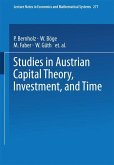
During the fifties and the sixties the neoclassical concept of the production function was criticized in numerous papers. In particular, the aggregation of different capital goods into a single number was reprehended. A second essential disadvantage, namely the neglect of the time structure of the production process, found, however, rela tively little attention. While up to the thirties the Austrian capital theory which stressed the time aspect of production was an important school, it fell into oblivion after the great capital controversies of the thirties. It took over thirty years, i. e.…mehr
During the fifties and the sixties the neoclassical concept of the production function was criticized in numerous papers. In particular, the aggregation of different capital goods into a single number was reprehended. A second essential disadvantage, namely the neglect of the time structure of the production process, found, however, rela tively little attention. While up to the thirties the Austrian capital theory which stressed the time aspect of production was an important school, it fell into oblivion after the great capital controversies of the thirties. It took over thirty years, i. e. till the beginning of the seventies be fore it came to a renaissance of the Austrian capital theory by var ious writers. We may roughly classify the different attempts of Hits rebirth in modern economics" into three groups: 1. The approach of ~ [1970, 1973, 1973a] has received most of the attention in the literature (Burmeister [1974], Faber [1975], Fehl [1975], ~[1975], Hagemann and ~ [1976]). It will be shown in Chapter 9 that ~ is only in so far a Neo-Austrian as he does explicitly take into consideration the vertical time structure of the production process. But he does not use the Austrian concepts of superiority of roundabout methods, of time preference and of the period of production. 2. The latter concept has been revived by the second group, to which Tintner [1970], von Weizs~cker [1971a, 1971b, 1974], ~ [1971, 1976 and ~ [1973, 1975, 1976] belong.
Produktdetails
Produktdetails
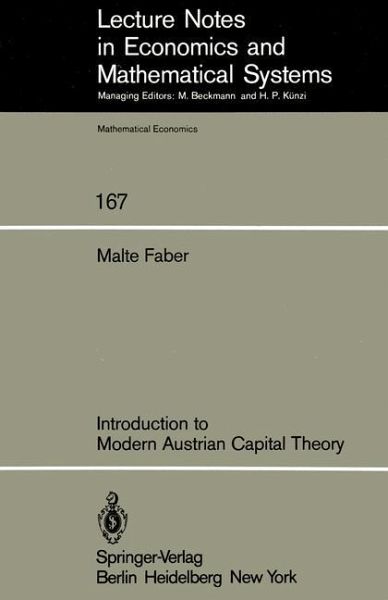
Lecture Notes in Economics and Mathematical Systems 167
Malte Faber, Professor Emeritus of Economics at the Heidelberg University. He received his doctorate from the Technical University of Berlin in 1969 and habilitated there in 1973. From 1974 to 2004 he held a chair in economic theory at the Heidelberg University, where he was director of the Alfred Weber Institute and from 1997-2004 director of the Interdisciplinary Institute for Environmental Economics. He has been Professor Emeritus since 2004 and teaches seminars on environmental problems and economic philosophy at German and international universities. From 1981 to 2017, he was an advisor to the German government, the US Environmental Protection Agency and the People's Republic of China. Since 1998, he has been giving courses and lectures on "Zen meditation and Christian contemplation" at the Heidelberg University and other locations. Reiner Manstetten, Lecturer in philosophy at the Heidelberg University and teacher of Christian contemplation. 1992 doctorate in philosophy on Meister Eckhart, 1997 habilitation in economics on the picture of humankind in economics, 2003 Ernst Bloch Prize of the City of Ludwigshafen. Publications on philosophical mysticism as well as on ecological economics and the foundations of economics, often in cooperation with Malte Faber. 2018 monograph: Die dunkle Seite der Wirtschaft (Alber Verlag). Marco Rudolf, Academic Assistant at Pforzheim University of Applied Sciences, doctoral student at the Karlsruhe Institute of Technology (KIT). After studying mathematics in Heidelberg and completing a master's degree in resource governance in Chile, he has been researching hydrogen in the energy transition and corporate carbon accounting since 2020. For him, transformation to a sustainable society means not only technical change, but also social change. In addition to his scientific work, he is involved in various youth organizations and organizes vacation camps for adults, where thefocus is on communal group experiences in an environment characterized by sustainable consumption and proximity to nature. Marc Frick, Academic Associate in the General Secretariat of the University of Basel. 2020 PhD in Political Theory on social-theoretical implications of gift practices. Publications on ecological economics in cooperation with Malte Faber and Reiner Manstetten as well as on social and ethical aspects of environmental and climate policy. Since 2015, he has been the honorary chairman of an amateur sports club, which has significantly shaped his view of social cohesion and the interaction of very different people to solve social challenges. Mi-Yong Becker, Professor of Sustainability with an Economic Focus at Bochum University of Applied Sciences. 2004 Doctorate in economics at the Heidelberg University. From 2004 to 2007, post-doctoral fellow of the DFG at the Research Training Group "Global Challenges" at the University of Tübingen. Subsequently research associate at the Helmholtz Center for Environmental Research until 2019, most recently as head of the "Governance and Innovation" working group. Winner of the German Environmental Award of the DBU 2018 together with M. Hirschfeld, R. Müller and M. v. Afferden for the development and political implementation of a decentralized wastewater system solution in Jordan. Professor at Bochum University of Applied Sciences since 2019 and member of the Executive Board as Vice President for Sustainability, Transfer & Entrepreneurship since 2022.
Inhaltsangabe
I: Austrian Capital Theory and the von Neumann-Model.- 1. Introduction.- 2. The Austrian Theory of Interest.- 3. The von Neumann-Model and its Relations to Austrian Capital and Interest Theory.- II: Modern Austrian Capital Theory.- 4. A Two-Period Two-Sector Neo-Austrian Model.- 5. A Multiperiod Two-Sector Model.- 6. A Multisector Model.- 7. The Schumpeter-von Böhm-Bawerk Controversy on the Rate of Interest in the Stationary State.- III: Relationship to other Approaches to Capital Theory.- 8. A Comparison with Results of Neoclassical Capital and Growth Theory.- 9. Hicks' Neo-Austrian Theory of Capital.- References.- Author Index.
I: Austrian Capital Theory and the von Neumann-Model.- 1. Introduction.- 2. The Austrian Theory of Interest.- 3. The von Neumann-Model and its Relations to Austrian Capital and Interest Theory.- II: Modern Austrian Capital Theory.- 4. A Two-Period Two-Sector Neo-Austrian Model.- 5. A Multiperiod Two-Sector Model.- 6. A Multisector Model.- 7. The Schumpeter-von Böhm-Bawerk Controversy on the Rate of Interest in the Stationary State.- III: Relationship to other Approaches to Capital Theory.- 8. A Comparison with Results of Neoclassical Capital and Growth Theory.- 9. Hicks' Neo-Austrian Theory of Capital.- References.- Author Index.
Es gelten unsere Allgemeinen Geschäftsbedingungen: www.buecher.de/agb
Impressum
www.buecher.de ist ein Internetauftritt der buecher.de internetstores GmbH
Geschäftsführung: Monica Sawhney | Roland Kölbl | Günter Hilger
Sitz der Gesellschaft: Batheyer Straße 115 - 117, 58099 Hagen
Postanschrift: Bürgermeister-Wegele-Str. 12, 86167 Augsburg
Amtsgericht Hagen HRB 13257
Steuernummer: 321/5800/1497
USt-IdNr: DE450055826