
Andere Kunden interessierten sich auch für
 Introduction to Supply Chain Resilience75,99 €
 Stochastic Programming in Supply Chain Risk Management121,99 €
 Stochastic Programming in Supply Chain Risk Management123,99 €
 Enterprise Risk Management Models65,99 €
 Enterprise Risk Management Models91,99 €
 Supply Chain Resilience136,99 €
 Supply Chain Resilience138,99 €
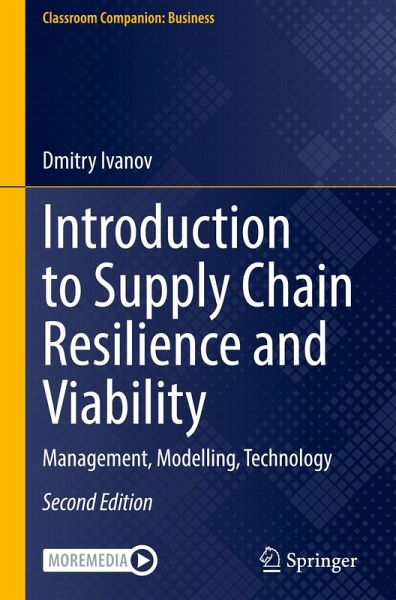
This book offers a concise yet comprehensive introduction to supply chain resilience, covering management, modeling and technology perspectives. Designed to accompany the textbook Global Supply Chain and Operations Management it addresses the topics of supply chain resilience and viability in more depth, describing the major principles and explaining methodologies to mitigate supply chain disruptions and recover. Numerous practical examples and short case studies are provided to illustrate theoretical concepts. Without relying heavily on mathematical derivations, the book explains major concepts and methods to build and improve supply chain resilience and tackle supply chain disruptions in a simple, uniform format to make it easy to understand for students and professionals with both management and engineering backgrounds.
In the second edition, existing chapters and their associated references have been updated to incorporate more recent industry examples and publications. Additionally, new topics have been introduced, including supply chain stress testing, resilience assessment, the adaptation-based view of resilience, critical node identification, and immune system-based resilience modeling.
Graduate/PhD students and supply chain professionals alike will benefit from the structured, didactically oriented and concise presentation of the concepts, principles and methods of supply chain resilience management, modeling, and technological implementation.
In the second edition, existing chapters and their associated references have been updated to incorporate more recent industry examples and publications. Additionally, new topics have been introduced, including supply chain stress testing, resilience assessment, the adaptation-based view of resilience, critical node identification, and immune system-based resilience modeling.
Graduate/PhD students and supply chain professionals alike will benefit from the structured, didactically oriented and concise presentation of the concepts, principles and methods of supply chain resilience management, modeling, and technological implementation.