George Engelhard, Jr. is a professor of educational measurement and policy in the Division of Educational Studies at Emory University. Professor Engelhard received his Ph.D. from The University of Chicago in the MESA (measurement, evaluation, and statistical analysis) program. Professor Engelhard is co-editor of four books, and the author or co-author of over 125 journal articles, book chapters, and monographs. He serves on national technical advisory committees on educational measurement and policy for several states including Georgia, Louisiana, Michigan, New Jersey, Ohio, Pennsylvania, and Washington. He is a past president of the Georgia Educational Research Association. Professor Engelhard has received numerous awards and fellowships including a National Academy of Education/Spencer Foundation Fellowship Award, a Lilly Post-Doctoral Teaching Award, and a Writing Across the Curriculum Project Award. He is a fellow of the American Educational Research Association.
Inhaltsangabe
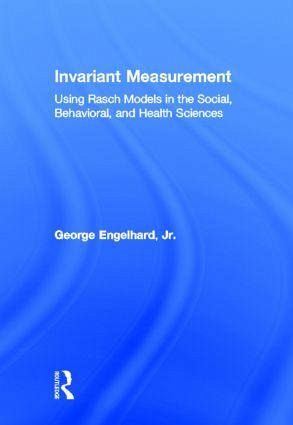
Part I. Introduction 1. Introduction and overview. Part II. Conceptual and theoretical issues. 2. Invariant measurement. 3. Rasch models. 4. Researcher-Constructed Measures. 5. An Historical and Comparative Perspective on Research Traditions in Measurement. 6. The Quest for Invariant Measurement within the Scaling Tradition. Part III. Technical Issues. 7. Methods of Estimation for the Dichotomous Rasch Model. 8. Model-Data Fit for the Dichotomous Rasch Model. Part IV: Assessments with raters: Rater-invariant measurement. 9. Rater-mediated assessments: Conceptual framework. 10. Evaluating the quality of rater-mediated assessments I: Indices of rater errors and systematic biases. 11. Evaluating the quality of rater-mediated assessments II: Indices of rater accuracy. Part V: Final Word.
Part I. Introduction 1. Introduction and overview. Part II. Conceptual and theoretical issues. 2. Invariant measurement. 3. Rasch models. 4. Researcher-Constructed Measures. 5. An Historical and Comparative Perspective on Research Traditions in Measurement. 6. The Quest for Invariant Measurement within the Scaling Tradition. Part III. Technical Issues. 7. Methods of Estimation for the Dichotomous Rasch Model. 8. Model-Data Fit for the Dichotomous Rasch Model. Part IV: Assessments with raters: Rater-invariant measurement. 9. Rater-mediated assessments: Conceptual framework. 10. Evaluating the quality of rater-mediated assessments I: Indices of rater errors and systematic biases. 11. Evaluating the quality of rater-mediated assessments II: Indices of rater accuracy. Part V: Final Word.
Es gelten unsere Allgemeinen Geschäftsbedingungen: www.buecher.de/agb
Impressum
www.buecher.de ist ein Internetauftritt der buecher.de internetstores GmbH
Geschäftsführung: Monica Sawhney | Roland Kölbl | Günter Hilger
Sitz der Gesellschaft: Batheyer Straße 115 - 117, 58099 Hagen
Postanschrift: Bürgermeister-Wegele-Str. 12, 86167 Augsburg
Amtsgericht Hagen HRB 13257
Steuernummer: 321/5800/1497
USt-IdNr: DE450055826