
Andere Kunden interessierten sich auch für
 Untersuchungen zu HHO- und DMM-Kraftstoffen im Dual-Fuel-Modus45,90 €
 Indagini sui carburanti HHO e DMM in modalità dual fuel30,99 €
 Investigaciones sobre los combustibles HHO y DMM en modo de combustible dual30,99 €
 Études sur les carburants HHO et DMM en mode bi-carburant30,99 €
 Issledowaniq topliwa HHO i DMM w dwuhtopliwnom rezhime30,99 €
 Investigações sobre combustíveis HHO e DMM em modo de combustível duplo30,99 €
 Studies on Biogas-Biodiesel fueled diesel engine under dual fuel mode30,99 €





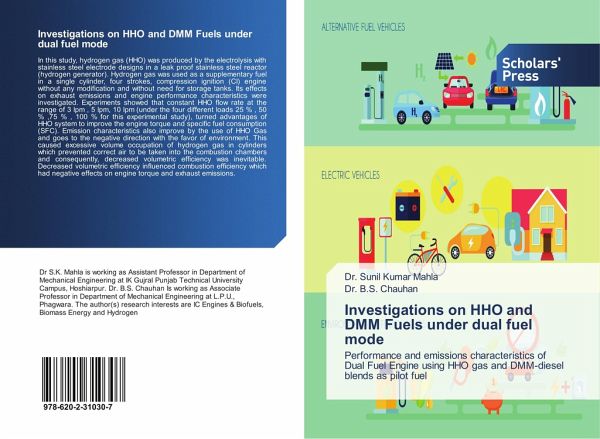
In this study, hydrogen gas (HHO) was produced by the electrolysis with stainless steel electrode designs in a leak proof stainless steel reactor (hydrogen generator). Hydrogen gas was used as a supplementary fuel in a single cylinder, four strokes, compression ignition (CI) engine without any modification and without need for storage tanks. Its effects on exhaust emissions and engine performance characteristics were investigated. Experiments showed that constant HHO flow rate at the range of 3 lpm , 5 lpm, 10 lpm (under the four different loads 25 % , 50 % ,75 % , 100 % for this experimental study), turned advantages of HHO system to improve the engine torque and specific fuel consumption (SFC). Emission characteristics also improve by the use of HHO Gas and goes to the negative direction with the favor of environment. This caused excessive volume occupation of hydrogen gas in cylinders which prevented correct air to be taken into the combustion chambers and consequently, decreased volumetric efficiency was inevitable. Decreased volumetric efficiency influenced combustion efficiency which had negative effects on engine torque and exhaust emissions.