Robert Schunk is Professor of Physics and the Director of the Center for Atmospheric and Space Sciences at Utah State University. He is also a co-founder and the President of Space Environment Corporation, a small high-tech company in Logan, Utah. He has over thirty-five years of experience in theory, numerical modeling, and data analysis in the general areas of plasma physics, fluid mechanics, kinetics, space physics, and planetary ionospheres and atmospheres. He has been a Principal Investigator on numerous NASA, NSF, Air Force and Navy grants and has chaired many national committees, international organizations and review panels. Professor Schunk received the D. Wynne Thorne Research Award from Utah State University in 1983, the Governor's Medal for Science and Technology from the State of Utah in 1988, gave the American Geophysical Union (AGU) Nicolet Lecture in 2002, is a Fellow of the AGU, and was inducted into the International Academy of Astronautics in 2006.
Inhaltsangabe
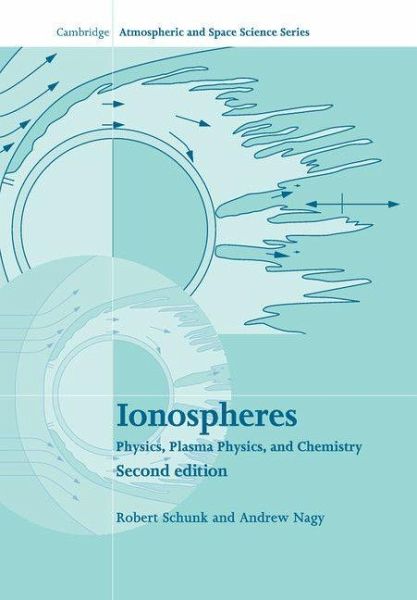
1. Introduction 2. Space environment 3. Transport equations 4. Collisions 5. Simplified transport equations 6. Wave phenomena 7. Magnetohydrodynamic formulation 8. Chemical processes 9. Ionization and energy exchange processes 10. Neutral atmospheres 11. The terrestrial ionosphere at middle and low latitudes 12. The terrestrial ionosphere at high latitudes 13. Planetary ionospheres 14. Ionospheric measurement techniques Appendix A. Physical constants and conversions Appendix B. Vector relations and operators Appendix C. Integrals and transformations Appendix D. Functions and series expansions Appendix E. System of units Appendix F. Maxwell transfer equations Appendix G. Collision models Appendix H. Maxwell velocity distribution Appendix I. Semilinear expressions for transport coefficients Appendix J. Solar fluxes and relevant cross sections Appendix K. Atmospheric models Appendix L. Scalars, vectors, dyadics and tensors Appendix M. Radio wave spectrum Appendix N. Simple derivation of continuity equation Appendix O. Numerical solution for F-region ionisation Index.
1. Introduction 2. Space environment 3. Transport equations 4. Collisions 5. Simplified transport equations 6. Wave phenomena 7. Magnetohydrodynamic formulation 8. Chemical processes 9. Ionization and energy exchange processes 10. Neutral atmospheres 11. The terrestrial ionosphere at middle and low latitudes 12. The terrestrial ionosphere at high latitudes 13. Planetary ionospheres 14. Ionospheric measurement techniques Appendix A. Physical constants and conversions Appendix B. Vector relations and operators Appendix C. Integrals and transformations Appendix D. Functions and series expansions Appendix E. System of units Appendix F. Maxwell transfer equations Appendix G. Collision models Appendix H. Maxwell velocity distribution Appendix I. Semilinear expressions for transport coefficients Appendix J. Solar fluxes and relevant cross sections Appendix K. Atmospheric models Appendix L. Scalars, vectors, dyadics and tensors Appendix M. Radio wave spectrum Appendix N. Simple derivation of continuity equation Appendix O. Numerical solution for F-region ionisation Index.
Es gelten unsere Allgemeinen Geschäftsbedingungen: www.buecher.de/agb
Impressum
www.buecher.de ist ein Internetauftritt der buecher.de internetstores GmbH
Geschäftsführung: Monica Sawhney | Roland Kölbl | Günter Hilger
Sitz der Gesellschaft: Batheyer Straße 115 - 117, 58099 Hagen
Postanschrift: Bürgermeister-Wegele-Str. 12, 86167 Augsburg
Amtsgericht Hagen HRB 13257
Steuernummer: 321/5800/1497
USt-IdNr: DE450055826