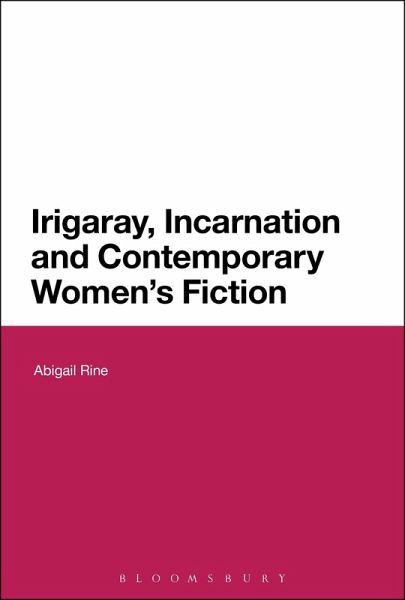
Drawing on the provocative recent work of feminist theorist Luce Irigaray, Irigaray, Incarnation and Contemporary Women's Fiction illuminates the vital and subversive role of literature in rewriting notions of the sacred. Abigail Rine demonstrates through careful readings how a range of contemporary women writers - from Margaret Atwood to Michèle Roberts and Alice Walker - think beyond traditional religious discourse and masculine models of subjectivity towards a new model of the sacred: one that seeks to reconcile the schism between the human and the divine, between the body and the word.…mehr
Drawing on the provocative recent work of feminist theorist Luce Irigaray, Irigaray, Incarnation and Contemporary Women's Fiction illuminates the vital and subversive role of literature in rewriting notions of the sacred. Abigail Rine demonstrates through careful readings how a range of contemporary women writers - from Margaret Atwood to Michèle Roberts and Alice Walker - think beyond traditional religious discourse and masculine models of subjectivity towards a new model of the sacred: one that seeks to reconcile the schism between the human and the divine, between the body and the word. Along the way, the book argues that literature is the ideal space for rethinking religion, precisely because it is a realm that cultivates imagination, mystery and incarnation.
Abigail Rine is Assistant Professor of English at George Fox University, USA.
Inhaltsangabe
Introduction 1. Refiguring the Sacred: Feminist Religious Revision 1.1 Women's Religious Revision: Critical Perspectives 1.2 Where Literature, Religion, and Feminism Meet 2. Becoming Incarnate: Luce Irigaray on Religion 2.1 Luce Irigaray and the Divine 2.2 Luce Irigaray and Incarnation 2.3 Literature as Incarnated Writing 3. 'In Love With Either/Or': Religion and Oppositional Logic in Margaret Atwood's The Handmaid's Tale 3.1 Opposites that Tear the World Apart 3.2 Bodies and Word(s) 3.3 Chaste Vessels and Unholy Harlots 3.4 The Gilead Within 4. 'Where God Begins': The Female Body and the Divine Word in Michèle Roberts' The Book Of Mrs Noah and Impossible Saints 4.1 'The Word that Structures Difference' 4.2 Subjecting the Flesh 4.3 Self-Incarnation 4.4 Rejection, Revision, Renewal 5. 'Your Father Who is Tender Like a Furnace': Divinity, Violence and Female Masochism in A.L. Kennedy's Original Bliss 5.1 Helen and the Apple 5.2 'How do I pleasure?' 5.3 The 'Palpable Gift' of God's Judgment 5.4 Coming to Our Senses 6. 'Sucked into the Black Cloth': Religion, Race and Sexual Shame in Alice Walker's By The Light of My Father's Smile 6.1 Religion as an Imperialist Force 6.2 The Wound of Sexual Shame 6.3 Walker's Womanist Spirit 6.4 The Lie that Unravelled the World Bibliography Index
Es gelten unsere Allgemeinen Geschäftsbedingungen: www.buecher.de/agb
Impressum
www.buecher.de ist ein Internetauftritt der buecher.de internetstores GmbH
Geschäftsführung: Monica Sawhney | Roland Kölbl | Günter Hilger
Sitz der Gesellschaft: Batheyer Straße 115 - 117, 58099 Hagen
Postanschrift: Bürgermeister-Wegele-Str. 12, 86167 Augsburg
Amtsgericht Hagen HRB 13257
Steuernummer: 321/5800/1497
USt-IdNr: DE450055826