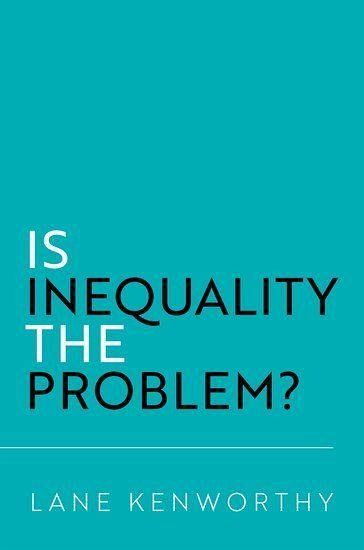
A data-rich analysis that will reshape our understanding of how rising income inequality has actually affected societies in the industrialized world. Increasing economic inequality is now one of the most studied subjects in the social sciences. The general view is that while its increase represents a bad social outcome in and of itself, its negative impact extends into numerous other realms of social life: declines in living standards for those in the lower deciles of the income ladder, worse health outcomes, reductions in happiness, and less opportunity for most. In Is Inequality the…mehr
A data-rich analysis that will reshape our understanding of how rising income inequality has actually affected societies in the industrialized world. Increasing economic inequality is now one of the most studied subjects in the social sciences. The general view is that while its increase represents a bad social outcome in and of itself, its negative impact extends into numerous other realms of social life: declines in living standards for those in the lower deciles of the income ladder, worse health outcomes, reductions in happiness, and less opportunity for most. In Is Inequality the Problem?, Lane Kenworthy draws from a vast trove of research on the rich democracies to argue that while inequality is normatively a problem and we should therefore work to reduce it, the evidence from wealthier countries does not show that income inequality has contributed much at all to the other social ills it is associated with, like poor health outcomes. The effects vary from society to society, but typically the key contributors to negative trends like this one are factors other than inequality. Instead of trying to improve living standards, democracy, opportunity, health, and happiness indirectly via reduction in income inequality or wealth inequality, policy makers are more likely to make progress by pursuing these goals directly. This contrarian yet balanced account of one of the main social problems of our era will reshape our understanding of how rising economic inequality has affected societies in the industrialized world.
Lane Kenworthy is Distinguished Professor of Sociology and Yankelovich Chair in Social Thought at the University of California-San Diego. He studies the causes and consequences of living standards, capabilities, poverty, inequality, mobility, employment, economic growth, social policy, taxes, public opinion, politics, and more in the United States and other rich longstanding-democratic countries. He is also the author of The Good Society, Would Democratic Socialism Be Better? (Oxford, 2022), Social Democratic Capitalism (Oxford, 2020), How Big Should Our Government Be? (2016), Social Democratic America (Oxford, 2014), Progress for the Poor (Oxford, 2011), Jobs with Equality (Oxford, 2008), Egalitarian Capitalism (2004), and In Search of National Economic Success (1995). His essays and shorter pieces have appeared at Foreign Affairs, the Washington Post, The Guardian, Boston Review, Consider the Evidence (his blog), and elsewhere.
Inhaltsangabe
* Chapter 1: Inequality Isn't the Problem * Chapter 2: Is Income Inequality Bad for Living Standards? * Chapter 3: Does Income Inequality Degrade Democracy? * Chapter 4: Does Income Inequality Obstruct Opportunity? * Chapter 5: Does Income Inequality Lessen Longevity? * Chapter 6: Does Income Inequality Hinder Happiness? * Chapter 7: Is Income Inequality Harmful? * Chapter 8: People Want Less Inequality, But It's Not a Priority for Them * Chapter 9: Inequality Reduction in Rich Nations May Impede Reduction of Worldwide Inequality * Chapter 10: What About Wealth? * Chapter 11: Inequality Reduction Should Be a Secondary Goal * Chapter 12: How to Reduce Inequality * Acknowledgments * Appendix * Notes * References * Index
* Chapter 1: Inequality Isn't the Problem * Chapter 2: Is Income Inequality Bad for Living Standards? * Chapter 3: Does Income Inequality Degrade Democracy? * Chapter 4: Does Income Inequality Obstruct Opportunity? * Chapter 5: Does Income Inequality Lessen Longevity? * Chapter 6: Does Income Inequality Hinder Happiness? * Chapter 7: Is Income Inequality Harmful? * Chapter 8: People Want Less Inequality, But It's Not a Priority for Them * Chapter 9: Inequality Reduction in Rich Nations May Impede Reduction of Worldwide Inequality * Chapter 10: What About Wealth? * Chapter 11: Inequality Reduction Should Be a Secondary Goal * Chapter 12: How to Reduce Inequality * Acknowledgments * Appendix * Notes * References * Index
Es gelten unsere Allgemeinen Geschäftsbedingungen: www.buecher.de/agb
Impressum
www.buecher.de ist ein Internetauftritt der buecher.de internetstores GmbH
Geschäftsführung: Monica Sawhney | Roland Kölbl | Günter Hilger
Sitz der Gesellschaft: Batheyer Straße 115 - 117, 58099 Hagen
Postanschrift: Bürgermeister-Wegele-Str. 12, 86167 Augsburg
Amtsgericht Hagen HRB 13257
Steuernummer: 321/5800/1497
USt-IdNr: DE450055826