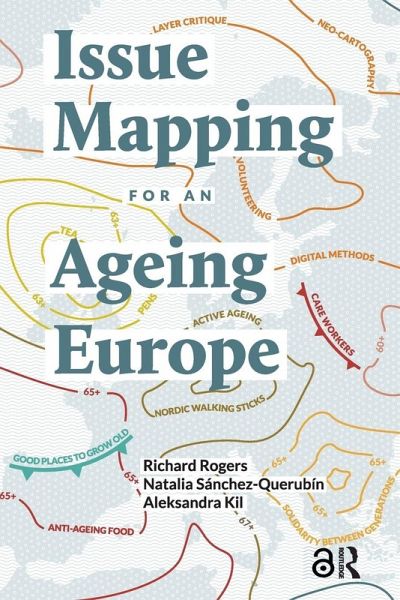
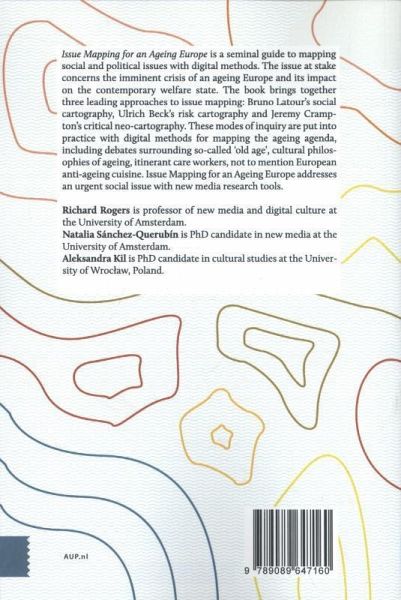
By employing websites of nongovernmental organizations, search engine queries identifying cultural philosophies about aging, and more, the contributors to this volume define the agenda for aging issues throughout Europe.
By employing websites of nongovernmental organizations, search engine queries identifying cultural philosophies about aging, and more, the contributors to this volume define the agenda for aging issues throughout Europe.
Richard Rogers, PhD, is Professor of New Media and Digital Culture, Media Studies, University of Amsterdam, and Director of the Digital Methods Initiative. He is author of Information Politics on the Web and Digital Methods (both MIT Press) and Doing Digital Methods (SAGE). Natalia Sánchez Querubín is PhD candidate in New Media at the University of Amsterdam. Aleksandra Kil is PhD candidate in Cultural Studies and member of the Soundscape Research Studio as well as the Laboratory for the Contemporary Humanities at the University of Wroclaw, Poland.
Inhaltsangabe
Acknowledgements. 1 Introduction: Issue mapping, ageing, and digital methods. 1.1 Issue mapping. 1.2 The ageing issue and its place in Europe. 1.3 Mapping theory: Social cartography, risk cartography, and critical neo-cartography. 1.4 Digital methods for issue mapping: New formats, data, and traceability. 1.5 Digital methods and the visualizations employed in the mappings. 2 A social cartography of ageing. 2.1 Ageing as a social issue. 2.2 How to trace associations: Operationalizing social cartography using digital methods. 2.3 Ageing as a European issue? The EU initiatives and local agendas. 2.4 Polish ageing NGOs, issue formats, and the local variation on Europeanization. 2.5 Which issue formats lend themselves to domestic debates on pension reform? The cases of U.K. and Poland. 2.6 Tea and pens as ?cosmos-objects? in the British public sector pension reform debate. 2.7 Staging the pension reform controversy in Poland. Which formats could empower action? 3 A risk cartography of ageing. 3.1 AGE U.K.?s hyperlinking behaviour. 3.2 Care worker migration as ageing issue (in the U.K. and beyond) and the quest for the cosmopolitan moment. 3.3 Migration of healthcare and social care workers and the impacts on victim states. 3.4 Care worker migration to the U.K.: A risk cartography. 4 A critical cartography of ageing. 4.1 Critical cartography and mapmaking. 4.2 Practicing critical mapmaking. 4.3 Neo-cartography and digital methods: The mash-up and the layer. 4.4 Issue layer I: The Polish care worker migration layer. 4.5 Issue layer II: Ageing issue centres and peripheries - NGOs, events, and sources of authority. 4.6 Issue layer III: Cross-cultural analysis of ageing issues. 4.7 Ageing resources map. 4.8 Ageing well according to European local Google domains: Ageing tips and an anti-ageing shopping list. 5 Conclusions: Mapping for an ageing Europe. 5.1 Producing social cartographies of ageing: The EUropeanization of ageing? 5.2 Producing risk cartographies of ageing: Winner and loser places. 5.3 Producing critical neo-cartographies of ageing: Issue layers and resource maps. 6 Glossary of tools used. 7. References. 8. Notes.
Acknowledgements. 1 Introduction: Issue mapping, ageing, and digital methods. 1.1 Issue mapping. 1.2 The ageing issue and its place in Europe. 1.3 Mapping theory: Social cartography, risk cartography, and critical neo-cartography. 1.4 Digital methods for issue mapping: New formats, data, and traceability. 1.5 Digital methods and the visualizations employed in the mappings. 2 A social cartography of ageing. 2.1 Ageing as a social issue. 2.2 How to trace associations: Operationalizing social cartography using digital methods. 2.3 Ageing as a European issue? The EU initiatives and local agendas. 2.4 Polish ageing NGOs, issue formats, and the local variation on Europeanization. 2.5 Which issue formats lend themselves to domestic debates on pension reform? The cases of U.K. and Poland. 2.6 Tea and pens as ?cosmos-objects? in the British public sector pension reform debate. 2.7 Staging the pension reform controversy in Poland. Which formats could empower action? 3 A risk cartography of ageing. 3.1 AGE U.K.?s hyperlinking behaviour. 3.2 Care worker migration as ageing issue (in the U.K. and beyond) and the quest for the cosmopolitan moment. 3.3 Migration of healthcare and social care workers and the impacts on victim states. 3.4 Care worker migration to the U.K.: A risk cartography. 4 A critical cartography of ageing. 4.1 Critical cartography and mapmaking. 4.2 Practicing critical mapmaking. 4.3 Neo-cartography and digital methods: The mash-up and the layer. 4.4 Issue layer I: The Polish care worker migration layer. 4.5 Issue layer II: Ageing issue centres and peripheries - NGOs, events, and sources of authority. 4.6 Issue layer III: Cross-cultural analysis of ageing issues. 4.7 Ageing resources map. 4.8 Ageing well according to European local Google domains: Ageing tips and an anti-ageing shopping list. 5 Conclusions: Mapping for an ageing Europe. 5.1 Producing social cartographies of ageing: The EUropeanization of ageing? 5.2 Producing risk cartographies of ageing: Winner and loser places. 5.3 Producing critical neo-cartographies of ageing: Issue layers and resource maps. 6 Glossary of tools used. 7. References. 8. Notes.
Es gelten unsere Allgemeinen Geschäftsbedingungen: www.buecher.de/agb
Impressum
www.buecher.de ist ein Internetauftritt der buecher.de internetstores GmbH
Geschäftsführung: Monica Sawhney | Roland Kölbl | Günter Hilger
Sitz der Gesellschaft: Batheyer Straße 115 - 117, 58099 Hagen
Postanschrift: Bürgermeister-Wegele-Str. 12, 86167 Augsburg
Amtsgericht Hagen HRB 13257
Steuernummer: 321/5800/1497
USt-IdNr: DE450055826