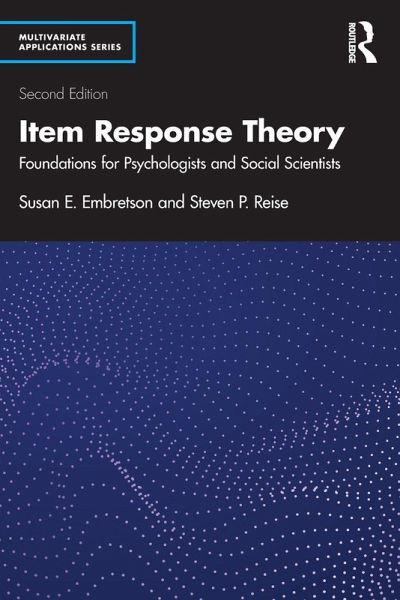
This book provides an intuitive and accessible introduction to item response theory (IRT), making complex psychometric concepts easier to grasp through graphical displays and familiar analogies.
This book provides an intuitive and accessible introduction to item response theory (IRT), making complex psychometric concepts easier to grasp through graphical displays and familiar analogies.
Susan E. Embretson is Professor Emeritus at both the University of Kansas and the Georgia Institute of Technology in the USA. She received her Ph.D. from the University of Minnesota. Her primary interest includes developing and applying item response theory (IRT) models for the response processes used by examinees to solve aptitude items. Steven P. Reise received his Ph.D. from the Department of Psychology at the University of Minnesota in 1990. Currently, he is Professor of Quantitative Psychology at UCLA. His research explores the application of item response theory (IRT) models to personality, psychopathology, and health outcome measures. In recent years, his interests have centered on bifactor modeling and projective IRT models.
Inhaltsangabe
Section I. Introduction 1. Background and History 2. Advantages of Item Response Theory 3. Item Response Theory as Model-Based Measurement Section II. Basic Item Response Theory Models 4. Binary Item Response Theory Models 5. Polytomous Item Response Theory Models Section III. Estimating Item Parameters and Scoring Persons 6. Measuring Persons 7. Estimating Item Parameters 8. Testing Assumptions and Assessing Fit Section IV. Applications of Item Response Theory Models in Test Development and Assessment 9. Properties of Item Response Theory Scales 10. Differential Item Functioning, Computerized Adaptive Testing and Scale Analysis 11. An Overview of Item Response Theory-Related Computer Software Section V. Advanced Item Response Theory Models 12. Multidimensional Item Response Theory Models 13. Explanatory, Mixture and Other Advanced Item Response Theory Models
Section I. Introduction 1. Background and History 2. Advantages of Item Response Theory 3. Item Response Theory as Model-Based Measurement Section II. Basic Item Response Theory Models 4. Binary Item Response Theory Models 5. Polytomous Item Response Theory Models Section III. Estimating Item Parameters and Scoring Persons 6. Measuring Persons 7. Estimating Item Parameters 8. Testing Assumptions and Assessing Fit Section IV. Applications of Item Response Theory Models in Test Development and Assessment 9. Properties of Item Response Theory Scales 10. Differential Item Functioning, Computerized Adaptive Testing and Scale Analysis 11. An Overview of Item Response Theory-Related Computer Software Section V. Advanced Item Response Theory Models 12. Multidimensional Item Response Theory Models 13. Explanatory, Mixture and Other Advanced Item Response Theory Models
Es gelten unsere Allgemeinen Geschäftsbedingungen: www.buecher.de/agb
Impressum
www.buecher.de ist ein Internetauftritt der buecher.de internetstores GmbH
Geschäftsführung: Monica Sawhney | Roland Kölbl | Günter Hilger
Sitz der Gesellschaft: Batheyer Straße 115 - 117, 58099 Hagen
Postanschrift: Bürgermeister-Wegele-Str. 12, 86167 Augsburg
Amtsgericht Hagen HRB 13257
Steuernummer: 321/5800/1497
USt-IdNr: DE450055826