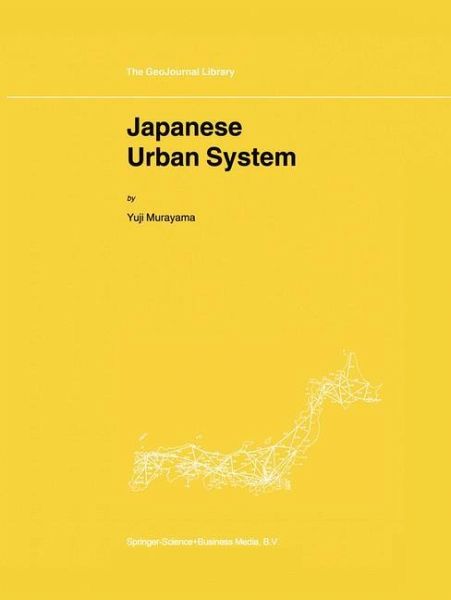
This book is an attempt to explain Japanese regional structure and associated dynamism in terms of urban systems. It is extremely effective to use the urban systems approach to explain the regional changes in today's Japan, which is undergoing changes wrought by economic globalization and the information revolution. This is because the transformation into a service economy has become the key component of the economic activities of cities, linkages are being mutually strengthened, and regional development is being determined by the interdependency of cities. Readers hoping to gain an…mehr
This book is an attempt to explain Japanese regional structure and associated dynamism in terms of urban systems. It is extremely effective to use the urban systems approach to explain the regional changes in today's Japan, which is undergoing changes wrought by economic globalization and the information revolution. This is because the transformation into a service economy has become the key component of the economic activities of cities, linkages are being mutually strengthened, and regional development is being determined by the interdependency of cities. Readers hoping to gain an understanding of the regional geography of Japan may feel that the structure and content of this book are lacking something. However, it is not the intention of this book to systematically paint a total geographical image of Japan within the context of East Asia. Instead, by focusing on urban systems theory, it might be possible to theorize about the factors related to the changing geography of Japan,suchas the growth and decline processes of Japanese urban systems, the strengthening of ties among cities and associated factors, and the expansion of socioeconomic exchanges with cities overseas, from a perspective that is different from the conventional approach.
Ko Ko Lwin is a researcher, geospatial analyst, and educator in geobig data processing, urban transport geography, remote sensing, and GIS. He obtained his Ph.D. at the Graduate School of Life and Environmental Sciences, University of Tsukuba, and his Master of Engineering degree at the Civil Engineering Department, University of Tokyo. He obtained his Bachelor of Honors degree in geology at Yangon University. He is a formal project assistant professor at the University of Tokyo; a senior visiting researcher at the National Institute of Information and Communications Technology; and a researcher at the University of Tsukuba. He carried out an international academic joint research project related to geobig data processing and applications in urban transport planning along with other government-funded research projects. He also completed many development projects in Japanese geospatial industries. Yuji Murayama is a professor emeritus at the University of Tsukuba, Japan. He has served as the representative director of Tokyo Geographical Society (2023-present), vice-president of Asian Geographical Association (2019-present), President (2018-20), chairperson (2016-18), and director (2010-14) of the Association of Japanese Geographers, member of Science Council of Japan (2005-2020), and president of GIS Association of Japan (2006-08). He was awarded IGU Lauréat d'Honneur in 2022. His research interests include urban and transport geography, geographical information science, and spatial analysis.
Inhaltsangabe
Overview.- 1 Study of Urban Systems: Outcomes and Issues.- 2 Diffusion of Innovation.- 3 Development Process of the East Asian Urban System.- 4 Regional Structure of the Information Flow.- 5 Regional Structure of the Commodity Flow.- 6 Accessibility Change in the Japanese Urban System.- 7 Spatial Dynamics of Migration in the Japanese Urban System.- 8 Population Movement.- 9 Commercial Activities in a Small City.- 10 Migration Chain in a Medium City.- 11 Land Use Change in Tokyo.- 12 Tokyo and Paris: Comparison of Urban Spatial Structure.- 13 Changing Japanese Urban System.
Overview.- 1 Study of Urban Systems: Outcomes and Issues.- 2 Diffusion of Innovation.- 3 Development Process of the East Asian Urban System.- 4 Regional Structure of the Information Flow.- 5 Regional Structure of the Commodity Flow.- 6 Accessibility Change in the Japanese Urban System.- 7 Spatial Dynamics of Migration in the Japanese Urban System.- 8 Population Movement.- 9 Commercial Activities in a Small City.- 10 Migration Chain in a Medium City.- 11 Land Use Change in Tokyo.- 12 Tokyo and Paris: Comparison of Urban Spatial Structure.- 13 Changing Japanese Urban System.
Es gelten unsere Allgemeinen Geschäftsbedingungen: www.buecher.de/agb
Impressum
www.buecher.de ist ein Internetauftritt der buecher.de internetstores GmbH
Geschäftsführung: Monica Sawhney | Roland Kölbl | Günter Hilger
Sitz der Gesellschaft: Batheyer Straße 115 - 117, 58099 Hagen
Postanschrift: Bürgermeister-Wegele-Str. 12, 86167 Augsburg
Amtsgericht Hagen HRB 13257
Steuernummer: 321/5800/1497
USt-IdNr: DE450055826