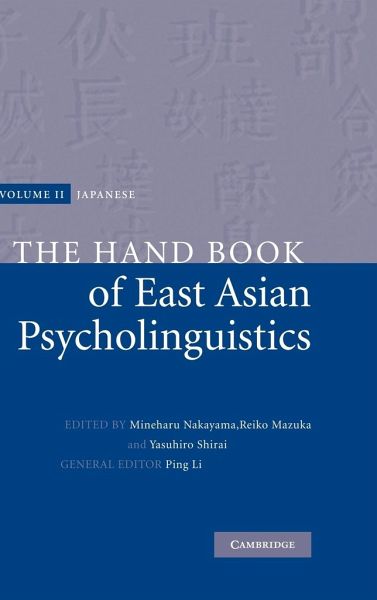
A large body of knowledge has accumulated in recent years on the cognitive processes and brain mechanisms underlying language. Much of this knowledge has come from studies of Indo-European languages, in particular English. Japanese, a language of growing interest to linguists, differs significantly from most Indo-European languages in its grammar, its lexicon, and its written and spoken forms - features which have profound implications for the learning, representation and processing of language. This handbook, the second in a three-volume series on East Asian psycholinguistics, presents a…mehr
A large body of knowledge has accumulated in recent years on the cognitive processes and brain mechanisms underlying language. Much of this knowledge has come from studies of Indo-European languages, in particular English. Japanese, a language of growing interest to linguists, differs significantly from most Indo-European languages in its grammar, its lexicon, and its written and spoken forms - features which have profound implications for the learning, representation and processing of language. This handbook, the second in a three-volume series on East Asian psycholinguistics, presents a state-of-the-art discussion of the psycholinguistic study of Japanese. With contributions by over fifty leading scholars, it covers topics in first and second language acquisition, language processing and reading, language disorders in children and adults, and the relationships between language, brain, culture, and cognition. It will be invaluable to all scholars and students interested in the Japanese language, as well as cognitive psychologists, linguists, and neuroscientists.
Ping Li is Associate Professor of Psychology at the University of Richmond. Mineharu Nakayama is Associate Professor in the Department of East Asian Languages and Literatures, The Ohio State University. Reiko Mazuka is Head of the Laboratory for Language Development at the RIKEN Brain Science Institute, Japan, and also Associate Professor in the Department of Psychology, Duke University. Yasuhiro Shirai is Professor of Linguistics in the Department of Linguistics at the University of Pittsburgh.
Inhaltsangabe
Part I. Language Acquisition: 1. Ontogeny of language Nubou Masataka 2. Caregiver's speech Toshiki Murase and Tamiko Ogura 3. The intrinsic linkage between gesture and speech in the prelinguistic stage Keiko Ejiri and Nobuko Uchida 4. Infant speech perception Akiko Hayashi 5. Phonological acquisition Mitsuhiko Ohta 6. Mechanism of lexical development: implications from Japanese children's word learning Mutsumi Imai 7. The acquisition of nouns and verbs in Japanese Yuriko Oshima-Takane 8. The acquisition of verbal nouns Yutaka Sato and Yoshi Yamashita 9. The acquisition of Japanese numeral classifiers Kasumi Yamamoto 10. The acquisition of case markers Hiromi Morikawa 11. The acquisition of tense and aspect Yasuhiro Shirai 12. On the origin of children's errors: the case of Japanese negation and direct passive Tetsuya Sano 13. Binding theory in UG and first language acquisition of Japanese Barbara Lust 14. The acquisition of the particles, 'ne', 'yo' and 'no' Haruko Minegishi Cook 15. The acquisition of linguistic politeness in Japanese Keiko Nakamura 16. Children's narrative structures Masahiko Minami 17. Memory talk and testimony in children Makiko Naka 18. Developmental dyslexia Jun Yamada 19. Japanese sign language Takashi Torigoe 20. The role of an innate acquisition device in second language acquisition Kazue Kanno 21. Japanese, the grammar of reflexives, and second language acquisition Margaret Thomas 22. Processes in L2 Japanese sentence production Noriko Iwasaki 23. Development of lexical competence among second-language readers Keiko Koda 24. Reading in Japanese as a second language Yukie Horiba 25. International code-switching in Japanese and English Miwa Nishimura Part II. Language Processing: 26. Phonetic and phonological organizations of speech in Japanese Haruo Kubozono 27. Speech segmentation by Japanese listeners: its language-specificity and language-universality Takashi Otake 28. Prosody in sentence processing Jennifer Venditti 29. Speech errors Yasushi Terao 30. Effects of word properties on Japanese sentence processing Tadahisa Kondo and Reiko Mazuka 31. Orthographic processing Hirofumi Saito 32. Lexical access Taeko Wydell 33. Incrementality in Japanese sentence processing Yuki Kamide 34. Processing alternative word orders Edson Miyamoto 35. Processing of relative clauses in Japanese: coping with multiple ambiguities Yuki Hirose 36. Processing of empty categories in Japanese Tsutomu Sakamoto 37. Difficulty of certain sentence constructions in comprehension Mineharu Nakayama, Shravan Vashisth and Richard L. Lewis 38. Reading and working memory Mariko Osaka 39. Sentence production in Japanese Hiroko Yamashita and Franklin Chang 40. Neural basis of syntactic processing in Japanese Hiroko Hagiwara 41. The competition model Yoshinori Sasaki and Brian McWhinney 42. Connectionist models Michiro Negishi 43. Computational linguistics Masayuki Asahara, Yasuharu Den and Yuji Matsumoto 44. Language and gesture as a single communicative system Nobuhiro Furuyama.
Part I. Language Acquisition: 1. Ontogeny of language Nubou Masataka 2. Caregiver's speech Toshiki Murase and Tamiko Ogura 3. The intrinsic linkage between gesture and speech in the prelinguistic stage Keiko Ejiri and Nobuko Uchida 4. Infant speech perception Akiko Hayashi 5. Phonological acquisition Mitsuhiko Ohta 6. Mechanism of lexical development: implications from Japanese children's word learning Mutsumi Imai 7. The acquisition of nouns and verbs in Japanese Yuriko Oshima-Takane 8. The acquisition of verbal nouns Yutaka Sato and Yoshi Yamashita 9. The acquisition of Japanese numeral classifiers Kasumi Yamamoto 10. The acquisition of case markers Hiromi Morikawa 11. The acquisition of tense and aspect Yasuhiro Shirai 12. On the origin of children's errors: the case of Japanese negation and direct passive Tetsuya Sano 13. Binding theory in UG and first language acquisition of Japanese Barbara Lust 14. The acquisition of the particles, 'ne', 'yo' and 'no' Haruko Minegishi Cook 15. The acquisition of linguistic politeness in Japanese Keiko Nakamura 16. Children's narrative structures Masahiko Minami 17. Memory talk and testimony in children Makiko Naka 18. Developmental dyslexia Jun Yamada 19. Japanese sign language Takashi Torigoe 20. The role of an innate acquisition device in second language acquisition Kazue Kanno 21. Japanese, the grammar of reflexives, and second language acquisition Margaret Thomas 22. Processes in L2 Japanese sentence production Noriko Iwasaki 23. Development of lexical competence among second-language readers Keiko Koda 24. Reading in Japanese as a second language Yukie Horiba 25. International code-switching in Japanese and English Miwa Nishimura Part II. Language Processing: 26. Phonetic and phonological organizations of speech in Japanese Haruo Kubozono 27. Speech segmentation by Japanese listeners: its language-specificity and language-universality Takashi Otake 28. Prosody in sentence processing Jennifer Venditti 29. Speech errors Yasushi Terao 30. Effects of word properties on Japanese sentence processing Tadahisa Kondo and Reiko Mazuka 31. Orthographic processing Hirofumi Saito 32. Lexical access Taeko Wydell 33. Incrementality in Japanese sentence processing Yuki Kamide 34. Processing alternative word orders Edson Miyamoto 35. Processing of relative clauses in Japanese: coping with multiple ambiguities Yuki Hirose 36. Processing of empty categories in Japanese Tsutomu Sakamoto 37. Difficulty of certain sentence constructions in comprehension Mineharu Nakayama, Shravan Vashisth and Richard L. Lewis 38. Reading and working memory Mariko Osaka 39. Sentence production in Japanese Hiroko Yamashita and Franklin Chang 40. Neural basis of syntactic processing in Japanese Hiroko Hagiwara 41. The competition model Yoshinori Sasaki and Brian McWhinney 42. Connectionist models Michiro Negishi 43. Computational linguistics Masayuki Asahara, Yasuharu Den and Yuji Matsumoto 44. Language and gesture as a single communicative system Nobuhiro Furuyama.
Es gelten unsere Allgemeinen Geschäftsbedingungen: www.buecher.de/agb
Impressum
www.buecher.de ist ein Internetauftritt der buecher.de internetstores GmbH
Geschäftsführung: Monica Sawhney | Roland Kölbl | Günter Hilger
Sitz der Gesellschaft: Batheyer Straße 115 - 117, 58099 Hagen
Postanschrift: Bürgermeister-Wegele-Str. 12, 86167 Augsburg
Amtsgericht Hagen HRB 13257
Steuernummer: 321/5800/1497
USt-IdNr: DE450055826