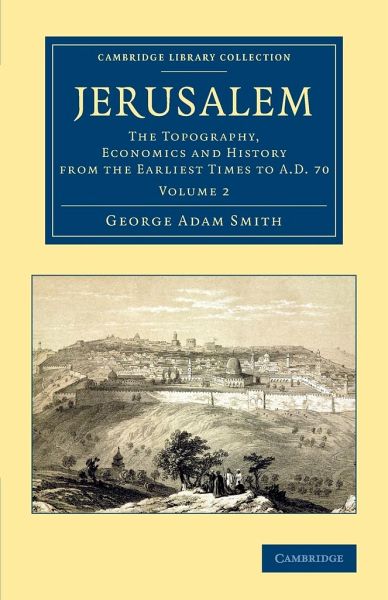
First published in two volumes between 1907 and 1908, this major work by the Scottish biblical scholar and geographer Sir George Adam Smith (1856-1942) is organised into three books. Volume 2 contains the third book and consists of a historical narrative that clarifies political and religious developments in ancient Jerusalem. It contains a number of useful maps, plans and photographs. Best known for his celebrated Historical Geography of the Holy Land (1894), Smith provides here a more detailed and specialist analysis, based on first-hand knowledge derived from the visits he made to the…mehr
First published in two volumes between 1907 and 1908, this major work by the Scottish biblical scholar and geographer Sir George Adam Smith (1856-1942) is organised into three books. Volume 2 contains the third book and consists of a historical narrative that clarifies political and religious developments in ancient Jerusalem. It contains a number of useful maps, plans and photographs. Best known for his celebrated Historical Geography of the Holy Land (1894), Smith provides here a more detailed and specialist analysis, based on first-hand knowledge derived from the visits he made to the region over the years. Spanning more than fourteen centuries of Jerusalem's history from 1400 BCE to 70 CE, these well-illustrated volumes remain a standard work of scholarship, expertly elucidating the changing shape of the city.
Sir George Adam Smith was a Scottish theologian. He was the Principal of the University of Aberdeen from 1909 to 1935 and a prominent figure in the United Free Church of Scotland. He was born in Calcutta, where his father, George Smith, C.I.E., was the principal of Doveton College, a boys' school in Madras. His mother's name was Janet Colquhoun Smith. By 1870, the family had returned to Scotland and resided at Scagore House in Seafield, Edinburgh. He was educated at Edinburgh's Royal High School. He subsequently went on to study Divinity at the University of Edinburgh and New College, graduating with an MA in 1875. In 1892, he was appointed Professor of Hebrew and Old Testament at the Free Church College, Glasgow. He transferred from the Free Church of Scotland to the United Free Church of Scotland in 1900, when it was founded. He was appointed Principal and Vice Chancellor of the University of Aberdeen in 1909 and served until his retirement in 1935. In 1916, he was chosen as a Fellow of the British Academy and knighted. He was Moderator of the General Assembly of the United Free Church of Scotland from 1916 to 1917. In 1917, he was made a Fellow of the Royal Society of Edinburgh. His proposers included John Horne, Cargill Gilston Knott, Ben Peach, and John Sutherland Black.
Inhaltsangabe
Prefatory note Table of the principal stages in the history Part III. The History: 1. The prelude 2. The conquest by David 3. Solomon and the temple 4. From Rehoboam to Ahaz 5. Isaiah's Jerusalem, from 740 onwards 6. Hezekiah and Sennacherib 7. Jerusalem under Manasseh 8. Josiah: Jerusalem and Deuteronomy 9. Jeremiah's Jerusalem 10. The desolate city 11. The ideal city and the real 12. The second temple, from Zechariah to Malachi 13. Ezra and Nehemiah 14. The rest of the Persian period 15. The Jew and the Greek 16. Jerusalem under the Maccabees and the Hasmoneans 17. Herod, the Romans and Jerusalem 18. Herod's castle and temple 19. The temple and the Lord 20. Jerusalem of the gospels Appendix General index Special indexes.
Prefatory note Table of the principal stages in the history Part III. The History: 1. The prelude 2. The conquest by David 3. Solomon and the temple 4. From Rehoboam to Ahaz 5. Isaiah's Jerusalem, from 740 onwards 6. Hezekiah and Sennacherib 7. Jerusalem under Manasseh 8. Josiah: Jerusalem and Deuteronomy 9. Jeremiah's Jerusalem 10. The desolate city 11. The ideal city and the real 12. The second temple, from Zechariah to Malachi 13. Ezra and Nehemiah 14. The rest of the Persian period 15. The Jew and the Greek 16. Jerusalem under the Maccabees and the Hasmoneans 17. Herod, the Romans and Jerusalem 18. Herod's castle and temple 19. The temple and the Lord 20. Jerusalem of the gospels Appendix General index Special indexes.
Es gelten unsere Allgemeinen Geschäftsbedingungen: www.buecher.de/agb
Impressum
www.buecher.de ist ein Internetauftritt der buecher.de internetstores GmbH
Geschäftsführung: Monica Sawhney | Roland Kölbl | Günter Hilger
Sitz der Gesellschaft: Batheyer Straße 115 - 117, 58099 Hagen
Postanschrift: Bürgermeister-Wegele-Str. 12, 86167 Augsburg
Amtsgericht Hagen HRB 13257
Steuernummer: 321/5800/1497
USt-IdNr: DE450055826