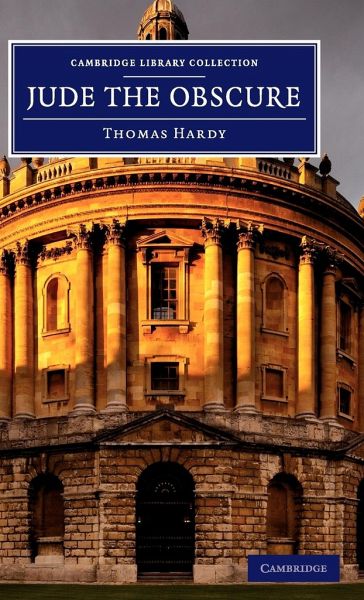
Thomas Hardy (1840-1928) wanted his last novel 'to deal unaffectedly with the fret and fever, derision and disaster, that may press in the wake of the strongest passion known to humanity, and to point, without a mincing of words, the tragedy of unfulfilled aims'. First published in its present form in 1895 (although post-dated 1896) after appearing as an abridged serial, the work was met with as much opprobrium as admiration. Critics wrote reviews entitled 'Jude the Obscene' and 'Hardy the Degenerate' because of the novel's explicit content and deliberate attacks on the education system and…mehr
Thomas Hardy (1840-1928) wanted his last novel 'to deal unaffectedly with the fret and fever, derision and disaster, that may press in the wake of the strongest passion known to humanity, and to point, without a mincing of words, the tragedy of unfulfilled aims'. First published in its present form in 1895 (although post-dated 1896) after appearing as an abridged serial, the work was met with as much opprobrium as admiration. Critics wrote reviews entitled 'Jude the Obscene' and 'Hardy the Degenerate' because of the novel's explicit content and deliberate attacks on the education system and marriage laws; even Hardy's wife took personal offence. Sparse and bleak, the story follows Jude Fawley, a promising self-taught scholar and village stonemason, as he navigates with increasing difficulty between the prejudices of the class system and two very different women: his wife, Arabella, and his ethereal, disturbed love, Sue Bridehead.
DESPERATE REMEDIES IS THE SECOND NOVEL BY THOMAS HARDY, ALBEIT THE FIRST TO BE PUBLISHED. IT WAS RELEASED ANONYMOUSLY BY TINSLEY BROTHERS IN 1871. Plot : Cytherea has taken a position as lady's maid to the eccentric arch-intriguer Miss Aldclyffe. On discovering that the man she loves, Edward Springrove, is already engaged to his cousin, Cytherea comes under the influence of Miss Aldclyffe's fascinating, manipulative steward Manston.Analysis : In Desperate Remedies a young woman, Cytherea Graye, is forced by poverty to accept a post as lady's maid to the eccentric Miss Aldclyffe, the woman whom her father had loved but had been unable to marry. Cytherea loves a young architect, Edward Springrove, but Miss Adclyffe's machinations, the discovery that Edward is already engaged to a woman whom he does not love, and the urgent need to support a sick brother drive Cytherea to accept the hand of Aeneas Manston, Miss Adclyffe's illegitimate son, whose first wife is believed to have perished in a fire however, their marriage is almost immediately nullified when it emerges that his first wife had left the inn before it caught fire. Manston's wife, apparently, returns to live with him, but Cytherea, her brother, the local rector, and Edward come to suspect that the woman claiming to be Mrs. Manston is an impostor. It emerges that Manston killed his wife in an argument after she left the inn, and had brought in the impostor to prevent his being prosecuted for murder, as the argument had been heard (but not seen) by a poacher, who suspected Manston of murder and had planned to go to the police if his wife did not turn up alive. In the novel's climax, Manston attempts to kidnap Cytherea and flee, but is stopped by Edward he later commits suicide in his cell, and Cytherea and Edward marry.Reviews : Blackmail, murder and romance are among the ingredients of Hardy's first published novel, and in it he draws blithely on the 'sensation novel' perfected by Wilkie Collins. Several perceptive critics praised the author as a novelist with a future when Desperate Remedies appeared anonymously in 1871.
Inhaltsangabe
Part First: at Marygreen, I XI; Part Second: at Christminster, I VII; Part Third: at Melchester, I X; Part Fourth: at Shaston, I VI; Part Fifth: at Aldbrickham and elsewhere, I VIII; Part Sixth: at Christminster again, I XI.
Part First: at Marygreen, I XI; Part Second: at Christminster, I VII; Part Third: at Melchester, I X; Part Fourth: at Shaston, I VI; Part Fifth: at Aldbrickham and elsewhere, I VIII; Part Sixth: at Christminster again, I XI.
Es gelten unsere Allgemeinen Geschäftsbedingungen: www.buecher.de/agb
Impressum
www.buecher.de ist ein Internetauftritt der buecher.de internetstores GmbH
Geschäftsführung: Monica Sawhney | Roland Kölbl | Günter Hilger
Sitz der Gesellschaft: Batheyer Straße 115 - 117, 58099 Hagen
Postanschrift: Bürgermeister-Wegele-Str. 12, 86167 Augsburg
Amtsgericht Hagen HRB 13257
Steuernummer: 321/5800/1497
USt-IdNr: DE450055826