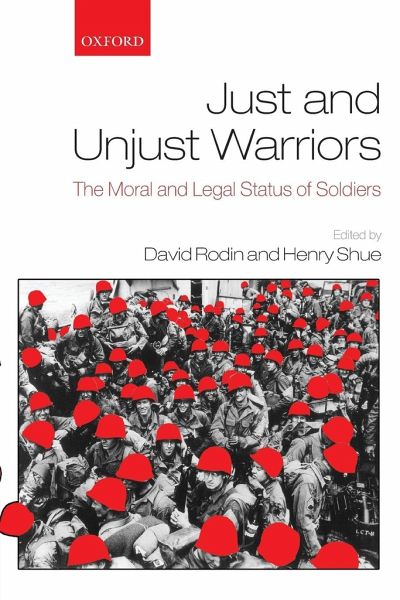
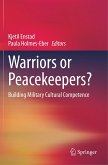
Can a soldier be held responsible for fighting in a war that is illegal or unjust? This is the question at the heart of a new debate that has the potential to profoundly change our understanding of the moral and legal status of warriors, wars, and indeed of moral agency itself. The debate pits a widely shared and legally entrenched principle of war-that combatants have equal rights and equal responsibilities irrespective of whether they are fi ghting in a war that is just or unjust-against a set of striking new arguments. These arguments challenge the idea that there is a separation between…mehr
Can a soldier be held responsible for fighting in a war that is illegal or unjust? This is the question at the heart of a new debate that has the potential to profoundly change our understanding of the moral and legal status of warriors, wars, and indeed of moral agency itself. The debate pits a widely shared and legally entrenched principle of war-that combatants have equal rights and equal responsibilities irrespective of whether they are fi ghting in a war that is just or unjust-against a set of striking new arguments. These arguments challenge the idea that there is a separation between the rules governing the justice of going to war (the jus ad bellum) and the rules governing what combatants can do in war (the jus in bello). If ad bellum and in bello rules are connected in the way these new arguments suggest, then many aspects of just war theory and laws of war would have to be rethought and perhaps reformed. This book contains eleven original and closely argued essays by leading figures in the ethics and laws of war and provides an authoritative treatment of this important new debate. The essays both challenge and defend many deeply held convictions: about the liability of soldiers for crimes of aggression, about the nature and justifi ability of terrorism, about the relationship between law and morality, the relationship between soldiers and states, and the relationship between the ethics of war and the ethics of ordinary life. This book is a project of the Oxford Leverhulme Programme on the Changing Character of War.
David Rodin is Research Fellow in Philosophy at the Changing Character of War Program, University of Oxford, and Senior Research Fellow at the Centre for Applied Philosophy and Public Ethics, the Australian National University. His research covers a wide range of topics in moral philosophy including the ethics of war and conflict, business ethics, and international justice. His is the author of War and Self-Defense (OUP 2002), which was awarded the American Philosophical Association Sharp Prize, and is co-editor of The Ethics of War: Shared Problems in Different Traditions (Ashgate, 2006), and of Preemption (OUP 2007). Henry Shue is Senior Research Fellow Emeritus at Merton College, Oxford; from 2002-2007 he was Professor of Politics and International Relations at the University of Oxford. Best known for Basic Rights (Princeton, 1980; 2nd Ed., 1996), he has written a number of highly influential articles including "Torture" (1978), "Exporting Hazards" (1981), "Mediating Duties" (1988), "Subsistence Emissions and Luxury Emissions" (1993), "War" (2003), and "Limiting Sovereignty" (2004). He continues to write on the ethical aspects of climate change and war, with a book called Limiting War currently in progress.
Inhaltsangabe
* 1: David Rodin and Henry Shue: Introduction * 2: Jeff McMahan: The Morality of War and the Law of War * 3: David Rodin: The Moral Inequality of Soldiers: Why Jus in Bello Asymmetry is Half Right * 4: Christopher Kutz: Fearful Symmetry * 5: Henry Shue: Do We Need a "Morality of War"? * 6: Judith Lichtenberg: How to Judge Soldiers Whose Cause in Unjust * 7: Cheyney Ryan: Moral equality, victimhood and the sovereignty symmetry problem * 8: Tony Coady: The Status of Combatants * 9: Anthony Coates: Is the Independent Application of Jus in Bello the way to Limit War? * 10: Gregory Reichberg: Just War and Regular War: Competing Paradigms * 11: Dan Zupan: A Presumption of the Moral Equality of Combatants: a Citizen Soldier' Perspective * 12: Adam Roberts: The Principle of Equal Application of the Laws of War
* 1: David Rodin and Henry Shue: Introduction * 2: Jeff McMahan: The Morality of War and the Law of War * 3: David Rodin: The Moral Inequality of Soldiers: Why Jus in Bello Asymmetry is Half Right * 4: Christopher Kutz: Fearful Symmetry * 5: Henry Shue: Do We Need a "Morality of War"? * 6: Judith Lichtenberg: How to Judge Soldiers Whose Cause in Unjust * 7: Cheyney Ryan: Moral equality, victimhood and the sovereignty symmetry problem * 8: Tony Coady: The Status of Combatants * 9: Anthony Coates: Is the Independent Application of Jus in Bello the way to Limit War? * 10: Gregory Reichberg: Just War and Regular War: Competing Paradigms * 11: Dan Zupan: A Presumption of the Moral Equality of Combatants: a Citizen Soldier' Perspective * 12: Adam Roberts: The Principle of Equal Application of the Laws of War
Es gelten unsere Allgemeinen Geschäftsbedingungen: www.buecher.de/agb
Impressum
www.buecher.de ist ein Internetauftritt der buecher.de internetstores GmbH
Geschäftsführung: Monica Sawhney | Roland Kölbl | Günter Hilger
Sitz der Gesellschaft: Batheyer Straße 115 - 117, 58099 Hagen
Postanschrift: Bürgermeister-Wegele-Str. 12, 86167 Augsburg
Amtsgericht Hagen HRB 13257
Steuernummer: 321/5800/1497
USt-IdNr: DE450055826