The capabilities approach is a widely influential alternative theory of justice, popularized by Nobel Prize winner Amartya Sen and also by Martha Nussbaum. Justice and the Capabilities Approach is the first work of its kind to publish in one place the most influential essays in the field covering a number of topics, including constitutional law, cosmopolitanism, distributive justice, the family, feminism, global justice, human rights, poverty, and social justice. The collection should help inform both scholars and students coming to the study of the capabilities approach for the first time of…mehr
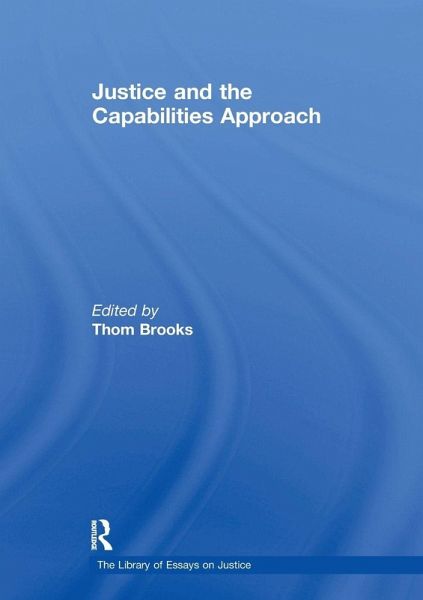
The capabilities approach is a widely influential alternative theory of justice, popularized by Nobel Prize winner Amartya Sen and also by Martha Nussbaum. Justice and the Capabilities Approach is the first work of its kind to publish in one place the most influential essays in the field covering a number of topics, including constitutional law, cosmopolitanism, distributive justice, the family, feminism, global justice, human rights, poverty, and social justice. The collection should help inform both scholars and students coming to the study of the capabilities approach for the first time of both the importance and complexity of the wider debate, as well as shed light on how the approach might be further improved and applied.
Thom Brooks, Reader in Political and Legal Philosophy, Newcastle University, UK
Inhaltsangabe
Contents: Introduction; Part I Distributive Justice: Well-being agency and freedom: the Dewey lectures 1984 Amartya Sen; Equality of welfare Ronald Dworkin; Equality of resources Ronald Dworkin. Part II Human Rights: Capabilities entitlements rights: supplementation and critique Martha C. Nussbaum; Rights capabilities and the good society Robin West; Elements of a theory of human rights Amartya Sen. Part III Constitutional Law: The Supreme Court 2006 Term - foreword: constitutions and capabilities: 'perception' against lofty formalism Martha C. Nussbaum; Constitutions and capabilities: a (necessarily) pragmatic approach Diane P. Wood. Part IV The Family: The problem with polygamy Thom Brooks; Who secures women's capabilities in Martha Nussbaum's quest for social justice? Amrita Basu. Part V Cosmopolitanism and Global Justice: Assessing global poverty and inequality: income resources and capabilities Ingrid Robeyns; Cosmopolitan law? Noah Feldman; Name index.
Rezensionen
'...a fine collection of essays.' Journal of Human Development and Capabilities
Es gelten unsere Allgemeinen Geschäftsbedingungen: www.buecher.de/agb
Impressum
www.buecher.de ist ein Internetauftritt der buecher.de internetstores GmbH
Geschäftsführung: Monica Sawhney | Roland Kölbl | Günter Hilger
Sitz der Gesellschaft: Batheyer Straße 115 - 117, 58099 Hagen
Postanschrift: Bürgermeister-Wegele-Str. 12, 86167 Augsburg
Amtsgericht Hagen HRB 13257
Steuernummer: 321/5800/1497
USt-IdNr: DE450055826