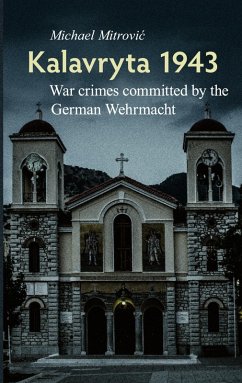
During the Second World War, soldiers of the German Wehrmacht destroyed over a hundred places in Greece. In the process, they shot tens of thousands of Greeks, often as a so-called punitive measure. One of the most horrific crimes was committed in Kalavrita on the Peloponnese in December 1943. The events are vividly described from various perspectives. The crimes committed by the German Wehrmacht in Kalavryta are just one of many crimes committed during this war. The number of victims of the fascist regime of the NSDAP and its allies is endless, and the atrocities committed are almost…mehr
During the Second World War, soldiers of the German Wehrmacht destroyed over a hundred places in Greece. In the process, they shot tens of thousands of Greeks, often as a so-called punitive measure. One of the most horrific crimes was committed in Kalavrita on the Peloponnese in December 1943. The events are vividly described from various perspectives. The crimes committed by the German Wehrmacht in Kalavryta are just one of many crimes committed during this war. The number of victims of the fascist regime of the NSDAP and its allies is endless, and the atrocities committed are almost unparalleled in their cruelty. And yet many still want to disavow these factually proven acts. Autocratic governments, right-wing populist and extreme right-wing movements and parties are experiencing a worldwide renaissance. In Germany, too, history is being falsified at will. Disinformation and lies, anti-Semitism and xenophobia are part of everyday life, and fascism is on the rise again. Especially in times like these, which are largely reminiscent of the Weimar Republic, maintaining a culture of remembrance is one of the most important issues alongside all the global challenges, because the past has impressively demonstrated where history can lead. Using the example of the war crimes committed in Kalavryta in 1943, this book presents a semi-documentary, but also subjectively narrated, fact-based account of the events.
Michael Mitrovic is of Serbian descent and has spent his entire professional life working in the field of language, voice and speech. He studied Slavic philology, German language and literature, Balkan studies and phonetics, and has worked as a speech therapist, early intervention teacher and translator. His publications on Greece include, among other topics, 'Das Meteora Wanderbuch' and 'Meteora - zwischen Himmel und Erde'. Both books have also been published in English under the titles 'Hiking Meteora Monasteries' and 'Meteora - Between Heaven and Earth'.
Es gelten unsere Allgemeinen Geschäftsbedingungen: www.buecher.de/agb
Impressum
www.buecher.de ist ein Internetauftritt der buecher.de internetstores GmbH
Geschäftsführung: Monica Sawhney | Roland Kölbl | Günter Hilger
Sitz der Gesellschaft: Batheyer Straße 115 - 117, 58099 Hagen
Postanschrift: Bürgermeister-Wegele-Str. 12, 86167 Augsburg
Amtsgericht Hagen HRB 13257
Steuernummer: 321/5800/1497
USt-IdNr: DE450055826