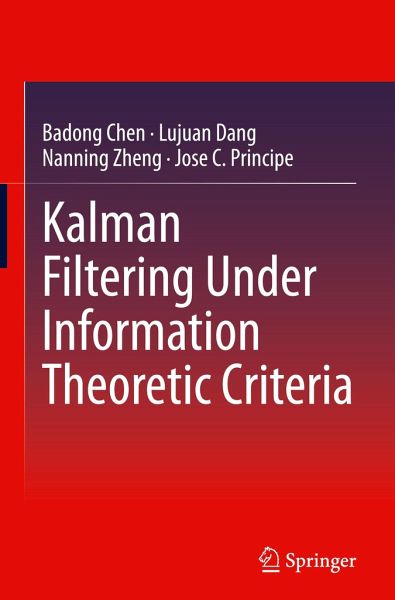
This book provides several efficient Kalman filters (linear or nonlinear) under information theoretic criteria. They achieve excellent performance in complicated non-Gaussian noises with low computation complexity and have great practical application potential. The book combines all these perspectives and results in a single resource for students and practitioners in relevant application fields. Each chapter starts with a brief review of fundamentals, presents the material focused on the most important properties and evaluates comparatively the models discussing free parameters and their…mehr
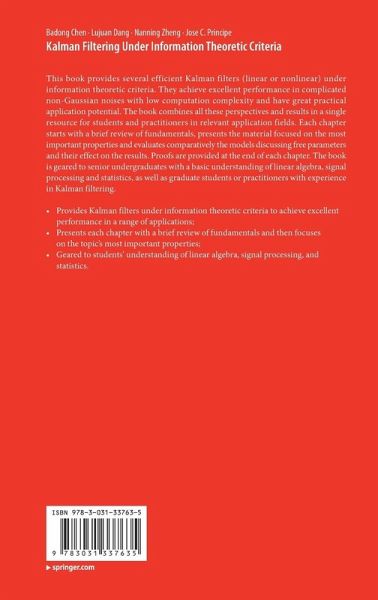
This book provides several efficient Kalman filters (linear or nonlinear) under information theoretic criteria. They achieve excellent performance in complicated non-Gaussian noises with low computation complexity and have great practical application potential. The book combines all these perspectives and results in a single resource for students and practitioners in relevant application fields. Each chapter starts with a brief review of fundamentals, presents the material focused on the most important properties and evaluates comparatively the models discussing free parameters and their effect on the results. Proofs are provided at the end of each chapter. The book is geared to senior undergraduates with a basic understanding of linear algebra, signal processing and statistics, as well as graduate students or practitioners with experience in Kalman filtering.
Haiquan Zhao (IEEE Senior Member) received the B.S. degree in applied mathematics in 1998, the M.S. degree and the Ph.D degree in Signal and Information Processing all at Southwest Jiaotong University, Chengdu, China, in 2005 and 2011, respectively. Since August 2012, he was a Professor with the School of Electrical Engineering, Southwest Jiaotong University, Chengdu, China. From 2015 to 2016, as a visiting scholar, he worked at University of Florida, USA. His current research interests include information theoretical learning, neural networks, adaptive network, adaptive filtering algorithm, nonlinear active noise control, nonlinear system identification, power system frequency estimation. At present, he is the author or coauthor of more than 140 international journal papers (SCI indexed), and the owner of 70 invention patents. Prof. Zhao has served as an active reviewer for several IEEE Transactions, IET series, Signal Processing, and other international journals. From August 2017, hewas appointed an Editorial board member of AEU- International Journal of Electronics and Communications. And also appointed an associate editor of IEEE Access from March 2019. At presented, he also was a handling editor of Signal Processing ( Top Journal).Badong Chen (IEEE Senior Member) received the B.S. and M.S. degrees in Control Theory and Engineering from Chongqing University, Chongqing, China, in 1997 and 2003, respectively, and the Ph.D. degree in Computer Science and Technology from Tsinghua University, Beijing, China, in 2008. He was a Postdoctoral Associate at the University of Florida Computational NeuroEngineering Laboratory (CNEL) from 2010 to 2012. He visited the Nanyang Technological University (NTU), Singapore, as a visiting research scientist in 2015. He also served as a senior research fellow with The Hong Kong Polytechnic University in 2017. Currently he is a professor at the Institute of Artificial Intelligence and Robotics (IAIR), Xi'an Jiaotong University,Xi'an, China. His research interests are in signal processing, machine learning, artificial intelligence, neural engineering and robotics. He has published two books and over 200 papers in various journals and conference proceedings and his papers have got over 5700 citations according to Google Scholar. Dr. Chen is an IEEE Senior Member, a Technical Committee Member of IEEE SPS Machine Learning for Signal Processing (MLSP) and IEEE CIS Cognitive and Developmental Systems (CDS), and an associate editor of IEEE Transactions on Cognitive and Developmental Systems, IEEE Transactions on Neural Networks and Learning Systems and Journal of The Franklin Institute, and has been on the editorial board of Entropy.
Inhaltsangabe
Chapter 1. Introduction.- Chapter 2. Kalman filtering.- Chapter 3. Information theoretic criteria.- Chapter 4. Kalman Filtering Under Information Theoretic Criteria.- Chapter 5. Extended Kalman Filtering Under Information Theoretic Criteria.- Chapter 6. Unscented Kalman Filter Under Information Theoretic Criteria.- Chapter 7. Cubature Kalman Filtering Under Information Theoretic Criteria.- Chapter 8. Additional Topics in Kalman Filtering Under Information Theoretic Criteria.
Chapter 1. Introduction.- Chapter 2. Kalman filtering.- Chapter 3. Information theoretic criteria.- Chapter 4. Kalman Filtering Under Information Theoretic Criteria.- Chapter 5. Extended Kalman Filtering Under Information Theoretic Criteria.- Chapter 6. Unscented Kalman Filter Under Information Theoretic Criteria.- Chapter 7. Cubature Kalman Filtering Under Information Theoretic Criteria.- Chapter 8. Additional Topics in Kalman Filtering Under Information Theoretic Criteria.
Rezensionen
"The book is well-suited for senior undergraduates who possess a foundational understanding of linear algebra, signal processing, and statistics. Additionally, it caters to graduate students or professionals who have practical experience in Kalman filtering." (Qi Lu, zbMATH 1532.93002, 2024)
Es gelten unsere Allgemeinen Geschäftsbedingungen: www.buecher.de/agb
Impressum
www.buecher.de ist ein Internetauftritt der buecher.de internetstores GmbH
Geschäftsführung: Monica Sawhney | Roland Kölbl | Günter Hilger
Sitz der Gesellschaft: Batheyer Straße 115 - 117, 58099 Hagen
Postanschrift: Bürgermeister-Wegele-Str. 12, 86167 Augsburg
Amtsgericht Hagen HRB 13257
Steuernummer: 321/5800/1497
USt-IdNr: DE450055826