

Andere Kunden interessierten sich auch für
 Psychologie vom empirischen Standpunkte99,90 €
 Karl Leonhard Reinhold's Transcendental Psychology84,99 €
 The Coherence of Kant's Transcendental Idealism158,99 €
 Kant and the Historical Turn58,99 €
 The Bounds of Transcendental Logic83,99 €
 The Bounds of Transcendental Logic83,99 €
 Kant's Theory of Knowledge65,99 €


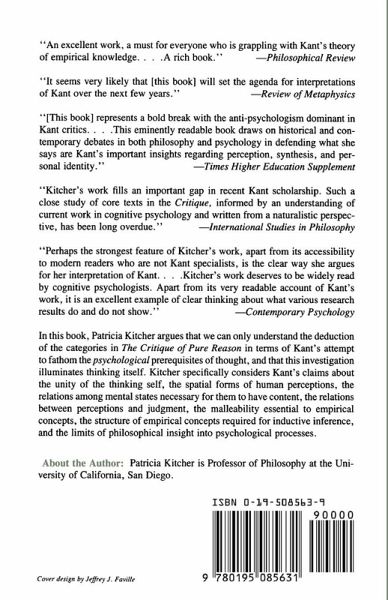
For the last 100 years historians have denigrated the psychology of the Critique of Pure Reason. In opposition, Patricia Kitcher argues that we can only understand the deduction of the categories in terms of Kant's attempt to fathom the psychological prerequisites of thought, and that this investigation illuminates thinking itself. Kant tried to understand the "task environment" of knowledge and thought: Given the data we acquire and the scientific generalizations we make, what basic cognitive capacities are necessary to perform these feats? What do these capacities imply about the inevitable structure of our knowledge? Kitcher specifically considers Kant's claims about the unity of the thinking self; the spatial forms of human perceptions; the relations among mental states necessary for them to have content; the relations between perceptions and judgment; the malleability essential to empirical concepts; the structure of empirical concepts required for inductive inference; and the limits of philosophical insight into psychological processes.
Based on a series of published essays, this book presents a clear account of Kant's views about the capacities a thinking subject must have to be capable of thought. This aspect of Kant's philosophy has been largely ignored by twentieth-century writers. From Kant's analysis of the necessary capacities for thought, Kitcher derives a new interpretation of the structure for the deduction of categories in The Critique of Pure Reason. She defends Kant's belief in the necessity of concepts that occur across all our thinking. She goes on to illuminate the problem of thinking itself, elucidating the uniquely useful set of starting assumptions about what thinking really involves, which are to be found in Kant's work.
Based on a series of published essays, this book presents a clear account of Kant's views about the capacities a thinking subject must have to be capable of thought. This aspect of Kant's philosophy has been largely ignored by twentieth-century writers. From Kant's analysis of the necessary capacities for thought, Kitcher derives a new interpretation of the structure for the deduction of categories in The Critique of Pure Reason. She defends Kant's belief in the necessity of concepts that occur across all our thinking. She goes on to illuminate the problem of thinking itself, elucidating the uniquely useful set of starting assumptions about what thinking really involves, which are to be found in Kant's work.