This volume offers a comprehensive examination of Hans Kelsen's legal and political philosophy, focusing on four central themes. The first part analyses Kelsen's theory of norms, including its periodisation and concepts of validity and coercion. The second part explores his perspectives on international law, addressing its structural analysis, primitive law characterisation, and teleology. The third part examines Kelsen's theory of democracy, its relationship with the pure theory of law, collective will, and democratisation of the administration. The final part discusses Kelsen's influence on…mehr
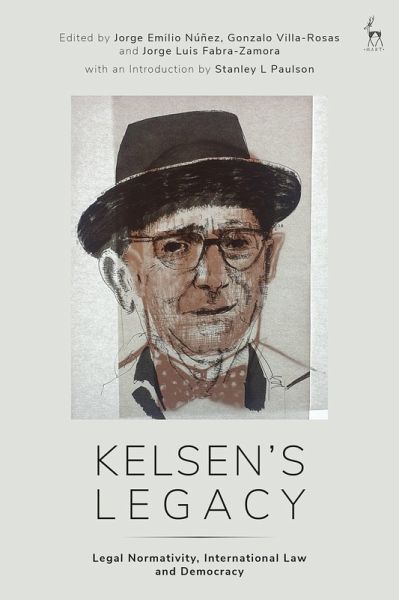
This volume offers a comprehensive examination of Hans Kelsen's legal and political philosophy, focusing on four central themes. The first part analyses Kelsen's theory of norms, including its periodisation and concepts of validity and coercion. The second part explores his perspectives on international law, addressing its structural analysis, primitive law characterisation, and teleology. The third part examines Kelsen's theory of democracy, its relationship with the pure theory of law, collective will, and democratisation of the administration. The final part discusses Kelsen's influence on the Vienna School of Legal Theory and its impact on case law and jurisprudence beyond Europe. This collection is essential for scholars and practitioners seeking to understand Kelsen's legacy.
Jorge Emilio Núñez is Reader in Legal Philosophy (Jurisprudence), Political Philosophy, and International Relations at Manchester Metropolitan University, UK. Gonzalo Villa-Rosas is Research Fellow at the Department of Legal and Constitutional History at the Faculty of Law of the University of Vienna, Austria. Jorge Luis Fabra-Zamora is Associate Professor at the University at Buffalo School of Law, State University of New York, USA.
Inhaltsangabe
Introduction Stanley L Paulson (University of Kiel Germany) 1. Reading 'Kelsen's Legacy' Gonzalo Villa-Rosas (University of Vienna Austria) Part I: Legal Norms 2. On Eugenio Bulygin's Kelsen Stanley L Paulson (University of Kiel Germany) 3. Hans Kelsen's Concept of the Relative A Priori Robert Alexy (University of Kiel Germany) 4. Kelsen the Outsider Iain Stewart (Macquarie Law School Sydney) 5. Varieties of Validity Carsten Heidemann (Schleswig-Holstein Bar Association Germany) 6. On Force Effectiveness and Law in Kelsen Julieta A Rabanos (University of Belgrade Serbia) Part II: International Law 7. The Pure Theory's Nomomechanics and the Structural Analysis of International Law Jörg Kammerhofer (University of Freiburg Germany) 8. Kelsen and 'Primitive' International Law: Three Solutions and a Problem Phil Edwards (Manchester Metropolitan University UK) 9. The Teleology of Peace and Kelsen's Philosophy of International Law Tomasz Widlak (University of Gdansk Poland) Part III: Democracy 10. Hans Kelsen's Normativism the Theory of Democracy and Enlightenment Values Monika Zalewska (University of Lodz Poland) 11. Hans Kelsen and the Crisis of Democracy Lars Vinx (University of Cambridge UK) 12. Kelsen and the Problem of Democratisation of the Administration Thomas Olechowski (University of Vienna Austria) Part IV: Kelsen's Legacy 13. 'A Monument More Lasting than Bronze Higher than the Pyramids' Regal Structures'? The Vienna School of the Pure Theory of Law as the Work and Legacy of Hans Kelsen Rodrigo Cadore (University of Freiburg Germany) 14. 'Kelsen in the Grenada Court': Simeon McIntosh's Contribution to the Understanding of Kelsen's Theory of Revolutionary Legality Asya Ostroukh (University of the West Indies Jamaica) 15. Hans Kelsen and Soviet Law Mikhail Antonov (Higher School of Economics Russia)
Introduction Stanley L Paulson (University of Kiel Germany) 1. Reading 'Kelsen's Legacy' Gonzalo Villa-Rosas (University of Vienna Austria) Part I: Legal Norms 2. On Eugenio Bulygin's Kelsen Stanley L Paulson (University of Kiel Germany) 3. Hans Kelsen's Concept of the Relative A Priori Robert Alexy (University of Kiel Germany) 4. Kelsen the Outsider Iain Stewart (Macquarie Law School Sydney) 5. Varieties of Validity Carsten Heidemann (Schleswig-Holstein Bar Association Germany) 6. On Force Effectiveness and Law in Kelsen Julieta A Rabanos (University of Belgrade Serbia) Part II: International Law 7. The Pure Theory's Nomomechanics and the Structural Analysis of International Law Jörg Kammerhofer (University of Freiburg Germany) 8. Kelsen and 'Primitive' International Law: Three Solutions and a Problem Phil Edwards (Manchester Metropolitan University UK) 9. The Teleology of Peace and Kelsen's Philosophy of International Law Tomasz Widlak (University of Gdansk Poland) Part III: Democracy 10. Hans Kelsen's Normativism the Theory of Democracy and Enlightenment Values Monika Zalewska (University of Lodz Poland) 11. Hans Kelsen and the Crisis of Democracy Lars Vinx (University of Cambridge UK) 12. Kelsen and the Problem of Democratisation of the Administration Thomas Olechowski (University of Vienna Austria) Part IV: Kelsen's Legacy 13. 'A Monument More Lasting than Bronze Higher than the Pyramids' Regal Structures'? The Vienna School of the Pure Theory of Law as the Work and Legacy of Hans Kelsen Rodrigo Cadore (University of Freiburg Germany) 14. 'Kelsen in the Grenada Court': Simeon McIntosh's Contribution to the Understanding of Kelsen's Theory of Revolutionary Legality Asya Ostroukh (University of the West Indies Jamaica) 15. Hans Kelsen and Soviet Law Mikhail Antonov (Higher School of Economics Russia)
Es gelten unsere Allgemeinen Geschäftsbedingungen: www.buecher.de/agb
Impressum
www.buecher.de ist ein Internetauftritt der buecher.de internetstores GmbH
Geschäftsführung: Monica Sawhney | Roland Kölbl | Günter Hilger
Sitz der Gesellschaft: Batheyer Straße 115 - 117, 58099 Hagen
Postanschrift: Bürgermeister-Wegele-Str. 12, 86167 Augsburg
Amtsgericht Hagen HRB 13257
Steuernummer: 321/5800/1497
USt-IdNr: DE450055826



![The Legend and the Legacy of Père Marquette [microform]](https://bilder.buecher.de/produkte/64/64364/64364975m.jpg "The Legend and the Legacy of Père Marquette [microform]")