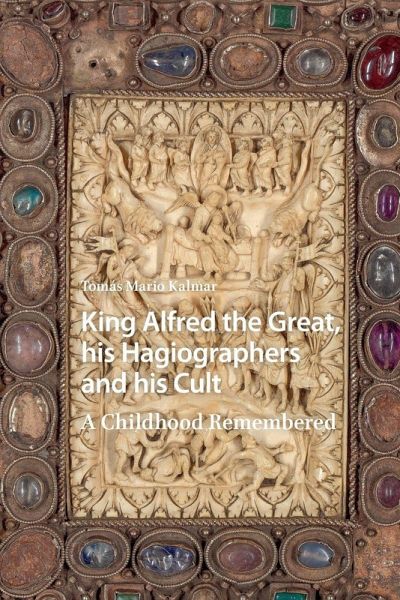
This book situates Alfred the Great in his hagiographic context. For 150 years, the fables told in the ninth century about Alfred's childhood have posed interlocking disciplinary challenges to historians committed to evicting romance from history. Blending current Hagiography Studies with historical, literary, and biblical hermeneutics can help us forgo the anti-hagiographic commitments which motivated the scholars who purified the Victorian cult of Alfred by expunging his legends and salvaging his historicity. The book focusses on the typological functions of three Alfredian fables from the…mehr
This book situates Alfred the Great in his hagiographic context. For 150 years, the fables told in the ninth century about Alfred's childhood have posed interlocking disciplinary challenges to historians committed to evicting romance from history. Blending current Hagiography Studies with historical, literary, and biblical hermeneutics can help us forgo the anti-hagiographic commitments which motivated the scholars who purified the Victorian cult of Alfred by expunging his legends and salvaging his historicity. The book focusses on the typological functions of three Alfredian fables from the Old English Chronicle, the Old English Boethius, and Asser's Vita Ælfredi, analyses the plot common to all three, critiques the psychological conjecture that Alfred's childhood memory was their common source, and shows that synoptically they can help us see how Alfred shaped the curve of his own life's destiny and how he engaged in the formation of his own cult to last a thousand years.
An independent Latino scholar living in Vermont, Tomás Kalmar (Ed.D., Harvard) specializes in interdisciplinary Alfredian Studies. He has published on Alfred and Asser in EOLAS and Peritia. He is the author of Illegal Alphabets and Adult Biliteracy (Routledge 2015). Andrew Prescott (FSA, FRHS) is Professor of Digital Humanities at the University of Glasgow. Alicia Spencer-Hall is an Honorary Senior Research Fellow at University College London. Their research interests include: medieval hagiography, disability, gender, digital culture, and film and media studies. Her first monograph, Medieval Saints and Modern Screens: Divine Visions as Cinematic Experience was published by Amsterdam University Press in 2018, and is now available Open Access. Trans and Genderqueer Subjects in Medieval Hagiography, a collection co-edited with Blake Gutt, was published in 2021. Shortlisted for the Transgender Non-Fiction award at the 34th Lambda Literary Awards, the volume is now also available Open Access. Their second monograph, Medieval Twitter, was published by Arc Humanities Press in 2024.
Inhaltsangabe
Foreword by Andrew Prescott Acknowledgments Some Key Dates I Cult and Canon: The Chronicle 1 Kiss the Reliquary 2 Remember the Pope 3 Fix the Date II Too Good to be True: The Life 4 Write the Life 5 Win the Book III The Curve of Destiny: The Works 6 Cross the Border 7 Win the Crown.
Foreword by Andrew Prescott Acknowledgments Some Key Dates I Cult and Canon: The Chronicle 1 Kiss the Reliquary 2 Remember the Pope 3 Fix the Date II Too Good to be True: The Life 4 Write the Life 5 Win the Book III The Curve of Destiny: The Works 6 Cross the Border 7 Win the Crown.
Es gelten unsere Allgemeinen Geschäftsbedingungen: www.buecher.de/agb
Impressum
www.buecher.de ist ein Internetauftritt der buecher.de internetstores GmbH
Geschäftsführung: Monica Sawhney | Roland Kölbl | Günter Hilger
Sitz der Gesellschaft: Batheyer Straße 115 - 117, 58099 Hagen
Postanschrift: Bürgermeister-Wegele-Str. 12, 86167 Augsburg
Amtsgericht Hagen HRB 13257
Steuernummer: 321/5800/1497
USt-IdNr: DE450055826

![The Whole Works of King Alfred the Great [Ed. by J.a. Giles]. Jubilee Ed](https://bilder.buecher.de/produkte/68/68916/68916397m.jpg "The Whole Works of King Alfred the Great [Ed. by J.a. Giles]. Jubilee Ed")