
Knowledge and Expertise in International Politics
A Handbook
Herausgeber: Bliesemann De Guevara, Berit; Warnecke, Andrea; Poopuu, Birgit; Kurowska, Xymena; Kaczmarska, Katarzyna
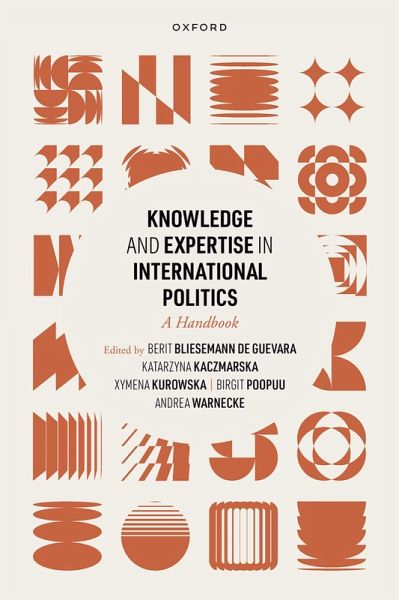
Knowledge and Expertise in International Politics
A Handbook
Herausgeber: Bliesemann De Guevara, Berit; Warnecke, Andrea; Poopuu, Birgit; Kurowska, Xymena; Kaczmarska, Katarzyna
- Gebundenes Buch
- Merkliste
- Auf die Merkliste
- Bewerten Bewerten
- Teilen
- Produkt teilen
- Produkterinnerung
- Produkterinnerung
This handbook focuses on whose knowledge matters in global politics, why, how, and with what effects. It consolidates knowledge as a transdisciplinary paradigm in international politics and helps readers navigate this new and fast-developing field.
Andere Kunden interessierten sich auch für
 A Relational Approach to NGOs in Global Politics127,99 €
 Economics and Politics Revisited132,99 €
 Herman Tutehau SaltonDangerous Diplomacy122,99 €
 Bessma MomaniOxford Handbook of the International Monetary Fund204,99 €
 Jon C W PevehouseThe Oxford Handbook of International Political Economy204,99 €
 Susan AllenBargaining in the Un Security Council97,99 €
 Dermot HodsonBanking on Europe107,99 €
-
-
-


This handbook focuses on whose knowledge matters in global politics, why, how, and with what effects. It consolidates knowledge as a transdisciplinary paradigm in international politics and helps readers navigate this new and fast-developing field.
Produktdetails
- Produktdetails
- Verlag: Oxford University Press
- Seitenzahl: 1104
- Erscheinungstermin: 25. Dezember 2025
- Englisch
- Abmessung: 240mm x 160mm x 65mm
- Gewicht: 1742g
- ISBN-13: 9780192871145
- ISBN-10: 0192871145
- Artikelnr.: 74536923
- Herstellerkennzeichnung
- Libri GmbH
- Europaallee 1
- 36244 Bad Hersfeld
- gpsr@libri.de
- Verlag: Oxford University Press
- Seitenzahl: 1104
- Erscheinungstermin: 25. Dezember 2025
- Englisch
- Abmessung: 240mm x 160mm x 65mm
- Gewicht: 1742g
- ISBN-13: 9780192871145
- ISBN-10: 0192871145
- Artikelnr.: 74536923
- Herstellerkennzeichnung
- Libri GmbH
- Europaallee 1
- 36244 Bad Hersfeld
- gpsr@libri.de
Berit Bliesemann de Guevara is Professor of International Politics and Co-Founder of the Centre for the International Politics of Knowledge at Aberystwyth University. She has been the principal investigator and co-investigator of projects studying the role of knowledge and expertise in and after violent conflict in Colombia and Myanmar and of international research networks on knowledge in conflict, funded by UK and German research councils. Katarzyna Kaczmarska is Senior Lecturer in Politics and International Relations at the University of Edinburgh. Her research interests centre on knowledge construction among scholars and practitioners of international politics, the theory and practice of academic freedom, and post-Soviet politics, as well as the ways in which socio-political contexts influence academic knowledge-making and use. She is the author of Making Global Knowledge in Local Contexts (Routledge, 2020). Xymena Kurowska is Associate Professor in International Relations at Central European University in Vienna. She received her doctorate in political and social sciences from the European University Institute in Florence, Italy, and works within International Political Sociology, using social and security theory, psychosocial and anthropological approaches, and relational and interpretive methodologies. Birgit Poopuu is Associate Professor of International Relations and co-director of the Central and Eastern European Security Hub (CEESHub) at Tallinn University's School of Governance, Law, and Society. Her research is curious about the role of radical and nonviolent knowledge and experience within international politics, with a focus on feminist and decolonial approaches to peace and conflict studies. She is the Principal Investigator of the European Horizon Twinning grant "A critical relational perspective on peace & security in CEE". Andrea Warnecke is Assistant Professor in History and International Studies at Leiden University's Institute for History. She holds a PhD in political and social sciences from the European University Institute, Florence. Her research on the practices of international organizations in peace and conflict is informed by several years of experience as a senior researcher and consultant on conflict, peacebuilding, and migration in think tanks, NGOs, and on behalf of government agencies and international organizations.
* Foreword * 1: Berit Bliesemann de Guevara, Katarzyna Kaczmarska, Xymena Kurowska, Birgit Poopuu, and Andrea Warnecke: Introduction: Studying International Politics Through the Lens of Knowledge and Expertise * PART I: KNOWLEDGE DEBATES IN INTERNATIONAL POLITICS * 2: Vineet Thakur: International Politics by Other Means: The Role of the Scholar in IR * 3: Beate Jahn: International Relations Knowledge and Practice: The Crisis of Critical Theory? * 4: Kimberly Hutchings: Gender and Knowledge (Re)Production in International Thought * 5: David L. Blaney and Arlene B. Tickner: Worlding and Worlds * 6: Dagmar Vorlí
ek: Science and International Relations: Knowing and Making the International * 7: Matthias Gross: Not Knowing as Expertise: Knowledge and the Politics of Ignorance * 8: Werner Distler and Mariam Salehi: Knowing Violence in International Politics * 9: Ingvild Bode and Hendrik Huelss: 'Artificial Intelligence' and the Production of Knowledge and Expertise in International Relations * 10: Audrey Alejandro: Studying Knowledge: An Analytical Guide for International Politics * 11: Siddharth Tripathi: Coloniality of Knowledge (Re)Production: Individual Entanglements and Collective Solidarities in Epistemic North-South Relationships * PART II: ACTOR-CENTRED APPROACHES * 12: Andrea Warnecke and Berit Bliesemann de Guevara: Actor-Centred Approaches to Knowledge and Expertise in International Politics * 13: Katharina Glaab and Nele Kortendiek: The Politics of Knowledge Production in International Organizations * 14: Mikkel Jarle Christensen and Mikael Rask Madsen: Legal Knowledge and Expertise in International Politics * 15: Andrea Warnecke: Informal Ties and Expertise in Global Crisis Governance: An Exploration of Network Methodologies * 16: Roland Kosti
and Berit Bliesemann de Guevara: Intimate Networks and Strategic Knowledge in Peacebuilding Interventions * 17: %Sárka Waisová: Deep Co-Production of Human Security at the Science-Politics Nexus * 18: Justyna Bandola-Gill: Quantified Expertise: Connecting Science and Politics in Global Governance * 19: Rolf Lidskog and Göran Sundqvist: From Product to Process: Science and the Making of International Environmental Governance * PART III: PRACTICE APPROACHES * 20: Berit Bliesemann de Guevara and Andrea Warnecke: Practice Approaches to Knowledge and Expertise in International Politics * 21: Trine Villumsen Berling: The Embedded Study of International Knowledge Practices: Towards a Methodology of Ironic Immersion * 22: Janice Gross Stein: Thinking, Feeling, and Choosing: Pragmatism, Political Psychology, and the Intelligence Community * 23: Saara Särmä and Juha A. Vuori: Arts-Based Methods in IR: What Knowledges Become Possible * 24: Annabelle Littoz-Monnet: The Co-Production of Expertise in Global Governance * 25: Christine Andrä: Producing Knowledge to Problematize War: A Foucauldian Approach to Knowledge Practices * 26: María Fernanda Olarte-Sierra: Forensic Experts and Knowledge Practices in Transitional Justice Scenarios * 27: Rocco Bellanova and Linda Monsees: Algorithmic Knowledge and International Politics * 28: Maria Martin de Almagro: Assembling Knowledge Through Pilot Projects and Massive Open Online Courses in International Policymaking * 29: Jan-Peter Voß: Instrument Constituencies and Spaces of Knowing Governance * 30: Nikolas Kosmatopoulos and Chloe Nasr: War and Peace: Techno-Political Assemblages in the Postcolonial Middle East * PART IV: CONTEXT-CENTRED APPROACHES * 31: Katarzyna Kaczmarska: Context-Centred Approaches to Knowledge and Expertise in International Politics * 32: Beverley Loke and Catherine Owen: Hierarchies and Contexts in International Relations Knowledge Production * 33: Yong-Soo Eun: A Broadening of International Relations: Knowledge Production Beyond West-Centrism * 34: Cai Wilkinson: Queer Knowing and Knowledge: The Case of Queer IR * 35: Christian Reus-Smit: The Problem with Cultural Contexts * 36: Katarzyna Kaczmarska: Academic Freedom and the Contexts of Knowledge Production * 37: Martin Müller and Alexandra Yatsyk: The Global Easts in the Geopolitics of Knowledge: The Decolonial Imperative * 38: Paulo Ravecca and Camilo López Burian: The Politics of International Relations: Glimpses from Chile and Uruguay * 39: Ari Jerrems, Mariela Cuadro, and Melody Fonseca: The Everyday Practices of Making a Global Discipline * 40: Beatrix Futak-Campbell: Creating a Global International Relations Section at the International Studies Association * 41: Alexander Ruser: Experts and Public Trust in the Policy Field of Climate Change * PART V: STRUCTURAL APPROACHES * 42: Birgit Poopuu and Xymena Kurowska: Structural Approaches to Knowledge and Expertise in International Politics * 43: Birgit Poopuu, Elisabeth Schweiger, and Elena Simon: The Violens in International Relations: Can We Produce Knowledge Differently? * 44: Luis Aue: Knowledge Regimes and the Postcolonial Hierarchies of International Health Quantification * 45: Claudia Aradau, Lucrezia Canzutti, and Sarah Perret: Regimes of Power/Non-Knowledge in Global Politics * 46: Victor Anas and Suda Perera: Experts in Conflict: Having Been There but Not Being From There * 47: Jamie J. Hagen, Anupama Ranawana, and Emma Pritchard: Queering Humanitarian Response Through LGBTIQ People's Expertise * 48: Alf Gunvald Nilsen and Laurence Cox: Social Movements and Insurgent Social Theory: Making Theoretical Knowledge Through Collective Action * 49: Michael Merlingen: EU Foreign Policy Ideas as International Relations of Domination: A Neo-Gramscian Perspective * 50: Gloria Novovi
: Poverty, Inequality, and Knowledge in Development Politics * PART VI: RELATIONAL APPROACHES * 51: Xymena Kurowska and Birgit Poopuu: Relational Approaches to Knowledge and Expertise in International Politics * 52: Patrick Thaddeus Jackson and Sujin Heo: Ways of Knowing: A Relational Account * 53: Emilian Kavalski: Relationality with Asian Characteristics? Healing the Columbus Syndrome of International Relations * 54: Emma Mc Cluskey: Anthropological Approaches to Knowledge in International Politics * 55: Alistair Markland: Fielding Knowledge: The Problematic Case of Human Rights Advocacy and Genocide Labelling * 56: Anna Danielsson: Field Methodology and the Relational Emergence of an 'Interventionary Object' * 57: Linda Åhäll: Being as a Mode of Knowing: Feminist Knowledge on Affect * 58: Aytak Dibavar: Transnational Feminist Solidarity: Story as a Relational Approach to Knowledge Production * 59: Erika Cudworth and Stephen Hobden: Complexity Thinking, Posthumanism, and International Relations Knowledge * 60: Amaya Querejazu: Pluriversal Knowledge and Shamans: The Aymara Yatiris as Knowers and Diplomats * PART VII: DISRUPTIONS AND MEDITATIONS * 61: Milja Kurki: Cosmologies, Sciences, Planetary Politics: Reflections on 'Knowledge' in New Registers * 62: Jonathan Luke Austin and Anna Leander: The Future of Academic Expertise: Speculative European Bureaucratic Fabulations * 63: Amal Abu-Bakare: Racism and Racialization in International Relations Knowledge * 64: Toni
erkez, James Finnis, Milja Kurki, Helen Miles, and Joseph Thurgate: Reflections on Imagination of Future and AI * 65: Thomas Fetzer, Xymena Kurowska, and Kateryna Zarembo: Hermeneutical Ignorance and 'Strong Objectivity' in Knowledge Production about the Russo-Ukrainian War * 66: Philip Conway: The Necessity of Being Negative: Critique and Care in the Anthropocene * 67: Berit Bliesemann de Guevara, Katarzyna Kaczmarska, Xymena Kurowska, Birgit Poopuu, and Andrea Warnecke: Creating Knowledge by Editing a Handbook: A Self-Critical Reflection
ek: Science and International Relations: Knowing and Making the International * 7: Matthias Gross: Not Knowing as Expertise: Knowledge and the Politics of Ignorance * 8: Werner Distler and Mariam Salehi: Knowing Violence in International Politics * 9: Ingvild Bode and Hendrik Huelss: 'Artificial Intelligence' and the Production of Knowledge and Expertise in International Relations * 10: Audrey Alejandro: Studying Knowledge: An Analytical Guide for International Politics * 11: Siddharth Tripathi: Coloniality of Knowledge (Re)Production: Individual Entanglements and Collective Solidarities in Epistemic North-South Relationships * PART II: ACTOR-CENTRED APPROACHES * 12: Andrea Warnecke and Berit Bliesemann de Guevara: Actor-Centred Approaches to Knowledge and Expertise in International Politics * 13: Katharina Glaab and Nele Kortendiek: The Politics of Knowledge Production in International Organizations * 14: Mikkel Jarle Christensen and Mikael Rask Madsen: Legal Knowledge and Expertise in International Politics * 15: Andrea Warnecke: Informal Ties and Expertise in Global Crisis Governance: An Exploration of Network Methodologies * 16: Roland Kosti
and Berit Bliesemann de Guevara: Intimate Networks and Strategic Knowledge in Peacebuilding Interventions * 17: %Sárka Waisová: Deep Co-Production of Human Security at the Science-Politics Nexus * 18: Justyna Bandola-Gill: Quantified Expertise: Connecting Science and Politics in Global Governance * 19: Rolf Lidskog and Göran Sundqvist: From Product to Process: Science and the Making of International Environmental Governance * PART III: PRACTICE APPROACHES * 20: Berit Bliesemann de Guevara and Andrea Warnecke: Practice Approaches to Knowledge and Expertise in International Politics * 21: Trine Villumsen Berling: The Embedded Study of International Knowledge Practices: Towards a Methodology of Ironic Immersion * 22: Janice Gross Stein: Thinking, Feeling, and Choosing: Pragmatism, Political Psychology, and the Intelligence Community * 23: Saara Särmä and Juha A. Vuori: Arts-Based Methods in IR: What Knowledges Become Possible * 24: Annabelle Littoz-Monnet: The Co-Production of Expertise in Global Governance * 25: Christine Andrä: Producing Knowledge to Problematize War: A Foucauldian Approach to Knowledge Practices * 26: María Fernanda Olarte-Sierra: Forensic Experts and Knowledge Practices in Transitional Justice Scenarios * 27: Rocco Bellanova and Linda Monsees: Algorithmic Knowledge and International Politics * 28: Maria Martin de Almagro: Assembling Knowledge Through Pilot Projects and Massive Open Online Courses in International Policymaking * 29: Jan-Peter Voß: Instrument Constituencies and Spaces of Knowing Governance * 30: Nikolas Kosmatopoulos and Chloe Nasr: War and Peace: Techno-Political Assemblages in the Postcolonial Middle East * PART IV: CONTEXT-CENTRED APPROACHES * 31: Katarzyna Kaczmarska: Context-Centred Approaches to Knowledge and Expertise in International Politics * 32: Beverley Loke and Catherine Owen: Hierarchies and Contexts in International Relations Knowledge Production * 33: Yong-Soo Eun: A Broadening of International Relations: Knowledge Production Beyond West-Centrism * 34: Cai Wilkinson: Queer Knowing and Knowledge: The Case of Queer IR * 35: Christian Reus-Smit: The Problem with Cultural Contexts * 36: Katarzyna Kaczmarska: Academic Freedom and the Contexts of Knowledge Production * 37: Martin Müller and Alexandra Yatsyk: The Global Easts in the Geopolitics of Knowledge: The Decolonial Imperative * 38: Paulo Ravecca and Camilo López Burian: The Politics of International Relations: Glimpses from Chile and Uruguay * 39: Ari Jerrems, Mariela Cuadro, and Melody Fonseca: The Everyday Practices of Making a Global Discipline * 40: Beatrix Futak-Campbell: Creating a Global International Relations Section at the International Studies Association * 41: Alexander Ruser: Experts and Public Trust in the Policy Field of Climate Change * PART V: STRUCTURAL APPROACHES * 42: Birgit Poopuu and Xymena Kurowska: Structural Approaches to Knowledge and Expertise in International Politics * 43: Birgit Poopuu, Elisabeth Schweiger, and Elena Simon: The Violens in International Relations: Can We Produce Knowledge Differently? * 44: Luis Aue: Knowledge Regimes and the Postcolonial Hierarchies of International Health Quantification * 45: Claudia Aradau, Lucrezia Canzutti, and Sarah Perret: Regimes of Power/Non-Knowledge in Global Politics * 46: Victor Anas and Suda Perera: Experts in Conflict: Having Been There but Not Being From There * 47: Jamie J. Hagen, Anupama Ranawana, and Emma Pritchard: Queering Humanitarian Response Through LGBTIQ People's Expertise * 48: Alf Gunvald Nilsen and Laurence Cox: Social Movements and Insurgent Social Theory: Making Theoretical Knowledge Through Collective Action * 49: Michael Merlingen: EU Foreign Policy Ideas as International Relations of Domination: A Neo-Gramscian Perspective * 50: Gloria Novovi
: Poverty, Inequality, and Knowledge in Development Politics * PART VI: RELATIONAL APPROACHES * 51: Xymena Kurowska and Birgit Poopuu: Relational Approaches to Knowledge and Expertise in International Politics * 52: Patrick Thaddeus Jackson and Sujin Heo: Ways of Knowing: A Relational Account * 53: Emilian Kavalski: Relationality with Asian Characteristics? Healing the Columbus Syndrome of International Relations * 54: Emma Mc Cluskey: Anthropological Approaches to Knowledge in International Politics * 55: Alistair Markland: Fielding Knowledge: The Problematic Case of Human Rights Advocacy and Genocide Labelling * 56: Anna Danielsson: Field Methodology and the Relational Emergence of an 'Interventionary Object' * 57: Linda Åhäll: Being as a Mode of Knowing: Feminist Knowledge on Affect * 58: Aytak Dibavar: Transnational Feminist Solidarity: Story as a Relational Approach to Knowledge Production * 59: Erika Cudworth and Stephen Hobden: Complexity Thinking, Posthumanism, and International Relations Knowledge * 60: Amaya Querejazu: Pluriversal Knowledge and Shamans: The Aymara Yatiris as Knowers and Diplomats * PART VII: DISRUPTIONS AND MEDITATIONS * 61: Milja Kurki: Cosmologies, Sciences, Planetary Politics: Reflections on 'Knowledge' in New Registers * 62: Jonathan Luke Austin and Anna Leander: The Future of Academic Expertise: Speculative European Bureaucratic Fabulations * 63: Amal Abu-Bakare: Racism and Racialization in International Relations Knowledge * 64: Toni
erkez, James Finnis, Milja Kurki, Helen Miles, and Joseph Thurgate: Reflections on Imagination of Future and AI * 65: Thomas Fetzer, Xymena Kurowska, and Kateryna Zarembo: Hermeneutical Ignorance and 'Strong Objectivity' in Knowledge Production about the Russo-Ukrainian War * 66: Philip Conway: The Necessity of Being Negative: Critique and Care in the Anthropocene * 67: Berit Bliesemann de Guevara, Katarzyna Kaczmarska, Xymena Kurowska, Birgit Poopuu, and Andrea Warnecke: Creating Knowledge by Editing a Handbook: A Self-Critical Reflection
* Foreword * 1: Berit Bliesemann de Guevara, Katarzyna Kaczmarska, Xymena Kurowska, Birgit Poopuu, and Andrea Warnecke: Introduction: Studying International Politics Through the Lens of Knowledge and Expertise * PART I: KNOWLEDGE DEBATES IN INTERNATIONAL POLITICS * 2: Vineet Thakur: International Politics by Other Means: The Role of the Scholar in IR * 3: Beate Jahn: International Relations Knowledge and Practice: The Crisis of Critical Theory? * 4: Kimberly Hutchings: Gender and Knowledge (Re)Production in International Thought * 5: David L. Blaney and Arlene B. Tickner: Worlding and Worlds * 6: Dagmar Vorlí
ek: Science and International Relations: Knowing and Making the International * 7: Matthias Gross: Not Knowing as Expertise: Knowledge and the Politics of Ignorance * 8: Werner Distler and Mariam Salehi: Knowing Violence in International Politics * 9: Ingvild Bode and Hendrik Huelss: 'Artificial Intelligence' and the Production of Knowledge and Expertise in International Relations * 10: Audrey Alejandro: Studying Knowledge: An Analytical Guide for International Politics * 11: Siddharth Tripathi: Coloniality of Knowledge (Re)Production: Individual Entanglements and Collective Solidarities in Epistemic North-South Relationships * PART II: ACTOR-CENTRED APPROACHES * 12: Andrea Warnecke and Berit Bliesemann de Guevara: Actor-Centred Approaches to Knowledge and Expertise in International Politics * 13: Katharina Glaab and Nele Kortendiek: The Politics of Knowledge Production in International Organizations * 14: Mikkel Jarle Christensen and Mikael Rask Madsen: Legal Knowledge and Expertise in International Politics * 15: Andrea Warnecke: Informal Ties and Expertise in Global Crisis Governance: An Exploration of Network Methodologies * 16: Roland Kosti
and Berit Bliesemann de Guevara: Intimate Networks and Strategic Knowledge in Peacebuilding Interventions * 17: %Sárka Waisová: Deep Co-Production of Human Security at the Science-Politics Nexus * 18: Justyna Bandola-Gill: Quantified Expertise: Connecting Science and Politics in Global Governance * 19: Rolf Lidskog and Göran Sundqvist: From Product to Process: Science and the Making of International Environmental Governance * PART III: PRACTICE APPROACHES * 20: Berit Bliesemann de Guevara and Andrea Warnecke: Practice Approaches to Knowledge and Expertise in International Politics * 21: Trine Villumsen Berling: The Embedded Study of International Knowledge Practices: Towards a Methodology of Ironic Immersion * 22: Janice Gross Stein: Thinking, Feeling, and Choosing: Pragmatism, Political Psychology, and the Intelligence Community * 23: Saara Särmä and Juha A. Vuori: Arts-Based Methods in IR: What Knowledges Become Possible * 24: Annabelle Littoz-Monnet: The Co-Production of Expertise in Global Governance * 25: Christine Andrä: Producing Knowledge to Problematize War: A Foucauldian Approach to Knowledge Practices * 26: María Fernanda Olarte-Sierra: Forensic Experts and Knowledge Practices in Transitional Justice Scenarios * 27: Rocco Bellanova and Linda Monsees: Algorithmic Knowledge and International Politics * 28: Maria Martin de Almagro: Assembling Knowledge Through Pilot Projects and Massive Open Online Courses in International Policymaking * 29: Jan-Peter Voß: Instrument Constituencies and Spaces of Knowing Governance * 30: Nikolas Kosmatopoulos and Chloe Nasr: War and Peace: Techno-Political Assemblages in the Postcolonial Middle East * PART IV: CONTEXT-CENTRED APPROACHES * 31: Katarzyna Kaczmarska: Context-Centred Approaches to Knowledge and Expertise in International Politics * 32: Beverley Loke and Catherine Owen: Hierarchies and Contexts in International Relations Knowledge Production * 33: Yong-Soo Eun: A Broadening of International Relations: Knowledge Production Beyond West-Centrism * 34: Cai Wilkinson: Queer Knowing and Knowledge: The Case of Queer IR * 35: Christian Reus-Smit: The Problem with Cultural Contexts * 36: Katarzyna Kaczmarska: Academic Freedom and the Contexts of Knowledge Production * 37: Martin Müller and Alexandra Yatsyk: The Global Easts in the Geopolitics of Knowledge: The Decolonial Imperative * 38: Paulo Ravecca and Camilo López Burian: The Politics of International Relations: Glimpses from Chile and Uruguay * 39: Ari Jerrems, Mariela Cuadro, and Melody Fonseca: The Everyday Practices of Making a Global Discipline * 40: Beatrix Futak-Campbell: Creating a Global International Relations Section at the International Studies Association * 41: Alexander Ruser: Experts and Public Trust in the Policy Field of Climate Change * PART V: STRUCTURAL APPROACHES * 42: Birgit Poopuu and Xymena Kurowska: Structural Approaches to Knowledge and Expertise in International Politics * 43: Birgit Poopuu, Elisabeth Schweiger, and Elena Simon: The Violens in International Relations: Can We Produce Knowledge Differently? * 44: Luis Aue: Knowledge Regimes and the Postcolonial Hierarchies of International Health Quantification * 45: Claudia Aradau, Lucrezia Canzutti, and Sarah Perret: Regimes of Power/Non-Knowledge in Global Politics * 46: Victor Anas and Suda Perera: Experts in Conflict: Having Been There but Not Being From There * 47: Jamie J. Hagen, Anupama Ranawana, and Emma Pritchard: Queering Humanitarian Response Through LGBTIQ People's Expertise * 48: Alf Gunvald Nilsen and Laurence Cox: Social Movements and Insurgent Social Theory: Making Theoretical Knowledge Through Collective Action * 49: Michael Merlingen: EU Foreign Policy Ideas as International Relations of Domination: A Neo-Gramscian Perspective * 50: Gloria Novovi
: Poverty, Inequality, and Knowledge in Development Politics * PART VI: RELATIONAL APPROACHES * 51: Xymena Kurowska and Birgit Poopuu: Relational Approaches to Knowledge and Expertise in International Politics * 52: Patrick Thaddeus Jackson and Sujin Heo: Ways of Knowing: A Relational Account * 53: Emilian Kavalski: Relationality with Asian Characteristics? Healing the Columbus Syndrome of International Relations * 54: Emma Mc Cluskey: Anthropological Approaches to Knowledge in International Politics * 55: Alistair Markland: Fielding Knowledge: The Problematic Case of Human Rights Advocacy and Genocide Labelling * 56: Anna Danielsson: Field Methodology and the Relational Emergence of an 'Interventionary Object' * 57: Linda Åhäll: Being as a Mode of Knowing: Feminist Knowledge on Affect * 58: Aytak Dibavar: Transnational Feminist Solidarity: Story as a Relational Approach to Knowledge Production * 59: Erika Cudworth and Stephen Hobden: Complexity Thinking, Posthumanism, and International Relations Knowledge * 60: Amaya Querejazu: Pluriversal Knowledge and Shamans: The Aymara Yatiris as Knowers and Diplomats * PART VII: DISRUPTIONS AND MEDITATIONS * 61: Milja Kurki: Cosmologies, Sciences, Planetary Politics: Reflections on 'Knowledge' in New Registers * 62: Jonathan Luke Austin and Anna Leander: The Future of Academic Expertise: Speculative European Bureaucratic Fabulations * 63: Amal Abu-Bakare: Racism and Racialization in International Relations Knowledge * 64: Toni
erkez, James Finnis, Milja Kurki, Helen Miles, and Joseph Thurgate: Reflections on Imagination of Future and AI * 65: Thomas Fetzer, Xymena Kurowska, and Kateryna Zarembo: Hermeneutical Ignorance and 'Strong Objectivity' in Knowledge Production about the Russo-Ukrainian War * 66: Philip Conway: The Necessity of Being Negative: Critique and Care in the Anthropocene * 67: Berit Bliesemann de Guevara, Katarzyna Kaczmarska, Xymena Kurowska, Birgit Poopuu, and Andrea Warnecke: Creating Knowledge by Editing a Handbook: A Self-Critical Reflection
ek: Science and International Relations: Knowing and Making the International * 7: Matthias Gross: Not Knowing as Expertise: Knowledge and the Politics of Ignorance * 8: Werner Distler and Mariam Salehi: Knowing Violence in International Politics * 9: Ingvild Bode and Hendrik Huelss: 'Artificial Intelligence' and the Production of Knowledge and Expertise in International Relations * 10: Audrey Alejandro: Studying Knowledge: An Analytical Guide for International Politics * 11: Siddharth Tripathi: Coloniality of Knowledge (Re)Production: Individual Entanglements and Collective Solidarities in Epistemic North-South Relationships * PART II: ACTOR-CENTRED APPROACHES * 12: Andrea Warnecke and Berit Bliesemann de Guevara: Actor-Centred Approaches to Knowledge and Expertise in International Politics * 13: Katharina Glaab and Nele Kortendiek: The Politics of Knowledge Production in International Organizations * 14: Mikkel Jarle Christensen and Mikael Rask Madsen: Legal Knowledge and Expertise in International Politics * 15: Andrea Warnecke: Informal Ties and Expertise in Global Crisis Governance: An Exploration of Network Methodologies * 16: Roland Kosti
and Berit Bliesemann de Guevara: Intimate Networks and Strategic Knowledge in Peacebuilding Interventions * 17: %Sárka Waisová: Deep Co-Production of Human Security at the Science-Politics Nexus * 18: Justyna Bandola-Gill: Quantified Expertise: Connecting Science and Politics in Global Governance * 19: Rolf Lidskog and Göran Sundqvist: From Product to Process: Science and the Making of International Environmental Governance * PART III: PRACTICE APPROACHES * 20: Berit Bliesemann de Guevara and Andrea Warnecke: Practice Approaches to Knowledge and Expertise in International Politics * 21: Trine Villumsen Berling: The Embedded Study of International Knowledge Practices: Towards a Methodology of Ironic Immersion * 22: Janice Gross Stein: Thinking, Feeling, and Choosing: Pragmatism, Political Psychology, and the Intelligence Community * 23: Saara Särmä and Juha A. Vuori: Arts-Based Methods in IR: What Knowledges Become Possible * 24: Annabelle Littoz-Monnet: The Co-Production of Expertise in Global Governance * 25: Christine Andrä: Producing Knowledge to Problematize War: A Foucauldian Approach to Knowledge Practices * 26: María Fernanda Olarte-Sierra: Forensic Experts and Knowledge Practices in Transitional Justice Scenarios * 27: Rocco Bellanova and Linda Monsees: Algorithmic Knowledge and International Politics * 28: Maria Martin de Almagro: Assembling Knowledge Through Pilot Projects and Massive Open Online Courses in International Policymaking * 29: Jan-Peter Voß: Instrument Constituencies and Spaces of Knowing Governance * 30: Nikolas Kosmatopoulos and Chloe Nasr: War and Peace: Techno-Political Assemblages in the Postcolonial Middle East * PART IV: CONTEXT-CENTRED APPROACHES * 31: Katarzyna Kaczmarska: Context-Centred Approaches to Knowledge and Expertise in International Politics * 32: Beverley Loke and Catherine Owen: Hierarchies and Contexts in International Relations Knowledge Production * 33: Yong-Soo Eun: A Broadening of International Relations: Knowledge Production Beyond West-Centrism * 34: Cai Wilkinson: Queer Knowing and Knowledge: The Case of Queer IR * 35: Christian Reus-Smit: The Problem with Cultural Contexts * 36: Katarzyna Kaczmarska: Academic Freedom and the Contexts of Knowledge Production * 37: Martin Müller and Alexandra Yatsyk: The Global Easts in the Geopolitics of Knowledge: The Decolonial Imperative * 38: Paulo Ravecca and Camilo López Burian: The Politics of International Relations: Glimpses from Chile and Uruguay * 39: Ari Jerrems, Mariela Cuadro, and Melody Fonseca: The Everyday Practices of Making a Global Discipline * 40: Beatrix Futak-Campbell: Creating a Global International Relations Section at the International Studies Association * 41: Alexander Ruser: Experts and Public Trust in the Policy Field of Climate Change * PART V: STRUCTURAL APPROACHES * 42: Birgit Poopuu and Xymena Kurowska: Structural Approaches to Knowledge and Expertise in International Politics * 43: Birgit Poopuu, Elisabeth Schweiger, and Elena Simon: The Violens in International Relations: Can We Produce Knowledge Differently? * 44: Luis Aue: Knowledge Regimes and the Postcolonial Hierarchies of International Health Quantification * 45: Claudia Aradau, Lucrezia Canzutti, and Sarah Perret: Regimes of Power/Non-Knowledge in Global Politics * 46: Victor Anas and Suda Perera: Experts in Conflict: Having Been There but Not Being From There * 47: Jamie J. Hagen, Anupama Ranawana, and Emma Pritchard: Queering Humanitarian Response Through LGBTIQ People's Expertise * 48: Alf Gunvald Nilsen and Laurence Cox: Social Movements and Insurgent Social Theory: Making Theoretical Knowledge Through Collective Action * 49: Michael Merlingen: EU Foreign Policy Ideas as International Relations of Domination: A Neo-Gramscian Perspective * 50: Gloria Novovi
: Poverty, Inequality, and Knowledge in Development Politics * PART VI: RELATIONAL APPROACHES * 51: Xymena Kurowska and Birgit Poopuu: Relational Approaches to Knowledge and Expertise in International Politics * 52: Patrick Thaddeus Jackson and Sujin Heo: Ways of Knowing: A Relational Account * 53: Emilian Kavalski: Relationality with Asian Characteristics? Healing the Columbus Syndrome of International Relations * 54: Emma Mc Cluskey: Anthropological Approaches to Knowledge in International Politics * 55: Alistair Markland: Fielding Knowledge: The Problematic Case of Human Rights Advocacy and Genocide Labelling * 56: Anna Danielsson: Field Methodology and the Relational Emergence of an 'Interventionary Object' * 57: Linda Åhäll: Being as a Mode of Knowing: Feminist Knowledge on Affect * 58: Aytak Dibavar: Transnational Feminist Solidarity: Story as a Relational Approach to Knowledge Production * 59: Erika Cudworth and Stephen Hobden: Complexity Thinking, Posthumanism, and International Relations Knowledge * 60: Amaya Querejazu: Pluriversal Knowledge and Shamans: The Aymara Yatiris as Knowers and Diplomats * PART VII: DISRUPTIONS AND MEDITATIONS * 61: Milja Kurki: Cosmologies, Sciences, Planetary Politics: Reflections on 'Knowledge' in New Registers * 62: Jonathan Luke Austin and Anna Leander: The Future of Academic Expertise: Speculative European Bureaucratic Fabulations * 63: Amal Abu-Bakare: Racism and Racialization in International Relations Knowledge * 64: Toni
erkez, James Finnis, Milja Kurki, Helen Miles, and Joseph Thurgate: Reflections on Imagination of Future and AI * 65: Thomas Fetzer, Xymena Kurowska, and Kateryna Zarembo: Hermeneutical Ignorance and 'Strong Objectivity' in Knowledge Production about the Russo-Ukrainian War * 66: Philip Conway: The Necessity of Being Negative: Critique and Care in the Anthropocene * 67: Berit Bliesemann de Guevara, Katarzyna Kaczmarska, Xymena Kurowska, Birgit Poopuu, and Andrea Warnecke: Creating Knowledge by Editing a Handbook: A Self-Critical Reflection