- Broschiertes Buch
- Merkliste
- Auf die Merkliste
- Bewerten Bewerten
- Teilen
- Produkt teilen
- Produkterinnerung
- Produkterinnerung
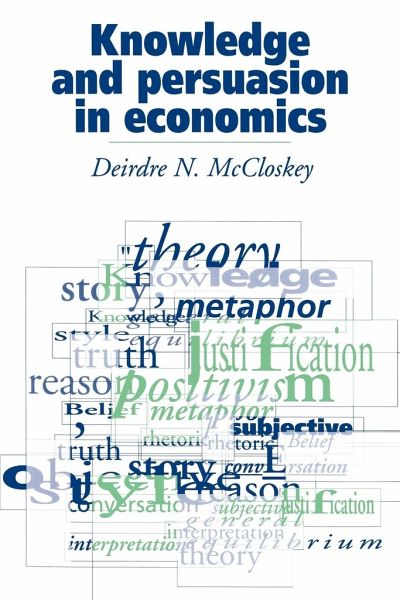
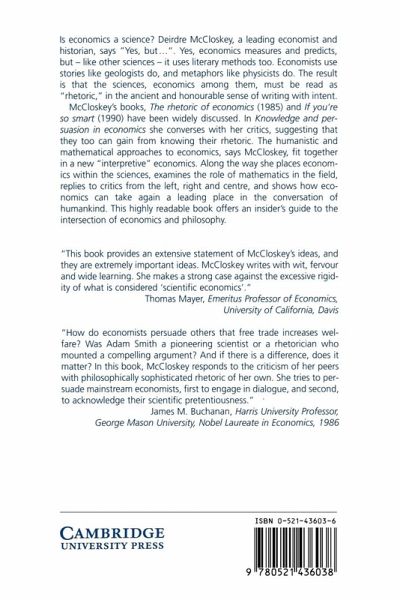
Argues that economics is a science, but a human science: a witty guide to the ins and outs of economic philosophy.
Andere Kunden interessierten sich auch für
Deirdre N. McCloskeyKnowledge and Persuasion in Economics145,99 €
C. MantzavinosIndividuals, Institutions, and Markets39,99 €
Lucio SarnoThe Economics of Exchange Rates92,99 €
John B. DavisIndividuals and Identity in Economics42,99 €
Albert O. HirschmanEssays in Trespassing53,99 €
Michele BoldrinAgainst Intellectual Monopoly111,99 €
Richard BronkThe Romantic Economist43,99 €-
-
-
Argues that economics is a science, but a human science: a witty guide to the ins and outs of economic philosophy.
Produktdetails
- Produktdetails
- Verlag: Cambridge University Press
- Seitenzahl: 464
- Erscheinungstermin: 30. August 2004
- Englisch
- Abmessung: 229mm x 152mm x 28mm
- Gewicht: 748g
- ISBN-13: 9780521436038
- ISBN-10: 0521436036
- Artikelnr.: 21348919
- Herstellerkennzeichnung
- Libri GmbH
- Europaallee 1
- 36244 Bad Hersfeld
- gpsr@libri.de
- Verlag: Cambridge University Press
- Seitenzahl: 464
- Erscheinungstermin: 30. August 2004
- Englisch
- Abmessung: 229mm x 152mm x 28mm
- Gewicht: 748g
- ISBN-13: 9780521436038
- ISBN-10: 0521436036
- Artikelnr.: 21348919
- Herstellerkennzeichnung
- Libri GmbH
- Europaallee 1
- 36244 Bad Hersfeld
- gpsr@libri.de
Part I. Exordium: 1. A positivist youth
2. Kicking the dead horse
Part II. Narration: 3. Economics in the human conversation
4. The rhetoric of economics
Part III. Division: 5. The Science word in economics
6. Three ways of reading economics to criticize itself
7. Popper and Lakatos: thin ways of reading economics
8. Thick readings: ethics, economics, sociology and rhetoric
Part IV. Proof: 9. The rise of a scientistic style
10. The rhetoric of mathematical formalism: existence theorems
11. General equilibrium and the rhetorical history of formalism
12. Blackboard Marxism
13. Formalists as poets and politicians
Part V. Refutation: 14. The very idea of epistemology
15. The tu quoque argument and the claims of rationalism
16. Armchair philosophy of economics: Rosenberg and Hausman
17. Philosophy of science without epistemology: the Popperians
18. The Rosenberg: reactionary modernism
19. Methodologists of economics, big-M and small
20. Getting 'rhetoric': Mark Blaug and the Eleatic Stranger
21. Coats/McPherson/Friedman: anti-meta-post-modernism
22. Splenetic rationalism, Austrian style
23. The economists of ideology: Heilbroner, Rossetti, and Mirowski
24. Rhetoric as morally radical
Part VI. Peroration: 25. The economy as a conversation
26. The consequences of rhetoric.
2. Kicking the dead horse
Part II. Narration: 3. Economics in the human conversation
4. The rhetoric of economics
Part III. Division: 5. The Science word in economics
6. Three ways of reading economics to criticize itself
7. Popper and Lakatos: thin ways of reading economics
8. Thick readings: ethics, economics, sociology and rhetoric
Part IV. Proof: 9. The rise of a scientistic style
10. The rhetoric of mathematical formalism: existence theorems
11. General equilibrium and the rhetorical history of formalism
12. Blackboard Marxism
13. Formalists as poets and politicians
Part V. Refutation: 14. The very idea of epistemology
15. The tu quoque argument and the claims of rationalism
16. Armchair philosophy of economics: Rosenberg and Hausman
17. Philosophy of science without epistemology: the Popperians
18. The Rosenberg: reactionary modernism
19. Methodologists of economics, big-M and small
20. Getting 'rhetoric': Mark Blaug and the Eleatic Stranger
21. Coats/McPherson/Friedman: anti-meta-post-modernism
22. Splenetic rationalism, Austrian style
23. The economists of ideology: Heilbroner, Rossetti, and Mirowski
24. Rhetoric as morally radical
Part VI. Peroration: 25. The economy as a conversation
26. The consequences of rhetoric.
Part I. Exordium: 1. A positivist youth
2. Kicking the dead horse
Part II. Narration: 3. Economics in the human conversation
4. The rhetoric of economics
Part III. Division: 5. The Science word in economics
6. Three ways of reading economics to criticize itself
7. Popper and Lakatos: thin ways of reading economics
8. Thick readings: ethics, economics, sociology and rhetoric
Part IV. Proof: 9. The rise of a scientistic style
10. The rhetoric of mathematical formalism: existence theorems
11. General equilibrium and the rhetorical history of formalism
12. Blackboard Marxism
13. Formalists as poets and politicians
Part V. Refutation: 14. The very idea of epistemology
15. The tu quoque argument and the claims of rationalism
16. Armchair philosophy of economics: Rosenberg and Hausman
17. Philosophy of science without epistemology: the Popperians
18. The Rosenberg: reactionary modernism
19. Methodologists of economics, big-M and small
20. Getting 'rhetoric': Mark Blaug and the Eleatic Stranger
21. Coats/McPherson/Friedman: anti-meta-post-modernism
22. Splenetic rationalism, Austrian style
23. The economists of ideology: Heilbroner, Rossetti, and Mirowski
24. Rhetoric as morally radical
Part VI. Peroration: 25. The economy as a conversation
26. The consequences of rhetoric.
2. Kicking the dead horse
Part II. Narration: 3. Economics in the human conversation
4. The rhetoric of economics
Part III. Division: 5. The Science word in economics
6. Three ways of reading economics to criticize itself
7. Popper and Lakatos: thin ways of reading economics
8. Thick readings: ethics, economics, sociology and rhetoric
Part IV. Proof: 9. The rise of a scientistic style
10. The rhetoric of mathematical formalism: existence theorems
11. General equilibrium and the rhetorical history of formalism
12. Blackboard Marxism
13. Formalists as poets and politicians
Part V. Refutation: 14. The very idea of epistemology
15. The tu quoque argument and the claims of rationalism
16. Armchair philosophy of economics: Rosenberg and Hausman
17. Philosophy of science without epistemology: the Popperians
18. The Rosenberg: reactionary modernism
19. Methodologists of economics, big-M and small
20. Getting 'rhetoric': Mark Blaug and the Eleatic Stranger
21. Coats/McPherson/Friedman: anti-meta-post-modernism
22. Splenetic rationalism, Austrian style
23. The economists of ideology: Heilbroner, Rossetti, and Mirowski
24. Rhetoric as morally radical
Part VI. Peroration: 25. The economy as a conversation
26. The consequences of rhetoric.