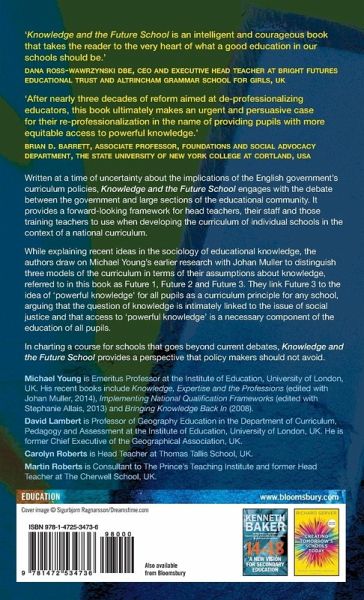
Written at a time of uncertainty about the implications of the English government's curriculum policies, Knowledge and the Future School engages with the debate between the government and large sections of the educational community. It provides a forward-looking framework for head teachers, their staff and those involved in training teachers to use when developing the curriculum of individual schools in the context of a national curriculum. While explaining recent ideas in the sociology of educational knowledge, the authors draw on Michael Young's earlier research with Johan Muller to…mehr
Written at a time of uncertainty about the implications of the English government's curriculum policies, Knowledge and the Future School engages with the debate between the government and large sections of the educational community. It provides a forward-looking framework for head teachers, their staff and those involved in training teachers to use when developing the curriculum of individual schools in the context of a national curriculum. While explaining recent ideas in the sociology of educational knowledge, the authors draw on Michael Young's earlier research with Johan Muller to distinguish three models of the curriculum in terms of their assumptions about knowledge, referred to in this book as Future 1, Future 2 and Future 3. They link Future 3 to the idea of 'powerful knowledge' for all pupils as a curriculum principle for any school, arguing that the question of knowledge is intimately linked to the issue of social justice and that access to 'powerful knowledge' is a necessary component of the education of all pupils. Knowledge and the Future School offers a new way of thinking about the problems that head teachers, their staff and curriculum designers face. In charting a course for schools that goes beyond current debates, it also provides a perspective that policy makers should not avoid.
Michael Young is Emeritus Professor at IOE, UCL's Faculty of Education and Society, University College London, UK. His recent books include Knowledge, Expertise and the Professions (edited with Johan Muller, 2014), Implementing National Qualification Frameworks (edited with Stephanie Allais, 2013) and Bringing Knowledge Back In (2008). David Lambert is Professor of Geography Education in the Department of Curriculum, Pedagogy and Assessment at IOE, UCL's Faculty of Education and Society, University College London, UK. He is former Chief Executive of the Geographical Association, UK. Carolyn Roberts is Head Teacher, Thomas Tallis School, UK. Martin Roberts is Consultant to The Prince's Teaching Institute and former Head Teacher, The Cherwell School, UK.
Inhaltsangabe
Preface: Why should you read this book? Martin Roberts (The Prince's Teaching Institute UK) and Carolyn Roberts (Thomas Tallis School UK) Introduction Michael Young (Institute of Education UK) and David Lambert (Institute of Education UK) Carolyn Roberts (Prince's Teaching Trust UK) and Martin Roberts (The Prince's Teaching Institute UK) 1. Knowledge curriculum and the future school Michael Young (Institute of Education UK) 2. Why curriculum? Michael Young (Institute of Education UK) 3. Powerful Knowledge as a curriculum principle Michael Young (Institute of Education UK) 4. The progressive case for a subject-based curriculum Michael Young (Institute of Education UK) 5. Curriculum change and control: a Headteacher's perspective Martin Roberts (The Prince's Teaching Institute UK) 6. Curriculum leadership and the knowledge-led school Carolyn Roberts (Thomas Tallis School UK) 6. Subject teachers in knowledge-led schools David Lambert (Institute of Education UK) 7. Afterword Michael Young (Institute of Education UK) David Lambert (Institute of Education UK) Carolyn Roberts (Thomas Tallis School UK) and Martin Roberts (The Prince's Teaching Institute UK) Bibliography Index
Preface: Why should you read this book? Martin Roberts (The Prince's Teaching Institute UK) and Carolyn Roberts (Thomas Tallis School UK) Introduction Michael Young (Institute of Education UK) and David Lambert (Institute of Education UK) Carolyn Roberts (Prince's Teaching Trust UK) and Martin Roberts (The Prince's Teaching Institute UK) 1. Knowledge curriculum and the future school Michael Young (Institute of Education UK) 2. Why curriculum? Michael Young (Institute of Education UK) 3. Powerful Knowledge as a curriculum principle Michael Young (Institute of Education UK) 4. The progressive case for a subject-based curriculum Michael Young (Institute of Education UK) 5. Curriculum change and control: a Headteacher's perspective Martin Roberts (The Prince's Teaching Institute UK) 6. Curriculum leadership and the knowledge-led school Carolyn Roberts (Thomas Tallis School UK) 6. Subject teachers in knowledge-led schools David Lambert (Institute of Education UK) 7. Afterword Michael Young (Institute of Education UK) David Lambert (Institute of Education UK) Carolyn Roberts (Thomas Tallis School UK) and Martin Roberts (The Prince's Teaching Institute UK) Bibliography Index
Es gelten unsere Allgemeinen Geschäftsbedingungen: www.buecher.de/agb
Impressum
www.buecher.de ist ein Internetauftritt der buecher.de internetstores GmbH
Geschäftsführung: Monica Sawhney | Roland Kölbl | Günter Hilger
Sitz der Gesellschaft: Batheyer Straße 115 - 117, 58099 Hagen
Postanschrift: Bürgermeister-Wegele-Str. 12, 86167 Augsburg
Amtsgericht Hagen HRB 13257
Steuernummer: 321/5800/1497
USt-IdNr: DE450055826