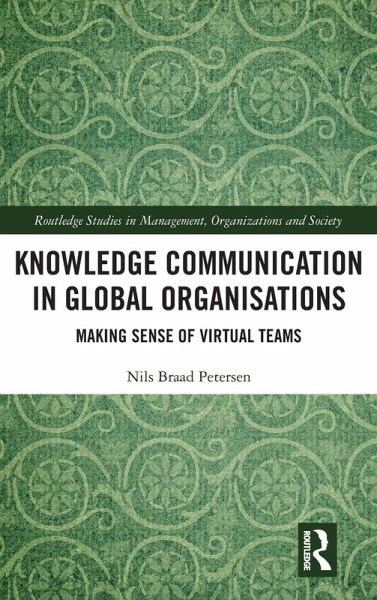
Nils Braad Petersen holds a PhD in Business Communicating from Aarhus University, Denmark.
Inhaltsangabe
Chapter 1: Introduction Part I: Discursive Sensemaking - Foundation, theory & method Chapter 2: Discursive Sensemaking Analysis - a foundation Chapter 3: Discursive Sensemaking Analysis - a theory Chapter 4: Discursive Sensemaking Analysis - a method Part II: Multidisciplinary perspective on knowledge communication practices in virtual teams Chapter 5: Challenges and opportunities of virtual work in global organisations Chapter 6: A vocabulary for describing virtual knowledge communication Chapter 7: Knowing as learning in Communities of Practice (CoP) Chapter 8: Professional identity as (D)iscursive construction Chapter 9: Relationships supporting virtual knowledge communication Chapter 10: Conclusion and discussion of theory and findings
Chapter 1: Introduction Part I: Discursive Sensemaking - Foundation, theory & method Chapter 2: Discursive Sensemaking Analysis - a foundation Chapter 3: Discursive Sensemaking Analysis - a theory Chapter 4: Discursive Sensemaking Analysis - a method Part II: Multidisciplinary perspective on knowledge communication practices in virtual teams Chapter 5: Challenges and opportunities of virtual work in global organisations Chapter 6: A vocabulary for describing virtual knowledge communication Chapter 7: Knowing as learning in Communities of Practice (CoP) Chapter 8: Professional identity as (D)iscursive construction Chapter 9: Relationships supporting virtual knowledge communication Chapter 10: Conclusion and discussion of theory and findings
Chapter 1: Introduction Part I: Discursive Sensemaking - Foundation, theory & method Chapter 2: Discursive Sensemaking Analysis - a foundation Chapter 3: Discursive Sensemaking Analysis - a theory Chapter 4: Discursive Sensemaking Analysis - a method Part II: Multidisciplinary perspective on knowledge communication practices in virtual teams Chapter 5: Challenges and opportunities of virtual work in global organisations Chapter 6: A vocabulary for describing virtual knowledge communication Chapter 7: Knowing as learning in Communities of Practice (CoP) Chapter 8: Professional identity as (D)iscursive construction Chapter 9: Relationships supporting virtual knowledge communication Chapter 10: Conclusion and discussion of theory and findings
Chapter 1: Introduction Part I: Discursive Sensemaking - Foundation, theory & method Chapter 2: Discursive Sensemaking Analysis - a foundation Chapter 3: Discursive Sensemaking Analysis - a theory Chapter 4: Discursive Sensemaking Analysis - a method Part II: Multidisciplinary perspective on knowledge communication practices in virtual teams Chapter 5: Challenges and opportunities of virtual work in global organisations Chapter 6: A vocabulary for describing virtual knowledge communication Chapter 7: Knowing as learning in Communities of Practice (CoP) Chapter 8: Professional identity as (D)iscursive construction Chapter 9: Relationships supporting virtual knowledge communication Chapter 10: Conclusion and discussion of theory and findings
Es gelten unsere Allgemeinen Geschäftsbedingungen: www.buecher.de/agb
Impressum
www.buecher.de ist ein Internetauftritt der buecher.de internetstores GmbH
Geschäftsführung: Monica Sawhney | Roland Kölbl | Günter Hilger
Sitz der Gesellschaft: Batheyer Straße 115 - 117, 58099 Hagen
Postanschrift: Bürgermeister-Wegele-Str. 12, 86167 Augsburg
Amtsgericht Hagen HRB 13257
Steuernummer: 321/5800/1497
USt-IdNr: DE450055826