
Andere Kunden interessierten sich auch für
 Understanding Kubrick's 200185,99 €
 Stanley Kubrick's 200149,99 €
 Kubrick's Men96,99 €
 Stanley Kubrick's The Shining100,00 €
 An Analysis of the complex plot of "Total Recall"14,99 €
 Understanding Kubrick's 200128,99 €
 Kubrick's Monolith34,99 €


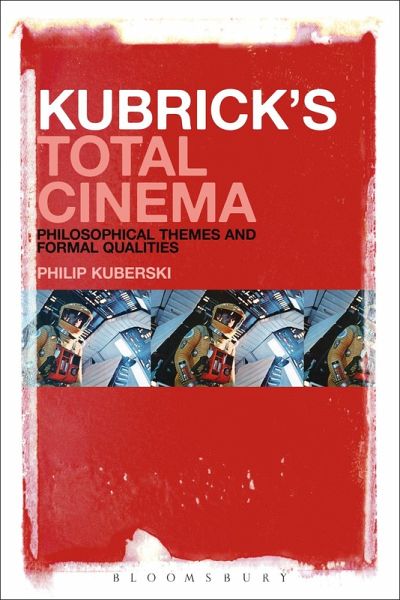
Whatever people think about Kubrick's work, most would agree that there is something distinctive, even unique, about the films he made: a coolness, an intellectual clarity, a critical edginess, and finally an intractable ambiguity. In an attempt to isolate the Kubrick difference, this book treats Kubrick's films to a conceptual and formal analysis rather than a biographical and chronological survey.
As Kubrick's cinema moves between the possibilities of human transcendence dramatized in 2001: A Space Odyssey and the dismal limitations of human nature exhibited in A Clockwork Orange, the filmmaker's style "de-realizes" cinematic realism while, paradoxically, achieving an unprecedented frankness of vision and documentary and technical richness. The result is a kind of vertigo: the audience is made aware of both the de-realized and the realized nature of cinema. As opposed to the usual studies providing a summary and commentary of individual films, this will be the first to provide an analysis of the "elements" of Kubrick's total cinema.
As Kubrick's cinema moves between the possibilities of human transcendence dramatized in 2001: A Space Odyssey and the dismal limitations of human nature exhibited in A Clockwork Orange, the filmmaker's style "de-realizes" cinematic realism while, paradoxically, achieving an unprecedented frankness of vision and documentary and technical richness. The result is a kind of vertigo: the audience is made aware of both the de-realized and the realized nature of cinema. As opposed to the usual studies providing a summary and commentary of individual films, this will be the first to provide an analysis of the "elements" of Kubrick's total cinema.
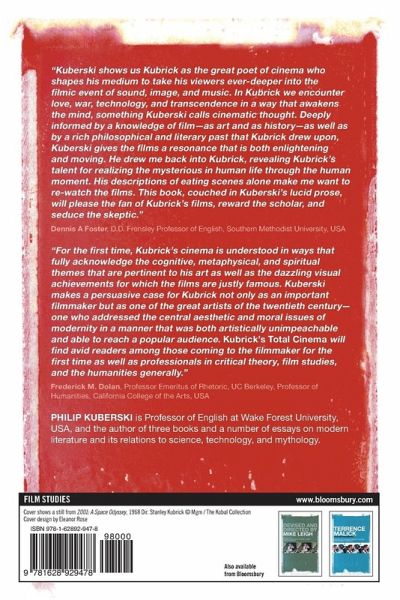
Philip Kuberski's review of Kubrick's films, Kubrick's Total Cinema, masterfully links the grandest themes of those films to the most intimate of physical details. He shows us Kubrick as the great poet of cinema who shapes his medium to take his viewers ever-deeper into the filmic event of sound, image, and music. In Kubrick we encounter love, war, technology and transcendence in a way that awakens the mind, something Kuberski calls cinematic thought. Deeply informed by a knowledge of film--as art and as history-as well as by a rich philosophical and literary past that Kubrick drew upon, Kuberski gives the films a resonance that is both enlightening and moving. He drew me back into Kubrick, revealing Kubrick's talent for realizing the mysterious in human life through the human moment. His descriptions of eating scenes alone make me want to re-watch the films. This book, couched in Kuberski's lucid prose, will please the fan of Kubrick's films, reward the scholar, and seduce the skeptic. Dennis A Foster, D.D. Frensley Professor of English, Southern Methodist University