

Andere Kunden interessierten sich auch für
 Non-Abelian Homological Algebra and Its Applications115,99 €
 Non-Abelian Homological Algebra and Its Applications113,99 €
 K-Theory43,99 €
 K-theory and Homological Algebra31,99 €
 Algebraic K-Theory and Its Applications49,99 €
 Algebraic K-Theory and Its Applications67,99 €
 Arithmetic Algebraic Geometry78,99 €
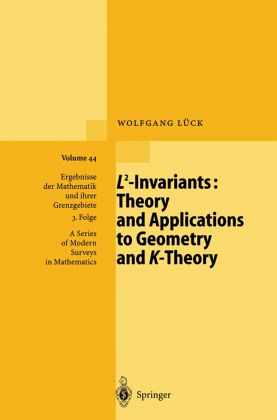
In algebraic topology some classical invariants - such as Betti numbers and Reidemeister torsion - are defined for compact spaces and finite group actions. They can be generalized using von Neumann algebras and their traces, and applied also to non-compact spaces and infinite groups. These new L2-invariants contain very interesting and novel information and can be applied to problems arising in topology, K-Theory, differential geometry, non-commutative geometry and spectral theory. It is particularly these interactions with different fields that make L2-invariants very powerful and exciting. The book presents a comprehensive introduction to this area of research, as well as its most recent results and developments. It is written in a way which enables the reader to pick out a favourite topic and to find the result she or he is interested in quickly and without being forced to go through other material.
From the reviews:
"The book under review represents a fundamental monograph on the theory of L2-invariants. ... To a great extent, it is self-contained. ... The book is very clearly written, it contains many examples and we can find exercises at the end of each chapter. ... At many places in the book, the reader will find hints for further research. ... The book will be of great interest to specialists but it can also be strongly recommended for postgraduate students."
(EMS Newsletter, March, 2005)
"L2-invariants were introduced into topology by Atiyah in 1976 ... . Since then, the theory has been developed successfully by many researchers, among them the author of this monograph ... . This book is an excellent survey of many up-to-date results ... . It could be used as a very good introduction to the subject of L2-invariants ... usable either for self-study or as a text for a graduate course. ... Lück's book will become the primary reference about L2-variants for the foreseeable future."
(Thomas Schick, Mathematical Reviews, 2003 m)
"L2-invariants were introduced into topology by Atiyah in the 1970's ... . The present book is the first substantial monograph on this topic. ... This is an impressive account of much of what is presently known about these invariants ... . It combines features of a text and a reference work; to a considerable degree the chapters can be read independently, and there are numerous nontrivial exercises, with nearly 50 pages of detailed hints at the end."
(Jonathan A. Hillman, Zentralblatt MATH, Vol. 1009, 2003)
"The book under review represents a fundamental monograph on the theory of L2-invariants. ... To a great extent, it is self-contained. ... The book is very clearly written, it contains many examples and we can find exercises at the end of each chapter. ... At many places in the book, the reader will find hints for further research. ... The book will be of great interest to specialists but it can also be strongly recommended for postgraduate students."
(EMS Newsletter, March, 2005)
"L2-invariants were introduced into topology by Atiyah in 1976 ... . Since then, the theory has been developed successfully by many researchers, among them the author of this monograph ... . This book is an excellent survey of many up-to-date results ... . It could be used as a very good introduction to the subject of L2-invariants ... usable either for self-study or as a text for a graduate course. ... Lück's book will become the primary reference about L2-variants for the foreseeable future."
(Thomas Schick, Mathematical Reviews, 2003 m)
"L2-invariants were introduced into topology by Atiyah in the 1970's ... . The present book is the first substantial monograph on this topic. ... This is an impressive account of much of what is presently known about these invariants ... . It combines features of a text and a reference work; to a considerable degree the chapters can be read independently, and there are numerous nontrivial exercises, with nearly 50 pages of detailed hints at the end."
(Jonathan A. Hillman, Zentralblatt MATH, Vol. 1009, 2003)