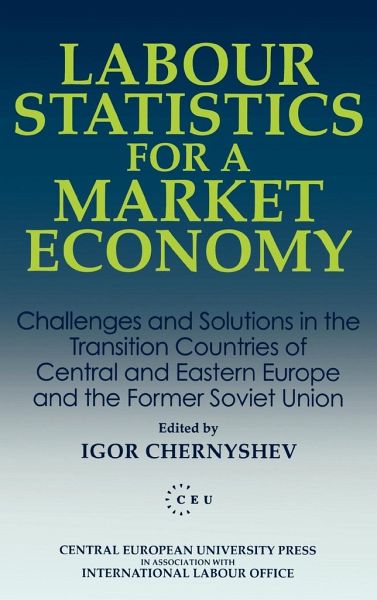
The International Labour Office is the moving force behind the adoption of the Labour Force Survey in Western countries as the only reliable means of gathering information about trends in employment and unemployment, and on pay. The countries of East-Central Europe and the former USSR have recognized their need of such statistiics and turned to the ILO to help them set up systems to provide data required by decision makers. This pioneering work shows how the old "command" economies are setting up brand new systems to classify occupations, to measure employment and unemployment, and to collect…mehr
The International Labour Office is the moving force behind the adoption of the Labour Force Survey in Western countries as the only reliable means of gathering information about trends in employment and unemployment, and on pay. The countries of East-Central Europe and the former USSR have recognized their need of such statistiics and turned to the ILO to help them set up systems to provide data required by decision makers. This pioneering work shows how the old "command" economies are setting up brand new systems to classify occupations, to measure employment and unemployment, and to collect information on wages and labour costs, which will be useful to students of the area and essential for statisticians world-wide concerned with the challenge of instigating an entirely new statistical service.
Igor Chernyshev Member of the ILO Bureau of Statistics since 1986, he previously worked with the Central Statistical Office of Ukraine. He holds a Master's degree in Economics and Statistics from the Kiev State University. His responsibility has been the ILO-comparable employment and unemployment estimates project, which has resulted in the regular publication of comparable data since 1990. He is currently organizing and coordinating the ILO technical support in the field of labour statistics to the countries of Central and Eastern Europe and the former Soviet Union.
Inhaltsangabe
Preface Introduction PART I: MAJOR CHALLENGES IN LABOUR STATISTICS 1. Labour force, employment and unemployment 2. Wage and labour cost 3. Classification of occupations 4. Measuring employment trends, labour shortages and skill gaps in transition countries 5. Revision of labour statistics systems in the countries of the Commonwealth of Independent States in the light of the ILO international recommendations 6. Some aspects of labour analysis in the CIS countries 7. Towards a strategy of reform for systems of pay classification in countries in Central and Eastern Europe 8. Hungarian labour statistics in transition PART 11: LABOUR FORCE, EMPLOYMENT AND UNEMPLOYMENT 9. International standards on the measurement of economic activity, employment, unemployment and underemployment 10. Statistical study of employment and unemployment in the Republic of Belarus 11. The Labour Force Survey in Czechoslovakia 12. The Hungarian Labour Force Survey, 1992: Reference Manual 13. The Polish Labour Force Survey 14. The Labour Force Survey: a means of statistical investigation of the Romanian labour market 15. The guidelines for the transition of Russian Federation III: WAGE AND LABOUR COST 16. International standards of wage statistics: summary 17. Establishment surveys: a review of national practices 18. Wage-fixing policy: consequences of wage data gathering 19. Wage and labour cost statistics in Czechoslovakia 20. The Hungarian Labour Cost Survey 21. Wage statistics in the Republic of Lithuania PART IV: CLASSIFICATION OF OCCUPATIONS 22. The revised International Standard Classification of Occupations (ISCO-88) 23. Mapping a national classification of occupations into ISCO-88: outline of a strategy 24. Mapping the world of work: an international review of the use and gathering of occupational information 25. The revision of the Hungarian system of classifying occupations 26. System of classification and description of occupations in the Soviet Union: structure, purpose and issues relating to improvements, ANNEXES
Preface Introduction PART I: MAJOR CHALLENGES IN LABOUR STATISTICS 1. Labour force, employment and unemployment 2. Wage and labour cost 3. Classification of occupations 4. Measuring employment trends, labour shortages and skill gaps in transition countries 5. Revision of labour statistics systems in the countries of the Commonwealth of Independent States in the light of the ILO international recommendations 6. Some aspects of labour analysis in the CIS countries 7. Towards a strategy of reform for systems of pay classification in countries in Central and Eastern Europe 8. Hungarian labour statistics in transition PART 11: LABOUR FORCE, EMPLOYMENT AND UNEMPLOYMENT 9. International standards on the measurement of economic activity, employment, unemployment and underemployment 10. Statistical study of employment and unemployment in the Republic of Belarus 11. The Labour Force Survey in Czechoslovakia 12. The Hungarian Labour Force Survey, 1992: Reference Manual 13. The Polish Labour Force Survey 14. The Labour Force Survey: a means of statistical investigation of the Romanian labour market 15. The guidelines for the transition of Russian Federation III: WAGE AND LABOUR COST 16. International standards of wage statistics: summary 17. Establishment surveys: a review of national practices 18. Wage-fixing policy: consequences of wage data gathering 19. Wage and labour cost statistics in Czechoslovakia 20. The Hungarian Labour Cost Survey 21. Wage statistics in the Republic of Lithuania PART IV: CLASSIFICATION OF OCCUPATIONS 22. The revised International Standard Classification of Occupations (ISCO-88) 23. Mapping a national classification of occupations into ISCO-88: outline of a strategy 24. Mapping the world of work: an international review of the use and gathering of occupational information 25. The revision of the Hungarian system of classifying occupations 26. System of classification and description of occupations in the Soviet Union: structure, purpose and issues relating to improvements, ANNEXES
Es gelten unsere Allgemeinen Geschäftsbedingungen: www.buecher.de/agb
Impressum
www.buecher.de ist ein Internetauftritt der buecher.de internetstores GmbH
Geschäftsführung: Monica Sawhney | Roland Kölbl | Günter Hilger
Sitz der Gesellschaft: Batheyer Straße 115 - 117, 58099 Hagen
Postanschrift: Bürgermeister-Wegele-Str. 12, 86167 Augsburg
Amtsgericht Hagen HRB 13257
Steuernummer: 321/5800/1497
USt-IdNr: DE450055826