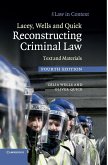
Since the publication of the first edition, this textbook has offered one of the most distinctive and innovative approaches to the study of criminal law. Looking at both traditional and emerging areas, such as public order offences and corporate manslaughter, it offers a broad and thorough perspective on the subject. Material is organised thematically and is clearly signposted at the beginning of each section to allow the student to navigate successfully through the different fields. This fourth edition looks at topical issues such as policing, the Serious Crime Act 2007, and reform of the…mehr
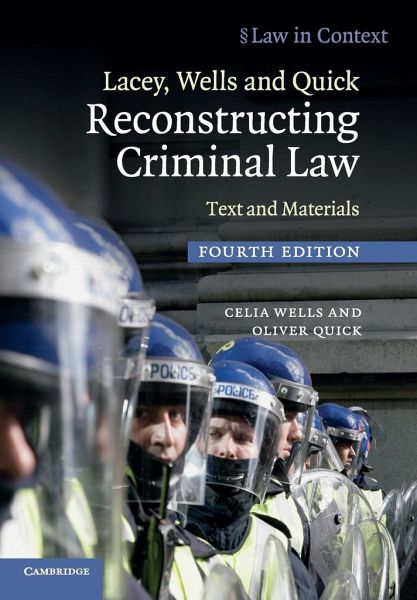
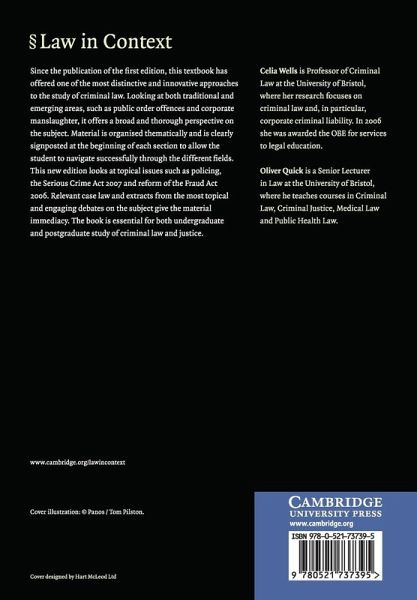
Since the publication of the first edition, this textbook has offered one of the most distinctive and innovative approaches to the study of criminal law. Looking at both traditional and emerging areas, such as public order offences and corporate manslaughter, it offers a broad and thorough perspective on the subject. Material is organised thematically and is clearly signposted at the beginning of each section to allow the student to navigate successfully through the different fields. This fourth edition looks at topical issues such as policing, the Serious Crime Act 2007, and reform of the Fraud Act 2006. Relevant case law and extracts from the most topical and engaging debates on the subject give the subject immediacy. The book is essential for both undergraduate and postgraduate study of criminal law and justice.
Celia Wells is Emerita Professor of Criminal Law at the University of Bristol. An early exponent of the need to understand law in wider contexts, in 1995 she became the first woman law professor at Cardiff. Awarded the OBE in 2006, she is a past President of the Society of Legal Scholars.
Inhaltsangabe
Part I. Approaching Criminal Law: 1. Images of criminal law 2. Criminal laws in context 3. Foundations of criminal law Part II. Law, Order and Security: 4. Social and political constructions of disorder 5. Securing order: pre-emptive measures 6. Public order: control mechanisms 7. Criminal law and justice: emerging themes Part III. Interpersonal Violence, Drug and Alcohol Abuse, Offence Preparation and Participation: 8. Offences against the person 9. Drug and alcohol abuse 10. Offence preparation and participation Part IV. Property and Propriety: 11. Defining and defending private property 12. Constructing property in criminal law 13. Property rights and criminal enforcement Part V. Regulating Sexuality and Bodily Autonomy: A Crisis of Trust and Intimacy?: 14. The social construction of sexuality and bodily autonomy 15. Sexual violence 16. Regulating sexuality 17. Criminalising health care choices Part VI. Making a Killing: Conceptions of Violence: 18. The social construction of violence and personal harm 19. The criminal regulation of public safety 20. Homicide: boundary issues 21. Murder and manslaughter.
Es gelten unsere Allgemeinen Geschäftsbedingungen: www.buecher.de/agb
Impressum
www.buecher.de ist ein Internetauftritt der buecher.de internetstores GmbH
Geschäftsführung: Monica Sawhney | Roland Kölbl | Günter Hilger
Sitz der Gesellschaft: Batheyer Straße 115 - 117, 58099 Hagen
Postanschrift: Bürgermeister-Wegele-Str. 12, 86167 Augsburg
Amtsgericht Hagen HRB 13257
Steuernummer: 321/5800/1497
USt-IdNr: DE450055826