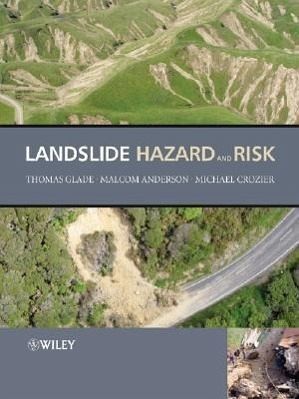
Impacts of landslides range from site destruction, through problems for the maintenance of buildings and infrastructure, to an impediment for economic development. Previous attempts to address landslide risk have either treated components of the problem in isolation or characterised the wider issue from just a single discipline perspective. This book takes a holistic view of landslide hazard and risk through the development of integrated approaches to analysis, perception and management. Landslide Hazard and Risk brings together a wide range of experience, covering the social, economic and…mehr
Impacts of landslides range from site destruction, through problems for the maintenance of buildings and infrastructure, to an impediment for economic development. Previous attempts to address landslide risk have either treated components of the problem in isolation or characterised the wider issue from just a single discipline perspective. This book takes a holistic view of landslide hazard and risk through the development of integrated approaches to analysis, perception and management. Landslide Hazard and Risk brings together a wide range of experience, covering the social, economic and cultural context, management options, and the application of science and technology, for the reduction of risk from landslides. This book is divided into four major parts covering conceptual models in approaching landslide risk, evaluation of risk, management of risk and end-to-end solutions of risk. It examines risk assessment and management from theory to practice, from conventional methodology to future possibilities. * Provides a range of multidisciplinary approaches and guidance on their appropriate use. * Presents specifications and contexts for the next generation of process models. * Focuses on the means and methods of investigation, and the treatment of data to represent the probabilities and uncertainties of hazard and risk. * Evaluates state-of-the-art techniques and future directions. This book is essential reading for professionals and practitioners in landscape, watershed and hazard management, as well as risk analysts, geomorphologists, hydrologists, foresters and environmental consultants. Would be excellent background reading for researchers and graduate students interested in landslides, hazards, risk assessment and slope stability in Departments of Geography, Earth Science, Environmental Science, Civil Engineering and Planning.
Thomas Glade is the editor of Landslide Hazard and Risk, published by Wiley. Malcolm G. Anderson is the editor of Landslide Hazard and Risk, published by Wiley. Michael J. Crozier is the editor of Landslide Hazard and Risk, published by Wiley.
Inhaltsangabe
List of Contributors. Preface. 1. Landslide Hazard and Risk: Issues, Concepts, and Approach(M. J. Crozier and T. Glade). Part I: Conceptual Models in Approaching LandslideRisk. 2. The nature of landslide hazard impact (T. Glade & M.Crozier). 3. A review of scale dependency in landslide hazard and risk(T. Glade & M. Crozier). 4. Systematic procedures of landslide-hazard mapping for riskassessment using spatial prediction models (Chang-Jo F. Chung& Andrea G. Fabbri). 5.Vulnerability to landslides (David Alexander). Part II: Evaluation of Risk. 6. Landslide risk perception, knowledge, and associated riskmanagement: Case studies and general lessons from Glacier NationalPark, Montana, USA (David R. Butler & Lisa M.DeChano). 7. Cultural consideration in landslide risk perception (GarthHarmsworth & Bill Raynor). 8 Reply of insurance industry to landslide risk (Hans-LeoPaus). 9. The role of administrative bodies in landslide riskassessment (Kurt Hollenstein). 10. Addressing landslide hazards: Towards a knowledge managementperspective (S. Michaels). Part III: Management of Landslide Risk. 11. Management frameworks for landslide hazard and risk: issuesand options (M. J. Crozier). 12. Reducing landslide hazards and risk in the United States:The role of the U. S. Geological Survey (G. F. Wieczorek, P. L.Gori & L. M. Highland). 13. Basic data and decision support for landslide management: Aconceptual framework (Walter Pfluegner). 14. Instability management from policy to practice (R.McInnes). 15. Geomorphologic mapping to assess landslide risk: concepts,methods and applications in the Umbria Region of central Italy(Paola Reichenbach, Mirco Galli, Mauro Cardinali, FaustoGuzzetti & Francesca Ardizzone). 16. Remote sensing of landslides (Vern Singhroy). 17. The rise and fall of a debris-flow warning system for theSan Francisco Bay Region, California (Raymond C.Wilson). 18. Reforestation schemes to manage regional landslide risk(Chris Phillips & Michael Marden). 19. Geotechnical structures for landslide risk reduction(Edward Nicholas Bromhead). Part IV: 'End-to-End Solutions' for LandslideRisk Assessment. 20. Towards the development of a landslide risk assessment forrural roads in Nepal (D. Petley, G. J. Hearn & A.Hart). 21. Quantitative landslide risk assessment of Cairns, Australia(Marion Michael-Leiba, Fred Baynes, Greg Scott & KenGranger). 22. The story of quantified risk and its place in slope safetypolicy in Hong Kong (A. W. Malone). 23. Rockfall risk management in high density urban areas. TheAndorran experience (Ramon Copons, Joan Manuel Vilaplana, JordiCorominas, Joan Altimir & Jordi Amigó). 24. Landslide risk assessment in Italy (MarinoSorriso-Valvo). 25. An initial approach to identifying slope stability controlsin southern Java and to providing community-based landslide warninginformation (D. Karnawati, I. Ibriam, M. G. Anderson, E. A.Holcombe, G. T. Mummery, J-P. Renaud & Y. Wang). Part V: Synopsis. 26. Landslide hazard and risk - concluding comment andperspectives (T. Glade & M. Crozier). Glossary. Thematic Index. Locations/regions.
Es gelten unsere Allgemeinen Geschäftsbedingungen: www.buecher.de/agb
Impressum
www.buecher.de ist ein Internetauftritt der buecher.de internetstores GmbH
Geschäftsführung: Monica Sawhney | Roland Kölbl | Günter Hilger
Sitz der Gesellschaft: Batheyer Straße 115 - 117, 58099 Hagen
Postanschrift: Bürgermeister-Wegele-Str. 12, 86167 Augsburg
Amtsgericht Hagen HRB 13257
Steuernummer: 321/5800/1497
USt-IdNr: DE450055826