Jan Nuyts / Eric Pederson (eds.)
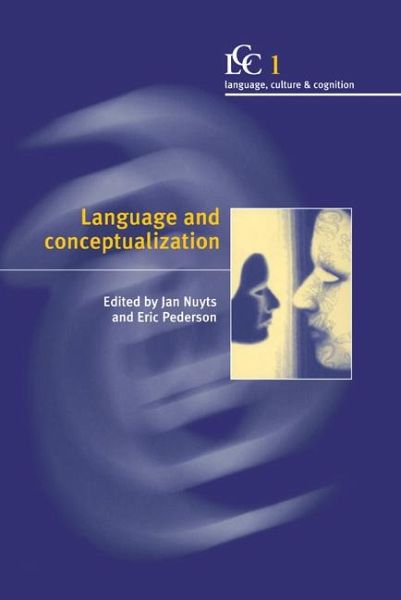
Language and Conceptualization
Herausgeber: Nuyts, Jan; Levinson, Stephen C.; Pederson, Eric
Jan Nuyts / Eric Pederson (eds.)
Language and Conceptualization
Herausgeber: Nuyts, Jan; Levinson, Stephen C.; Pederson, Eric
- Gebundenes Buch
- Merkliste
- Auf die Merkliste
- Bewerten Bewerten
- Teilen
- Produkt teilen
- Produkterinnerung
- Produkterinnerung
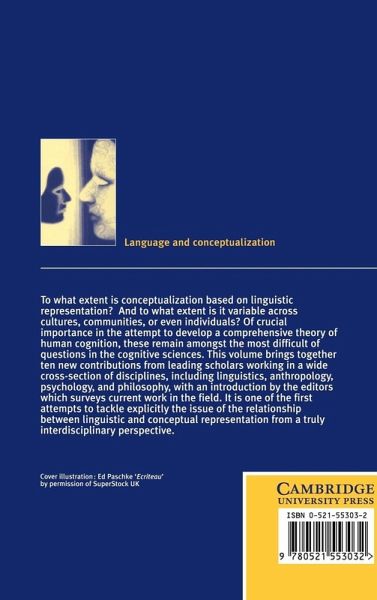
This is one of the first attempts to tackle the issue of the relationship between linguistic and conceptual representation from a truly interdisciplinary perspective.
Andere Kunden interessierten sich auch für
Tatiana LavrentievaStructural organization of the conceptual field of oppositeness45,99 €
Yusuf Ahmed GwarzoA Study on Metaphoric and Metonymic Expressions in Hausa41,99 €
Chang Chung-AnOn Qian Zhongshu's Conceptualization of Translation178,99 €
Jordan H. LeeThe AI Screenwriter's Guide19,99 €
Shu-Ling WuCognitive Linguistics and Second Language Acquisition of Chinese111,99 €
Madeleine Bates / M. Weischedel (eds.)Challenges in Natural Language Processing111,99 €
Federica Busa / Pierrette Bouillon (eds.)The Language of Word Meaning121,99 €-
-
-
This is one of the first attempts to tackle the issue of the relationship between linguistic and conceptual representation from a truly interdisciplinary perspective.
Produktdetails
- Produktdetails
- Verlag: Cambridge University Press
- Seitenzahl: 292
- Erscheinungstermin: 22. November 2005
- Englisch
- Abmessung: 235mm x 157mm x 22mm
- Gewicht: 628g
- ISBN-13: 9780521553032
- ISBN-10: 0521553032
- Artikelnr.: 22462666
- Herstellerkennzeichnung
- Libri GmbH
- Europaallee 1
- 36244 Bad Hersfeld
- gpsr@libri.de
- Verlag: Cambridge University Press
- Seitenzahl: 292
- Erscheinungstermin: 22. November 2005
- Englisch
- Abmessung: 235mm x 157mm x 22mm
- Gewicht: 628g
- ISBN-13: 9780521553032
- ISBN-10: 0521553032
- Artikelnr.: 22462666
- Herstellerkennzeichnung
- Libri GmbH
- Europaallee 1
- 36244 Bad Hersfeld
- gpsr@libri.de
1. Overview: on the relationship between language and conceptualization
Eric Pederson and Jan Nuyts; 2. From outer to inner space: linguistic
categories and non-linguistic thinking Stephen C. Levinson; 3. Spatial
operations in deixis, cognition and culture: where to orient oneself in
Behlare Balthasar Bickel; 4. Remote worlds: the conceptual representation
of linguistic world Paul Werth; 5. Role and individual interpretations of
change predicates Eve Sweetser; 6. Changing place in English and German:
language-specific preferences in the conceptualisation of spatial relations
Mary Carroll; 7. Mapping conceptual representations into linguistic
representations: the role of attention in grammar Russell S. Tomlin; 8.
Growth points cross-linguistically David McNeill; 9. On the modularity of
sentence processing: semantical generality and the language of thought Jay
David Atlas; 10. The contextual basis of cognitive semantics Ronald W.
Langacker; 11. The cognitive foundations of pragmatic principles:
implications for theories of linguistic and cognitive representation Edward
A. Robinson.
Eric Pederson and Jan Nuyts; 2. From outer to inner space: linguistic
categories and non-linguistic thinking Stephen C. Levinson; 3. Spatial
operations in deixis, cognition and culture: where to orient oneself in
Behlare Balthasar Bickel; 4. Remote worlds: the conceptual representation
of linguistic world Paul Werth; 5. Role and individual interpretations of
change predicates Eve Sweetser; 6. Changing place in English and German:
language-specific preferences in the conceptualisation of spatial relations
Mary Carroll; 7. Mapping conceptual representations into linguistic
representations: the role of attention in grammar Russell S. Tomlin; 8.
Growth points cross-linguistically David McNeill; 9. On the modularity of
sentence processing: semantical generality and the language of thought Jay
David Atlas; 10. The contextual basis of cognitive semantics Ronald W.
Langacker; 11. The cognitive foundations of pragmatic principles:
implications for theories of linguistic and cognitive representation Edward
A. Robinson.
1. Overview: on the relationship between language and conceptualization
Eric Pederson and Jan Nuyts; 2. From outer to inner space: linguistic
categories and non-linguistic thinking Stephen C. Levinson; 3. Spatial
operations in deixis, cognition and culture: where to orient oneself in
Behlare Balthasar Bickel; 4. Remote worlds: the conceptual representation
of linguistic world Paul Werth; 5. Role and individual interpretations of
change predicates Eve Sweetser; 6. Changing place in English and German:
language-specific preferences in the conceptualisation of spatial relations
Mary Carroll; 7. Mapping conceptual representations into linguistic
representations: the role of attention in grammar Russell S. Tomlin; 8.
Growth points cross-linguistically David McNeill; 9. On the modularity of
sentence processing: semantical generality and the language of thought Jay
David Atlas; 10. The contextual basis of cognitive semantics Ronald W.
Langacker; 11. The cognitive foundations of pragmatic principles:
implications for theories of linguistic and cognitive representation Edward
A. Robinson.
Eric Pederson and Jan Nuyts; 2. From outer to inner space: linguistic
categories and non-linguistic thinking Stephen C. Levinson; 3. Spatial
operations in deixis, cognition and culture: where to orient oneself in
Behlare Balthasar Bickel; 4. Remote worlds: the conceptual representation
of linguistic world Paul Werth; 5. Role and individual interpretations of
change predicates Eve Sweetser; 6. Changing place in English and German:
language-specific preferences in the conceptualisation of spatial relations
Mary Carroll; 7. Mapping conceptual representations into linguistic
representations: the role of attention in grammar Russell S. Tomlin; 8.
Growth points cross-linguistically David McNeill; 9. On the modularity of
sentence processing: semantical generality and the language of thought Jay
David Atlas; 10. The contextual basis of cognitive semantics Ronald W.
Langacker; 11. The cognitive foundations of pragmatic principles:
implications for theories of linguistic and cognitive representation Edward
A. Robinson.