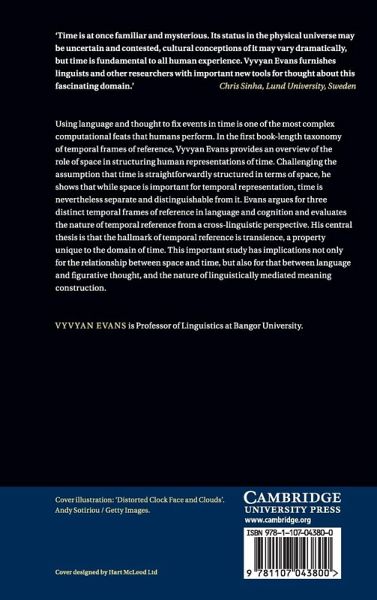
Using language and thought to fix events in time is one of the most complex computational feats that humans perform. In the first book-length taxonomy of temporal frames of reference, Vyvyan Evans provides an overview of the role of space in structuring human representations of time. Challenging the assumption that time is straightforwardly structured in terms of space, he shows that while space is important for temporal representation, time is nevertheless separate and distinguishable from it. Evans argues for three distinct temporal frames of reference in language and cognition and evaluates…mehr
Using language and thought to fix events in time is one of the most complex computational feats that humans perform. In the first book-length taxonomy of temporal frames of reference, Vyvyan Evans provides an overview of the role of space in structuring human representations of time. Challenging the assumption that time is straightforwardly structured in terms of space, he shows that while space is important for temporal representation, time is nevertheless separate and distinguishable from it. Evans argues for three distinct temporal frames of reference in language and cognition and evaluates the nature of temporal reference from a cross-linguistic perspective. His central thesis is that the hallmark of temporal reference is transience, a property unique to the domain of time. This important study has implications not only for the relationship between space and time, but also for that between language and figurative thought, and the nature of linguistically-mediated meaning construction.
Vyvyan Evans is a native of Chester, England. He holds a PhD in linguistics from Georgetown University, Washington, D.C., and is a Professor of Linguistics. He has published numerous acclaimed popular science and technical books on language and linguistics. His popular science essays and articles have appeared in numerous venues including 'The Guardian', 'Psychology Today', 'New York Post', 'New Scientist', 'Newsweek' and 'The New Republic'. His award-winning writing focuses, in one way or another, on the nature of language and mind, the impact of technology on language, and the future of communication. His science fiction work explores the status of language and digital communication technology as potential weapons of mass destruction. For further biographical details visit his official website: www.vyvevans.net. For details of his science fiction writing, visit the Songs of the Sage book series website: www.songs-of-the-sage.com.
Inhaltsangabe
Part I. Orientation: 1. Introduction 2. Access semantics 3. The nature of temporal reference Part II. Temporal Frames of Reference: 4. Deictic temporal reference 5. Sequential temporal reference 6. Extrinsic temporal reference 7. Time versus space Part III. Meaning Construction and Temporal Reference: 8. Conceptual metaphors and lexical concepts 9. Figurative meaning construction in LCCM theory 10. Semantic affordances and temporal reference 11. Universals and diversity in the cross-linguistic representation of time.
Part I. Orientation: 1. Introduction 2. Access semantics 3. The nature of temporal reference Part II. Temporal Frames of Reference: 4. Deictic temporal reference 5. Sequential temporal reference 6. Extrinsic temporal reference 7. Time versus space Part III. Meaning Construction and Temporal Reference: 8. Conceptual metaphors and lexical concepts 9. Figurative meaning construction in LCCM theory 10. Semantic affordances and temporal reference 11. Universals and diversity in the cross-linguistic representation of time.
Es gelten unsere Allgemeinen Geschäftsbedingungen: www.buecher.de/agb
Impressum
www.buecher.de ist ein Internetauftritt der buecher.de internetstores GmbH
Geschäftsführung: Monica Sawhney | Roland Kölbl | Günter Hilger
Sitz der Gesellschaft: Batheyer Straße 115 - 117, 58099 Hagen
Postanschrift: Bürgermeister-Wegele-Str. 12, 86167 Augsburg
Amtsgericht Hagen HRB 13257
Steuernummer: 321/5800/1497
USt-IdNr: DE450055826