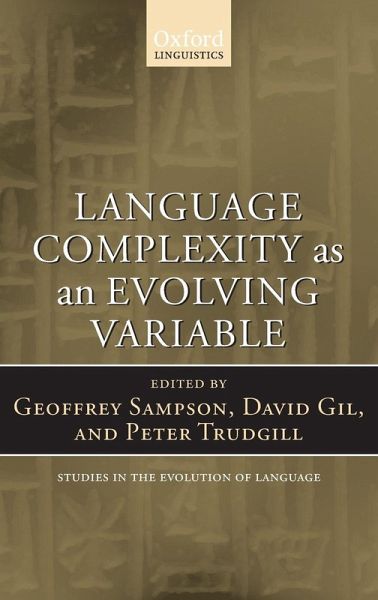
This fascinating book challenges the idea that languages are equally complex. Eighteen scholars look at evidence from a wide range of times and places. They consider the links between linguistic structure and change and social complexity. Their conclusions challenge conventional ideas about the nature of language and contemporary theory.
This fascinating book challenges the idea that languages are equally complex. Eighteen scholars look at evidence from a wide range of times and places. They consider the links between linguistic structure and change and social complexity. Their conclusions challenge conventional ideas about the nature of language and contemporary theory.
Geoffrey Sampson is Professor of Natural Language Computing at the University of Sussex. He has held positions at SOAS and LSE and at the universities of Oxford, Lancaster, and Leeds, where he was Professor of Linguistics from 1985-1990. His recent books include Empirical Linguistics and The 'Language Instinct' Debate (Continuum 2001 and 2005), and Love Songs of Early China (Shaun Tyas, 2006). David Gil is Scientific Researcher at the Max Planck Institute for Evolutionary Anthropology in Leipzig. He has held positions at UCLA, the University of Tel Aviv, and at the National University of Singapore. He is co-editor of The World Atlas of Language Structure (OUP, 2005) and author of numerous articles in journals such as Linguistic Inquiry and Linguistics . Peter Trudgill is Professor Emeritus of English Linguistics at the University of Fribourg. He previously held chairs at the Universities of Lausanne, Essex, and Reading. He is also Adjunct Professor at La Trobe University, Adjunct Professor at Agder University, and Honorary Professor at the University of East Anglia. His books include Dialects in Contact (Blackwell, 1986), Sociolinguistics (fourth edition, Penguin 2000), and New-dialect formation: on the inevitability of colonial Englishes (Edinburgh, 2004).
Inhaltsangabe
* 1: Geoffrey Sampson: A Linguistic Axiom Challenged * 2: David Gil: How Much grammar Does it Take to Sail a Boat? * 3: Walter Bisang: On the Evolution of Complexity - Sometimes Less is More in East and Mainland Southeast Asia * 4: Ãsten Dahl: Testing the Assumption of Complexity Invariance: The Case of Elfdalian and Swedish * 5: Benedikt Szmrecsanyi and Bernd Kortmann: Between Simplification and Complexification: Non-standard Varieties of English Around the World * 6: Matti Miestamo: Implicational Hierarchies and Grammatical Complexity * 7: Peter Trudgill: Sociolinguistic Typology and Complexification * 8: Johanna Nichols: Linguistic Complexity: A Comprehensive Definition and Survey * 9: Kaius Sinnemÿki: Complexity in Core Argument Marking and Population Size * 10: John McWhorter: Oh noo!: A Bewilderingly Multifunctional Saramaccan Word Teaches us How a Creole Language Develops Complexity * 11: Utz Maas: Orality Versus Literacy as a Dimension of Complexity * 12: Ngoni Chipere: Individual Differences in Processing complex Grammatical Structures * 13: Fred Karlsson: Origin and Maintenance of Clausal Embedding Complexity * 14: Ljiljana Progovac: Layering of Grammar: Vestiges of Protosyntax in Present-day Languages * 15: Geoffrey Sampson: An Interview With Dan Everett * 16: EugÃ(c)nie Stapert: Universals in Language or Cognition? Evidence from English Languae Acquisition and from Pirahã * 17: Guy Deutscher: "Overall Complexity" - a Wild Goose Chase? * 18: John A. Hawkins: An Efficiency Theory of Complexity and Related Phenomena * 19: The Editors: Envoi * References * Index
* 1: Geoffrey Sampson: A Linguistic Axiom Challenged * 2: David Gil: How Much grammar Does it Take to Sail a Boat? * 3: Walter Bisang: On the Evolution of Complexity - Sometimes Less is More in East and Mainland Southeast Asia * 4: Ãsten Dahl: Testing the Assumption of Complexity Invariance: The Case of Elfdalian and Swedish * 5: Benedikt Szmrecsanyi and Bernd Kortmann: Between Simplification and Complexification: Non-standard Varieties of English Around the World * 6: Matti Miestamo: Implicational Hierarchies and Grammatical Complexity * 7: Peter Trudgill: Sociolinguistic Typology and Complexification * 8: Johanna Nichols: Linguistic Complexity: A Comprehensive Definition and Survey * 9: Kaius Sinnemÿki: Complexity in Core Argument Marking and Population Size * 10: John McWhorter: Oh noo!: A Bewilderingly Multifunctional Saramaccan Word Teaches us How a Creole Language Develops Complexity * 11: Utz Maas: Orality Versus Literacy as a Dimension of Complexity * 12: Ngoni Chipere: Individual Differences in Processing complex Grammatical Structures * 13: Fred Karlsson: Origin and Maintenance of Clausal Embedding Complexity * 14: Ljiljana Progovac: Layering of Grammar: Vestiges of Protosyntax in Present-day Languages * 15: Geoffrey Sampson: An Interview With Dan Everett * 16: EugÃ(c)nie Stapert: Universals in Language or Cognition? Evidence from English Languae Acquisition and from Pirahã * 17: Guy Deutscher: "Overall Complexity" - a Wild Goose Chase? * 18: John A. Hawkins: An Efficiency Theory of Complexity and Related Phenomena * 19: The Editors: Envoi * References * Index
Es gelten unsere Allgemeinen Geschäftsbedingungen: www.buecher.de/agb
Impressum
www.buecher.de ist ein Internetauftritt der buecher.de internetstores GmbH
Geschäftsführung: Monica Sawhney | Roland Kölbl | Günter Hilger
Sitz der Gesellschaft: Batheyer Straße 115 - 117, 58099 Hagen
Postanschrift: Bürgermeister-Wegele-Str. 12, 86167 Augsburg
Amtsgericht Hagen HRB 13257
Steuernummer: 321/5800/1497
USt-IdNr: DE450055826