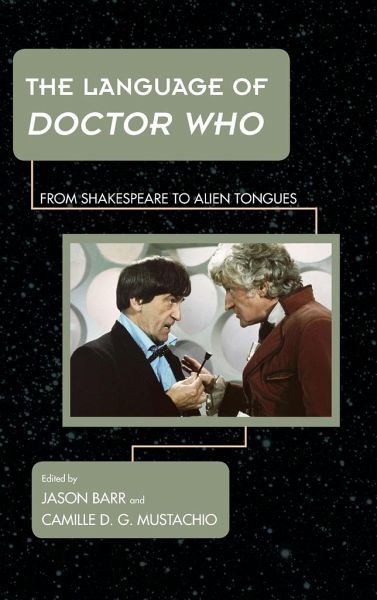
The BBC television series Doctor Who has been a cherished cornerstone of science fiction for five decades. This edited collection provides critical analyses of the series, connecting popular culture and academia through its exploration of the rich intersection of language, literature, and text in Doctor Who. Essays delve into a wide range of topics, from semantics to fandom and the power of the written word.
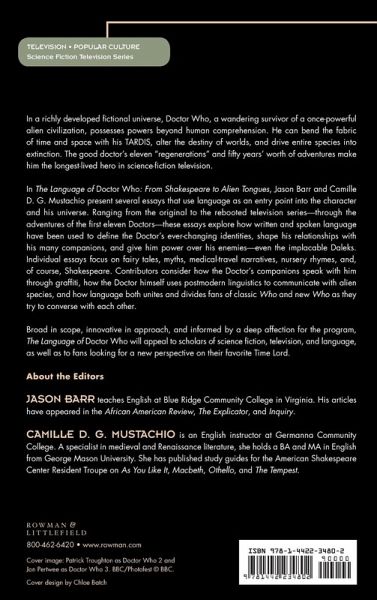
The BBC television series Doctor Who has been a cherished cornerstone of science fiction for five decades. This edited collection provides critical analyses of the series, connecting popular culture and academia through its exploration of the rich intersection of language, literature, and text in Doctor Who. Essays delve into a wide range of topics, from semantics to fandom and the power of the written word.
Jason Barr teaches English at Blue Ridge Community College in Virginia. His articles have appeared in the African American Review, The Explicator, and Inquiry. Camille D. G. Mustachio is an English instructor at Germanna Community College. A specialist in medieval and Renaissance literature, she holds a BA and MA in English from George Mason University. She has published study guides for the American Shakespeare Center Resident Troupe on As You Like It, Macbeth, Othello, and The Tempest.
Inhaltsangabe
Acknowledgments Introduction: "It Looks Like You Need a Doctor" Part One: Classic Who Chapter 1: Doctor who? What's he talking about?: Performativity and the First Doctor, Dene October Chapter 2: A Contribution to Dialogue: Doctor Who and the (Un)Spoken Word, Andrew O'Day Chapter 3: "The Moment Has Been Prepared For": Regeneration and Language in "Logopolis" and "Castrovalva," Rhonda Knight Chapter 4: Sensation, Serialization, and Seven: Reading Doctor Who as a Mid-Victorian Text through "Ghost Light," Sam Maggs Chapter 5: The Sylvester McCoy Era of Target Books and the Literary Experience, Ramie Tateishi Chapter 6: The Doctor's Wondrous Wandering Dialectic Approach to the Universe, Sheila Sandapen Part Two: New Who Chapter 7: The Wolf, the Sparrow, and the River: Feminine Empowerment through Graffiti, Camille D. G. Mustachio Chapter 8: Translation Failure: The TARDIS, Cross-Temporal Language Contact, and Medieval Travel Narrative, Jonathan Hsy Chapter 9: Brave New Words: Theatre as Magic in "The Shakespeare Code," Buket Akgün Chapter 10: A Utopia of Words: Doctor Who, Shakespeare, and the Gendering of Utopia, Delilah Bermudez Brataas Chapter 11: Silence in the Archives: The Magic of Libraries, Valerie Estelle Frankel Chapter 12: Destructive Texts and the Uncanny in "Human Nature"/"Family of Blood," Dana Fore Chapter 13: "All Your Little Tin Soldiers": Doctor Who and the Language of the First World War, David Budgen Chapter 14: Fairy Tales, Nursery Rhymes and Myths in Steven Moffat's Doctor Who, Anne Malewski Chapter 15: The Language of Myth: Violence and the Sacred in Doctor Who, Lori A. Davis Perry Chapter 16: The Doctor and Amy Pond: A Bedtime Story, Michael Billings Chapter 17: Language Games in the Whoniverse, Erica Moore Chapter 18: The Discourse of Authenticity in the Doctor Who Fan Community, Katie Booth and Paul Booth
Acknowledgments Introduction: "It Looks Like You Need a Doctor" Part One: Classic Who Chapter 1: Doctor who? What's he talking about?: Performativity and the First Doctor, Dene October Chapter 2: A Contribution to Dialogue: Doctor Who and the (Un)Spoken Word, Andrew O'Day Chapter 3: "The Moment Has Been Prepared For": Regeneration and Language in "Logopolis" and "Castrovalva," Rhonda Knight Chapter 4: Sensation, Serialization, and Seven: Reading Doctor Who as a Mid-Victorian Text through "Ghost Light," Sam Maggs Chapter 5: The Sylvester McCoy Era of Target Books and the Literary Experience, Ramie Tateishi Chapter 6: The Doctor's Wondrous Wandering Dialectic Approach to the Universe, Sheila Sandapen Part Two: New Who Chapter 7: The Wolf, the Sparrow, and the River: Feminine Empowerment through Graffiti, Camille D. G. Mustachio Chapter 8: Translation Failure: The TARDIS, Cross-Temporal Language Contact, and Medieval Travel Narrative, Jonathan Hsy Chapter 9: Brave New Words: Theatre as Magic in "The Shakespeare Code," Buket Akgün Chapter 10: A Utopia of Words: Doctor Who, Shakespeare, and the Gendering of Utopia, Delilah Bermudez Brataas Chapter 11: Silence in the Archives: The Magic of Libraries, Valerie Estelle Frankel Chapter 12: Destructive Texts and the Uncanny in "Human Nature"/"Family of Blood," Dana Fore Chapter 13: "All Your Little Tin Soldiers": Doctor Who and the Language of the First World War, David Budgen Chapter 14: Fairy Tales, Nursery Rhymes and Myths in Steven Moffat's Doctor Who, Anne Malewski Chapter 15: The Language of Myth: Violence and the Sacred in Doctor Who, Lori A. Davis Perry Chapter 16: The Doctor and Amy Pond: A Bedtime Story, Michael Billings Chapter 17: Language Games in the Whoniverse, Erica Moore Chapter 18: The Discourse of Authenticity in the Doctor Who Fan Community, Katie Booth and Paul Booth
Es gelten unsere Allgemeinen Geschäftsbedingungen: www.buecher.de/agb
Impressum
www.buecher.de ist ein Internetauftritt der buecher.de internetstores GmbH
Geschäftsführung: Monica Sawhney | Roland Kölbl | Günter Hilger
Sitz der Gesellschaft: Batheyer Straße 115 - 117, 58099 Hagen
Postanschrift: Bürgermeister-Wegele-Str. 12, 86167 Augsburg
Amtsgericht Hagen HRB 13257
Steuernummer: 321/5800/1497
USt-IdNr: DE450055826