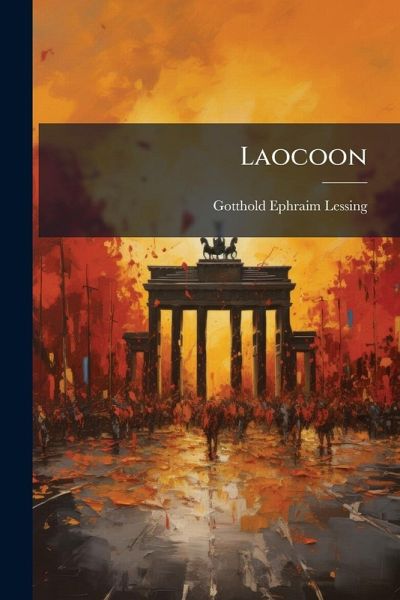
Gotthold Ephraim Lessing's "Laocoon: An Essay on the Limits of Painting and Poetry," is a foundational text in aesthetics and literary theory. This translation offers English readers access to Lessing's influential exploration of the distinct characteristics and boundaries of visual and literary arts. Lessing delves into the classical sculpture of Laocoon and his sons to consider how painting and poetry achieve different effects and are subject to different limitations. He argues for a clear separation of the arts, emphasizing that painting should focus on visual beauty and poetry on actions…mehr
Gotthold Ephraim Lessing's "Laocoon: An Essay on the Limits of Painting and Poetry," is a foundational text in aesthetics and literary theory. This translation offers English readers access to Lessing's influential exploration of the distinct characteristics and boundaries of visual and literary arts. Lessing delves into the classical sculpture of Laocoon and his sons to consider how painting and poetry achieve different effects and are subject to different limitations. He argues for a clear separation of the arts, emphasizing that painting should focus on visual beauty and poetry on actions and emotions. This essay remains a vital contribution to understanding the principles of art criticism and the enduring debate over the relationship between form and content. This work has been selected by scholars as being culturally important, and is part of the knowledge base of civilization as we know it. This work was reproduced from the original artifact, and remains as true to the original work as possible. Therefore, you will see the original copyright references, library stamps (as most of these works have been housed in our most important libraries around the world), and other notations in the work. This work is in the public domain in the United States of America, and possibly other nations. Within the United States, you may freely copy and distribute this work, as no entity (individual or corporate) has a copyright on the body of the work. As a reproduction of a historical artifact, this work may contain missing or blurred pages, poor pictures, errant marks, etc. Scholars believe, and we concur, that this work is important enough to be preserved, reproduced, and made generally available to the public. We appreciate your support of the preservation process, and thank you for being an important part of keeping this knowledge alive and relevant.
Gotthold Ephraim Lessing was a German philosopher, dramatist, publicist, and art critic whose work shaped the course of German literature during the Enlightenment. Born on January 22, 1729, in Kamenz, Germany, he was the son of Johann Gottfried Lessing and Justine Salome Feller. From an early age, he displayed a keen interest in learning, which eventually led him to study theology and medicine before fully turning to literature and philosophy. Lessing s writings, both creative and theoretical, pushed forward ideas of religious tolerance, intellectual freedom, and the importance of critical inquiry. Among his most influential works are his plays and essays, which challenged rigid dogmas and encouraged open-minded discourse. His admiration for figures like Aristotle, William Shakespeare, Johann Joachim Winckelmann, and Voltaire shaped his intellectual development. Lessing s career spanned roles as a playwright, critic, and philosopher, making him a central figure in the German Enlightenment. He had siblings, including Karl Gotthelf Lessing and Dorothea Salome Lessing, with whom he maintained connections throughout his life. Lessing died on February 15, 1781, in Lower Saxony, Germany, leaving behind a legacy of bold thinking and transformative contributions to art, literature, and philosophy.
Es gelten unsere Allgemeinen Geschäftsbedingungen: www.buecher.de/agb
Impressum
www.buecher.de ist ein Internetauftritt der buecher.de internetstores GmbH
Geschäftsführung: Monica Sawhney | Roland Kölbl | Günter Hilger
Sitz der Gesellschaft: Batheyer Straße 115 - 117, 58099 Hagen
Postanschrift: Bürgermeister-Wegele-Str. 12, 86167 Augsburg
Amtsgericht Hagen HRB 13257
Steuernummer: 321/5800/1497
USt-IdNr: DE450055826