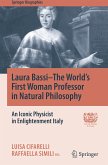
This book presents the extraordinary story of a Bolognese woman of the settecento. Laura Maria Caterina Bassi (1711-1778) defended 49 Theses at the University of Bologna on April 17, 1732 and was awarded a doctoral degree on May 12 of the same year. Three weeks before her defense, she was made a member of the Academy of Sciences in Bologna. On June 27 she defended 12 additional Theses. Several of the 61 Theses were on physics and other science topics. Laura was drawn by the philosophy of Newton at a time when most scientists in Europe were still focused on Descartes and Galen. This last set of…mehr
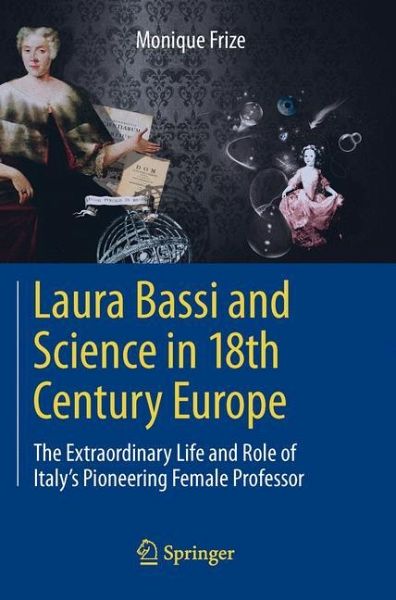
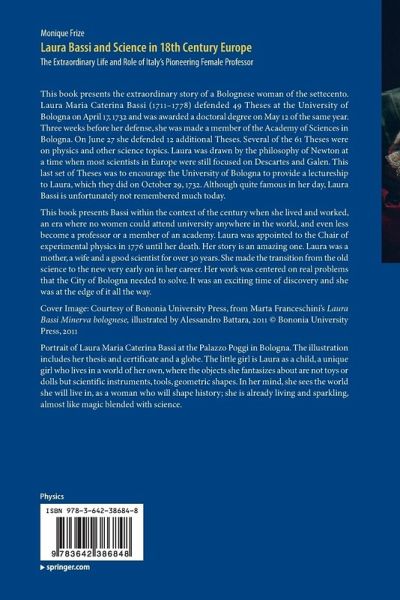
This book presents the extraordinary story of a Bolognese woman of the settecento. Laura Maria Caterina Bassi (1711-1778) defended 49 Theses at the University of Bologna on April 17, 1732 and was awarded a doctoral degree on May 12 of the same year. Three weeks before her defense, she was made a member of the Academy of Sciences in Bologna. On June 27 she defended 12 additional Theses. Several of the 61 Theses were on physics and other science topics. Laura was drawn by the philosophy of Newton at a time when most scientists in Europe were still focused on Descartes and Galen. This last set of Theses was to encourage the University of Bologna to provide a lectureship to Laura, which they did on October 29, 1732. Although quite famous in her day, Laura Bassi is unfortunately not remembered much today.
This book presents Bassi within the context of the century when she lived and worked, an era where no women could attend university anywhere in the world, and even less become a professor or a member of an academy. Laura was appointed to the Chair of experimental physics in 1776 until her death. Her story is an amazing one. Laura was a mother, a wife and a good scientist for over 30 years. She made the transition from the old science to the new very early on in her career. Her work was centered on real problems that the City of Bologna needed to solve. It was an exciting time of discovery and she was at the edge of it all the way.
Artikelnr. des Verlages: 86153464, 978-3-642-38684-8
Seitenzahl: 216
Erscheinungstermin: 24. Juli 2013
Englisch
Abmessung: 235mm x 155mm x 12mm
Gewicht: 342g
ISBN-13: 9783642386848
ISBN-10: 3642386849
Artikelnr.: 38062497
Herstellerkennzeichnung
Springer-Verlag GmbH
Tiergartenstr. 17
69121 Heidelberg
ProductSafety@springernature.com
Autorenporträt
Monique (Aubry) Frize was the first women to obtain an engineering degree at the University of Ottawa (BASc EE) in 1966. She obtained an MPhil and DIC at Imperial College in London, an MBA at U de Moncton, and a doctorate at Erasmus Universiteit in Rotterdam, The Netherlands. Frize worked for 18 years as a biomedical engineer in hospitals; and 20 years as a full Professor in electrical engineering, at UNB while holding the national Chair for women in engineering (1989-1997); and at Carleton and University of Ottawa (1997-2010), while holding the Ontario Chair for women in science and engineering (1997-2002). Frize published six books and over 200 articles in peer-refereed conference proceedings and journals. She was awarded the Order of Canada, five honorary degrees, and inducted as fellow of IEEE, CAE, CMBES and Engineers Canada. She was awarded the Gold Medal of Professional Engineers Ontario in 2000. Monique Frize gave over 400 talks in Canada and in several other countries between 1990 and 2010. Claire Deschênes is currently Professor Emerita at Laval University. In 1989, she was hired as the first woman professor in engineering at the Faculty of sciences and engineering of Laval University (Canada), where she founded the Hydraulic Machine Laboratory (LAMH) and the research Consortium on hydraulic machines. Prof. Deschênes is member of the Order of Canada, Knight of Ordre national du Québec and Fellow of Engineers Canada. In 2015, she received the NSERC Synergy Award for innovation - two or more industries, on behalf of the Consortium in Hydraulic Machines, and in 2020 the Prix du Quebec Lionel-Boulet for her remarkable career in industrial research. She received two Honorary Doctorates, from University of Ottawa and Université de Sherbrooke. Claire Deschênes was holder of one the NSERC Chair for women in science and engineering in Quebec from 1997 to 2005. As such, she was member or Chair of numerous boards. She is co-founder of three non-profit organizations of women in S&E: Affestim, CIWES (former INWES-ERI) and INWES. Over her career, she published more than 100 scientific papers and conferences. Over 50 graduated students and 80 undergrad students were trained in LAMH for the benefit of the Canadian industry. Ruby Heap is currently Professor Emerita at the University of Ottawa's Department of History. During her career, Ruby committed herself to the development of Francophone and Anglophone scholarship and student training in the fields of educational history and of women's and gender history. She co-founded (1989) and co-edited the journal Historical Studies in Education/Revue d'histoire de l'éducation, and was appointed in 1999 as Founding Director of the University of Ottawa's Institute of Women's Studies. She then served as associate dean at the Faculty of Graduate and Postdoctoral Studies and, more recently, as associate vice-president, research. During this period, Ruby also began researching the still largely unknown history of women in Canadian engineering. Through her involvement with the INWES Education and Research Institute (INWES-ERI), she also advocated the interdisciplinary study of women in STEM, and called for the creation of a national Archive devoted to their history in Canada, a project that came to fruition in 2018. Ruby Heap is the recipient of the Professional Engineers of Ontario's President Award (2010), of the Order of Academic Palms from the French Republic (2016) and of the Royal Society of Canada's Ursula Franklin Prize in Gender Studies (2018).
Inhaltsangabe
An Extraordinary Event in 1732.- "Querelle des femmes" and Debates on the "Woman Question".- Women in Science and Medicine in Europe Prior to the Eighteenth Century.- Laura Bassi: Her Education and Her Marriage.- The Slow Start of Laura Bassi's Scientific Career and the Bolognese Community's Response to her Work.- A Transition from the "Old" to the New Science.- Scientific Works by Laura Bassi and Giuseppe Veratti.- Laura Bassi and her Networks (1732-1745).- Correspondence with Men in Science and Medicine (1746-1778).- Famous Women in Science in Laura Bassi's Epoch.- After Laura Bassi: Women in Science and Health careers in Nineteenth Century Italy.
An Extraordinary Event in 1732.- "Querelle des femmes" and Debates on the "Woman Question".- Women in Science and Medicine in Europe Prior to the Eighteenth Century.- Laura Bassi: Her Education and Her Marriage.- The Slow Start of Laura Bassi's Scientific Career and the Bolognese Community's Response to her Work.- A Transition from the "Old" to the New Science.- Scientific Works by Laura Bassi and Giuseppe Veratti.- Laura Bassi and her Networks (1732-1745).- Correspondence with Men in Science and Medicine (1746-1778).- Famous Women in Science in Laura Bassi's Epoch.- After Laura Bassi: Women in Science and Health careers in Nineteenth Century Italy.
Es gelten unsere Allgemeinen Geschäftsbedingungen: www.buecher.de/agb
Impressum
www.buecher.de ist ein Internetauftritt der buecher.de internetstores GmbH
Geschäftsführung: Monica Sawhney | Roland Kölbl | Günter Hilger
Sitz der Gesellschaft: Batheyer Straße 115 - 117, 58099 Hagen
Postanschrift: Bürgermeister-Wegele-Str. 12, 86167 Augsburg
Amtsgericht Hagen HRB 13257
Steuernummer: 321/5800/1497
USt-IdNr: DE450055826