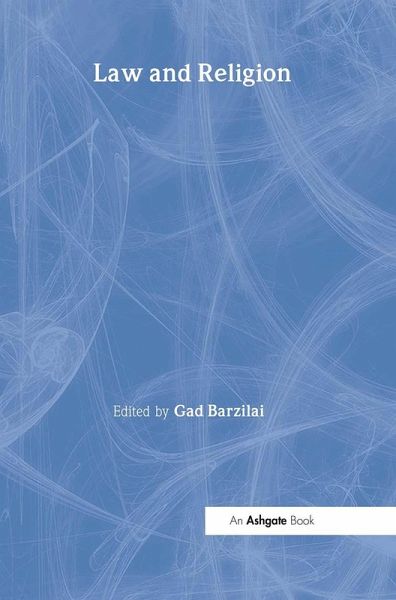
In ethics and law, questions of right and wrong have some ultimate basis. The source of authority in a legal system would seem to be either divine and transcendent (God, or Gods) or temporal and earthly (man, or men). The contributions to this text discuss the link between religion and law.
In ethics and law, questions of right and wrong have some ultimate basis. The source of authority in a legal system would seem to be either divine and transcendent (God, or Gods) or temporal and earthly (man, or men). The contributions to this text discuss the link between religion and law.
Produktdetails
Produktdetails
The International Library of Essays in Law and Society
Gad Barzilai is Professor of International Studies, Law and Political Science, trained mainly in law & political science. He is currently based at the Jackson School of International Studies & Comparative Law and Society Studies Center in the University of Washington, USA. His previous book was awarded the Best Book Prize by the Association of Israel Studies. Barzilai has published more than 110 articles and sixteen books and edited volumes in leading journals and publishing houses. He has offered perspectives and theories for better understanding of law, politics, and dispute resolution. He is now working on developing a macro theory on law and politics in global comparative history. Barzilai is on the Board of Trustees of the Law and Society Association, served at the Board of the American Journal of Political Science, and was the Founding Director of the International Dan David Prize.
Inhaltsangabe
Contents: Series preface; Introduction; Part I Religions as Sources of Human Rights: The morality of human rights: a nonreligious ground?, Michael J. Perry; The metaphorical reciprocity between theology and law, Paul Lehmann; From the trial of Adam and Eve to the judgements of Solomon and Daniel, Daniel Friedmann; Christian natural law: the spirit and method of, Giovanni Ambrosetti; Religious foundations of law in the West: an historical perspective, Harold J. Berman; Law and religion in contemporary Islam, Noel J. Coulson; Characteristic features of Islamic law: perceptions and misconceptions, Mahdi Zahraa. Part II Religions as Traditions of Law: Obligation: a Jewish jurisprudence of the social order, Robert M. Cover; The Chinese conceptions of law: Confucian, legalist and Buddhist, Luke T. Lee and Whalen W. Lai; Hindu conceptions of law, Ludo Rocher; A conversation with Tibetans? Reconsidering the relationship between religious beliefs and secular legal discourse, Rebecca R. French; Consensus and suspicion: judicial reasoning and social change in an Indonesian society 1960-1994, John R. Bowen; Cultured technology: the internet and religious fundamentalism, Karine Barzilai-Nahon and Gad Barzilai. Part III Religions and Human Rights: Conflicts: Female circumcision: religious practice v. human rights violation, Jessica A. Platt; Behind the veil: women's rights in Islamic societies, Nayer Honarvar; Rights, religion and community: approaches to violence against women in the context of globalization, Sally Engel Merry; Nomos and narrative, Robert M. Cover; Disorderly differences: recognition, accommodation, and American law, Austin Sarat and Roger Berkowitz; Are human rights universal?, Shashi Tharoor; Name index.
Contents: Series preface; Introduction; Part I Religions as Sources of Human Rights: The morality of human rights: a nonreligious ground?, Michael J. Perry; The metaphorical reciprocity between theology and law, Paul Lehmann; From the trial of Adam and Eve to the judgements of Solomon and Daniel, Daniel Friedmann; Christian natural law: the spirit and method of, Giovanni Ambrosetti; Religious foundations of law in the West: an historical perspective, Harold J. Berman; Law and religion in contemporary Islam, Noel J. Coulson; Characteristic features of Islamic law: perceptions and misconceptions, Mahdi Zahraa. Part II Religions as Traditions of Law: Obligation: a Jewish jurisprudence of the social order, Robert M. Cover; The Chinese conceptions of law: Confucian, legalist and Buddhist, Luke T. Lee and Whalen W. Lai; Hindu conceptions of law, Ludo Rocher; A conversation with Tibetans? Reconsidering the relationship between religious beliefs and secular legal discourse, Rebecca R. French; Consensus and suspicion: judicial reasoning and social change in an Indonesian society 1960-1994, John R. Bowen; Cultured technology: the internet and religious fundamentalism, Karine Barzilai-Nahon and Gad Barzilai. Part III Religions and Human Rights: Conflicts: Female circumcision: religious practice v. human rights violation, Jessica A. Platt; Behind the veil: women's rights in Islamic societies, Nayer Honarvar; Rights, religion and community: approaches to violence against women in the context of globalization, Sally Engel Merry; Nomos and narrative, Robert M. Cover; Disorderly differences: recognition, accommodation, and American law, Austin Sarat and Roger Berkowitz; Are human rights universal?, Shashi Tharoor; Name index.
Es gelten unsere Allgemeinen Geschäftsbedingungen: www.buecher.de/agb
Impressum
www.buecher.de ist ein Internetauftritt der buecher.de internetstores GmbH
Geschäftsführung: Monica Sawhney | Roland Kölbl | Günter Hilger
Sitz der Gesellschaft: Batheyer Straße 115 - 117, 58099 Hagen
Postanschrift: Bürgermeister-Wegele-Str. 12, 86167 Augsburg
Amtsgericht Hagen HRB 13257
Steuernummer: 321/5800/1497
USt-IdNr: DE450055826