
Andere Kunden interessierten sich auch für
 Farewell to Matters of Principle88,99 €
 On the Genealogy of Morals15,99 €
 The Intrigue of Ethics103,99 €
 CONFUSION OF SPHERES C123,99 €
 Levinas, Storytelling and Anti-Storytelling179,99 €
 Nietzsche's Postmoralism69,99 €
 On Consequentialism17,95 €
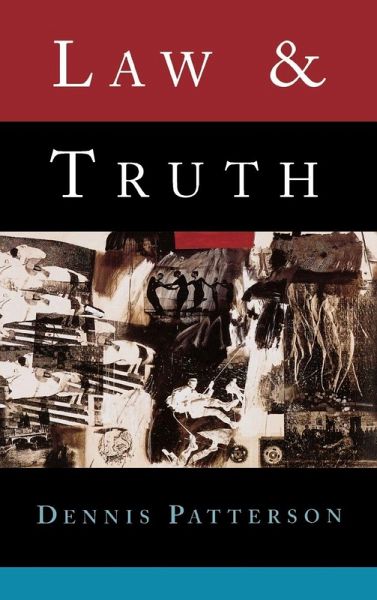
Patterson applies the modern debate between Realism and Anti-realism to the question of the nature of law. Starting from the question 'What is legal knowledge?' he examines the answers provided by the principal comtemporary theories of jurisprudence, concluding that they are all inextricably bound uo with the nature of justification. He concludes with a novel aaccount of legal knowledge as pragmatism.
Taking up a single question - "What does it mean to say that a proposition of law is true?" - this book advances a major new account of truth in law. Drawing upon the later philosophy of Wittgenstein, as well as more recent postmodern theory of the relationship between language, meaning, and the world, Patterson examines leading contemporary jurisprudential approaches to this question and finds them flawed in similar and previously unnoticed ways. Despite surface differences, the most widely discussed accounts of legal meaning - from moral realism to interpretivism - each commit themselves, Patterson argues, to a defective notion of reference in accounting for the truth of legal propositions. Tracing this common truth-conditional perspective - wherein propositions of law are true in virtue of some condition, be it a moral essence, a social fact, or communal agreement - to its source in modernism, Patterson develops an alternative (postmodern) account of legal justification, one in which linguistic practice - the use of forms of legal argument - holds the key to legal meaning. A work of provocative scope, argued with uncommon clarity, Law and Truth will interest legal theorists, philosophers, and anyone else concerned with the implications of postmodern thought for jurisprudence.
Taking up a single question - "What does it mean to say that a proposition of law is true?" - this book advances a major new account of truth in law. Drawing upon the later philosophy of Wittgenstein, as well as more recent postmodern theory of the relationship between language, meaning, and the world, Patterson examines leading contemporary jurisprudential approaches to this question and finds them flawed in similar and previously unnoticed ways. Despite surface differences, the most widely discussed accounts of legal meaning - from moral realism to interpretivism - each commit themselves, Patterson argues, to a defective notion of reference in accounting for the truth of legal propositions. Tracing this common truth-conditional perspective - wherein propositions of law are true in virtue of some condition, be it a moral essence, a social fact, or communal agreement - to its source in modernism, Patterson develops an alternative (postmodern) account of legal justification, one in which linguistic practice - the use of forms of legal argument - holds the key to legal meaning. A work of provocative scope, argued with uncommon clarity, Law and Truth will interest legal theorists, philosophers, and anyone else concerned with the implications of postmodern thought for jurisprudence.