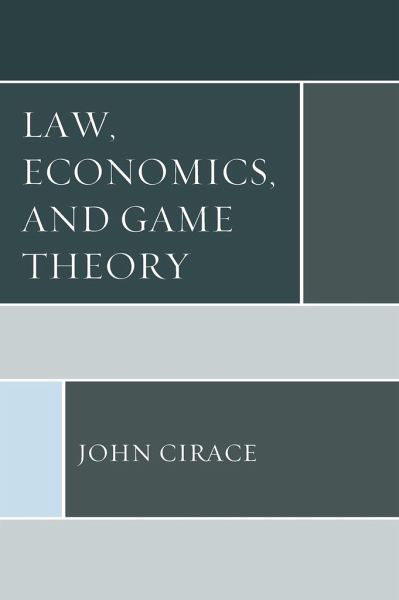
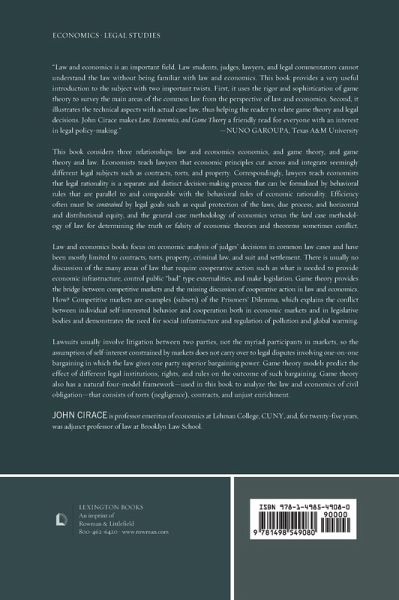
This book uses game theory to explain conflict between individual self-interested behavior and cooperation in economic markets, lawsuits, and legislative bodies. It demonstrates the need for social regulation in addition to free markets and judicial decisions in common law cases.
Acknowledgments Illustrations Introduction Part I: When are Thinking like an Economist and Thinking like a Lawyer Consistent? Chapter 1: Pareto Efficiency and Kaldor-Hicks Criterion Compared Chapter 2: Rational Economic Behavior and Logic Defined Chapter 3: Judicial Use of Economic Rationality (Efficiency) Chapter 4: Equal Protection and Lexical Constraints on Efficiency Chapter 5: Legal Rationality and Logic Defined Chapter 6: When are Law and Economics Consistent (Isomorphic)? Part II: Providing Infrastructure and Controlling Externalities Requires Resolving Conflicts between Individual Self-Interest and Cooperation Chapter 7: Prisoners' Dilemma and Introduction to Game Theory Chapter 8: Market and Government Failures as Prisoners' Dilemmas Chapter 9: Five Requirements for Competitive Markets Chapter 10: In the Long Run We Are All Dead Part III: General Case vs. Hard Case Methodologies: Rottenberg, Coase, Calabresi, and Posner Chapter 11: Rottenberg's Theorem: Effect of a Change in Propert
Es gelten unsere Allgemeinen Geschäftsbedingungen: www.buecher.de/agb
Impressum
www.buecher.de ist ein Internetauftritt der buecher.de internetstores GmbH
Geschäftsführung: Monica Sawhney | Roland Kölbl | Günter Hilger
Sitz der Gesellschaft: Batheyer Straße 115 - 117, 58099 Hagen
Postanschrift: Bürgermeister-Wegele-Str. 12, 86167 Augsburg
Amtsgericht Hagen HRB 13257
Steuernummer: 321/5800/1497
USt-IdNr: DE450055826