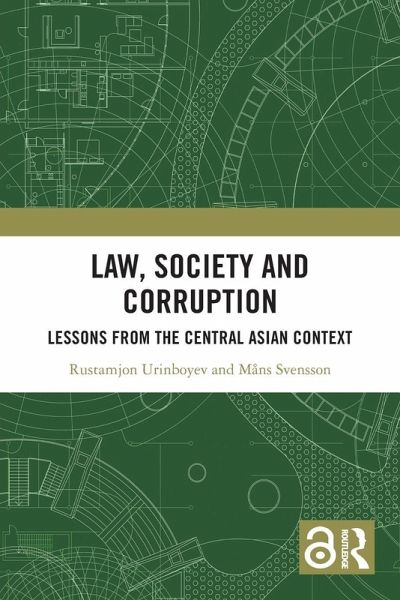
This book presents new socio-legal perspectives and insights on the social life of corruption and anticorruption in authoritarian regimes. This book takes up the case of Uzbekistan-an authoritarian regime in Central Asia and one of the most corrupt countries in the world according to Transparency International's Corruption Perceptions Index-and examines the corruption that developed in a tightly closed authoritarian regime permeated by a large-scale shadow economy, a weak rule of law, and a collectivist legal culture. Building on socio-legal frameworks of legal compliance, living law and legal…mehr
This book presents new socio-legal perspectives and insights on the social life of corruption and anticorruption in authoritarian regimes. This book takes up the case of Uzbekistan-an authoritarian regime in Central Asia and one of the most corrupt countries in the world according to Transparency International's Corruption Perceptions Index-and examines the corruption that developed in a tightly closed authoritarian regime permeated by a large-scale shadow economy, a weak rule of law, and a collectivist legal culture. Building on socio-legal frameworks of legal compliance, living law and legal pluralism, the central argument of the book is that the roles, meanings, and logics of corruption are fluid, and depend on a myriad of structural variables, and contextual and situational factors. This book will be of value to researchers, academics, and students in the fields of sociology of law, legal anthropology, and Central Asian studies, especially those with an interest in the intersection of law, society, and corruption in authoritarian regime contexts. The Open Access version of this book, available at www.taylorfrancis.com, has been made available under a Creative Commons Attribution (CC-BY) 4.0 International license.
Rustamjon Urinboyev is Associate Professor in the Department of Sociology of Law at Lund University, Sweden, Professor in the Department of International Law and Human Rights at Tashkent State University of Law, Uzbekistan, and Adjunct Professor in the Department of Social Sciences, Tashkent State University of Economics, Uzbekistan. Måns Svensson is Full Professor of Sociology of Law at the School of Education, Humanities and Social Sciences at Halmstad University, Sweden, and President of Jönköping University, Sweden.
Inhaltsangabe
1: Understanding Corruption in Authoritarian Regimes 2: Political Environment and Governance Trajectories in Uzbekistan 3: Anticorruption Laws Policies and Initiatives in Uzbekistan: An Overview of the Legal and Institutional Environment 4: Law Society and Corruption in Uzbekistan: A Socio-Legal Analysis of Macro-Level Developments 5: Corruption Informality and Coping Strategies in Meso-Level Arenas 6: The Social Life of Corruption in Micro-Level Arenas 7: The Interplay Between Law Society and (Anti)corruption in Authoritarian Regimes
Es gelten unsere Allgemeinen Geschäftsbedingungen: www.buecher.de/agb
Impressum
www.buecher.de ist ein Internetauftritt der buecher.de internetstores GmbH
Geschäftsführung: Monica Sawhney | Roland Kölbl | Günter Hilger
Sitz der Gesellschaft: Batheyer Straße 115 - 117, 58099 Hagen
Postanschrift: Bürgermeister-Wegele-Str. 12, 86167 Augsburg
Amtsgericht Hagen HRB 13257
Steuernummer: 321/5800/1497
USt-IdNr: DE450055826