
Andere Kunden interessierten sich auch für
![Deirdire, and the Lay of the Children of Uisne, Orally Collected in the Island of Barra [Scotland, in 1867] and Literally Translated by Alexander Carm]( "Deirdire, and the Lay of the Children of Uisne, Orally Collected in the Island of Barra [Scotland, in 1867] and Literally Translated by Alexander Carm") Deirdire, and the Lay of the Children of Uisne, Orally Collected in the Island of Barra [Scotland, in 1867] and Literally Translated by Alexander Carm30,99 €
Deirdire, and the Lay of the Children of Uisne, Orally Collected in the Island of Barra [Scotland, in 1867] and Literally Translated by Alexander Carm30,99 € Prophecy and Politics in the Early Carolingian World137,99 €
 Housing the Stranger in the Mediterranean World79,99 €
 The World of Catholic Renewal, 1540 1770101,99 €
 French Intellectuals and Politics from the Dreyfus Affair to the Occupation38,99 €
 French Intellectuals and Politics from the Dreyfus Affair to the Occupation38,99 €
 The Bronze Object in the Middle Ages128,99 €
![Deirdire, and the Lay of the Children of Uisne, Orally Collected in the Island of Barra [Scotland, in 1867] and Literally Translated by Alexander Carm](https://bilder.buecher.de/produkte/67/67206/67206042m.jpg "Deirdire, and the Lay of the Children of Uisne, Orally Collected in the Island of Barra [Scotland, in 1867] and Literally Translated by Alexander Carm")
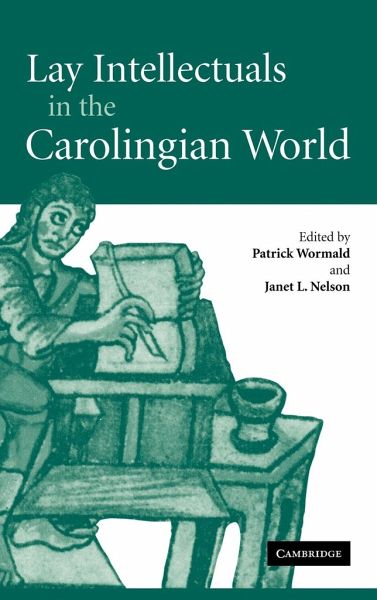
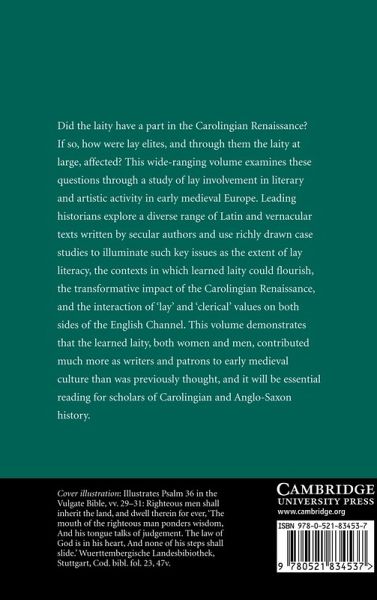
Did the laity have a part in the Carolingian Renaissance? If so, how were lay elites, and through them the laity at large affected? This fascinating and wide-ranging volume examines these questions through a study of lay involvement in literary and artistic activity in early medieval Europe. Leading historians explore a diverse range of Latin and vernacular texts written by secular authors and use richly-drawn case studies to illuminate such key issues as the extent of lay literacy, the contexts in which learned laity could flourish, the transformative impact of the Carolingian Renaissance, and the interaction of 'lay' and 'clerical' values on both sides of the Channel. This volume demonstrates that the learned laity, both women as well as men, contributed much more as writers and patrons to early medieval culture than was previously thought and it will be essential reading for scholars of Carolingian and Anglo-Saxon history.